Pollinating Peartree: Reflections on Bridge Road part 1

I was surprised to realise I haven’t written a blog specifically about the Pollinating Peartree project since my first post in January 2021. For a while I’ve been thinking that I’d like to do two things. One is to reflect on what I’ve learned, as I think it could be helpful to others who might want to adopt planters or verges. Since I started working on the Wilder Southampton project in September 2022, I’ve often drawn on this experience. My other aim is to provide more detail about the Bridge Road areas for passersby, to explain what’s happening.
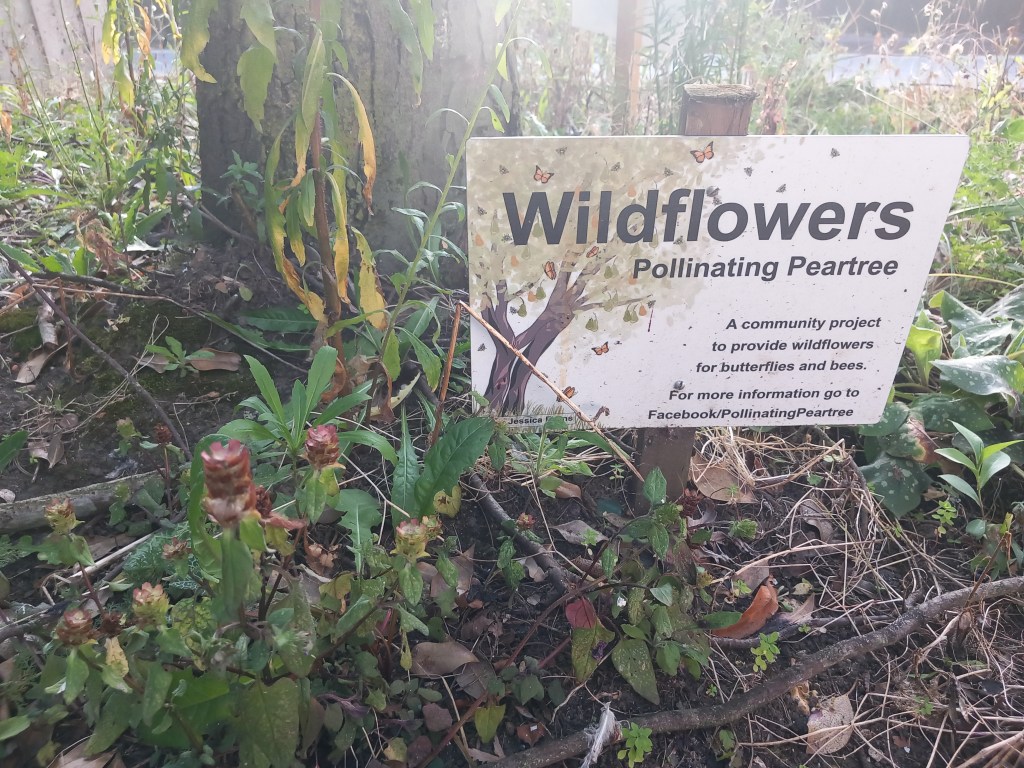
There are two areas to Bridge Road, and both have Pollinating Peartree signs which give the Facebook page address. But not everyone uses Facebook so this blog is another way to communicate. This photo was taken in early Sept 2023, towards the end of a week-long, very hot spell. This partly explains why there are no flowers in bloom. Left of the sign is some Self-Heal that’s gone to seed, next to that are some Dandelion leaves, and to the right are some Lungwort leaves. There are also twigs and dead leaves, from the tree.

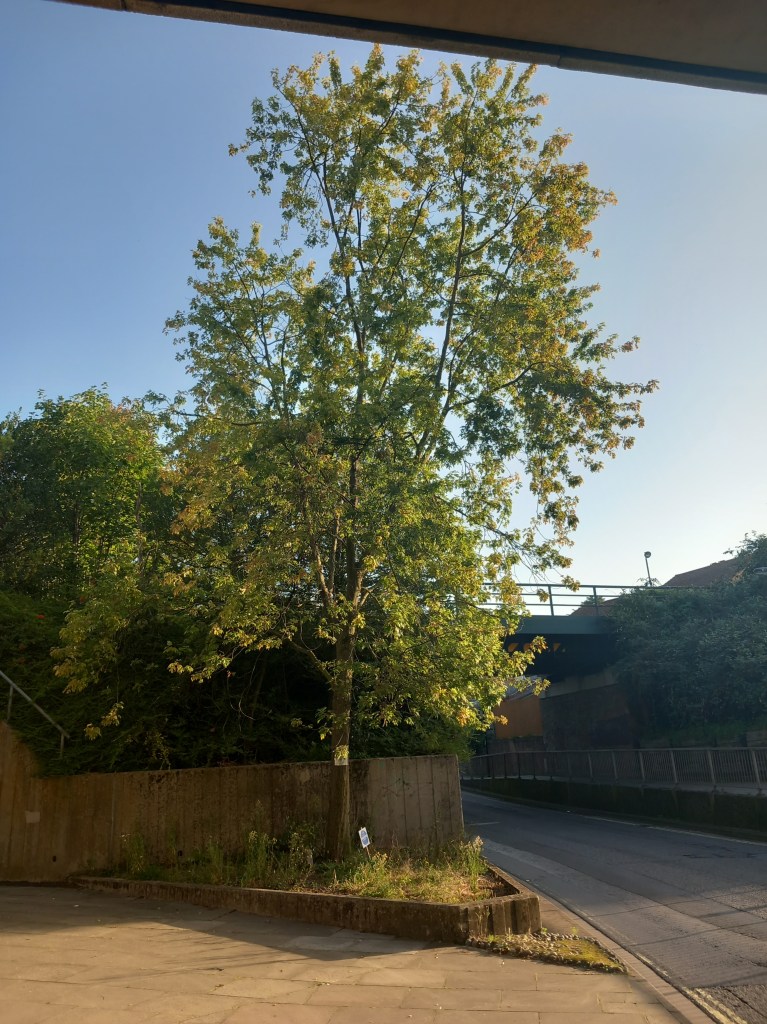
The tree is a maple and I’d estimate it to be about 30 feet (10 m) tall. The dark band at the top of the photo is the underside of the Itchen Bridge. Behind the tree, to the right, is the railway bridge over Bridge Road. I named this area the Tree Triangle as it’s almost triangular and I like alliteration! This photo was also taken on 9 Sept 2023. The planter doesn’t look lush, and in truth, it rarely does. The tree takes a lot of moisture from the ground, which never gets a good soaking when it rains anyway as it’s quite sheltered. It isn’t practical to water the bed beyond giving individual plants a good soaking when they’re newly planted. So, two lessons from this patch: beware of taking on a bed with a mature tree in it! There are also lots of roots that make digging difficult. And secondly, consider the distance from your water source to the bed. This is about a 5 minute cycle, and I usually take two or three 2-litre bottles of rain water with me if I want to do targeted watering.
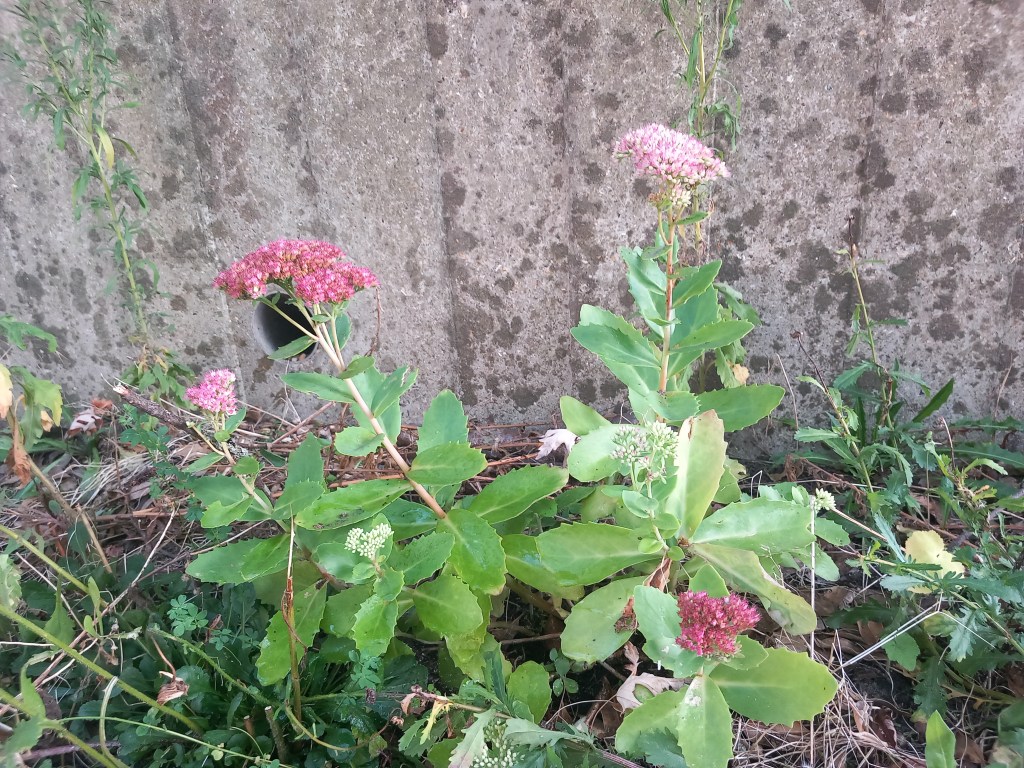
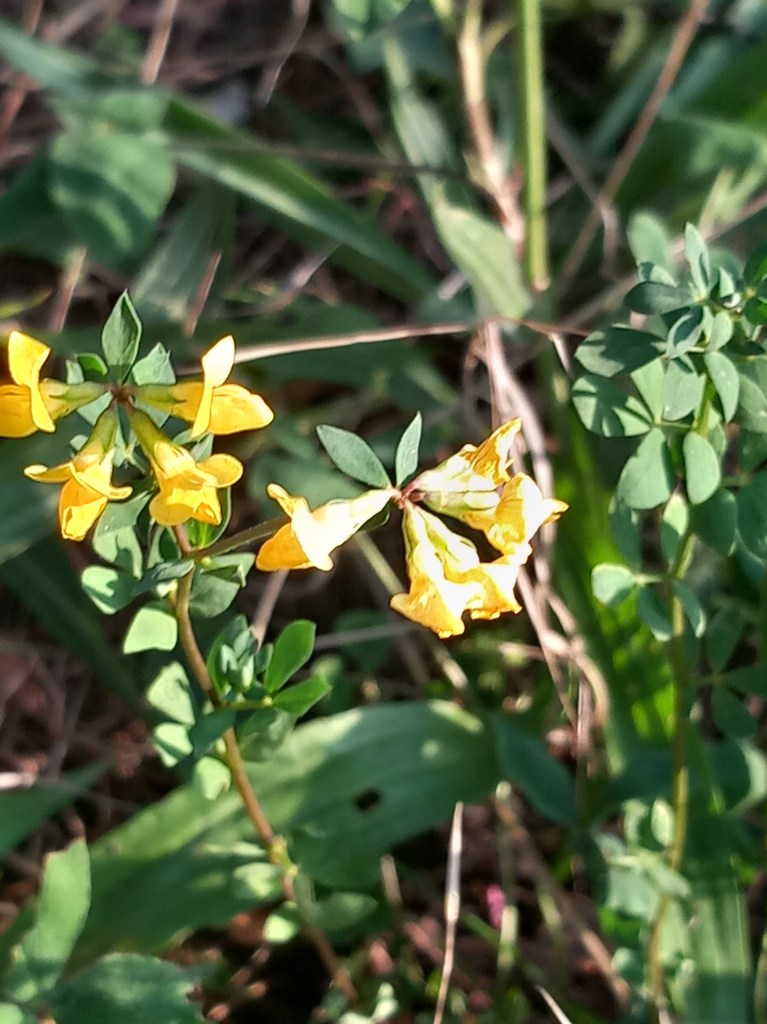
Despite the weather, there are currently a few plants in flower, including drought-tolerant Sedum (ice plant) and Horseshoe Vetch, which must have come from a seed mix we scattered. We planted the sedum close to the wall, away from the driest areas. Usually when we plant, we add some extra compost or leaf-mould around the plant as well as watering it well. Why don’t we just put some top soil, you might wonder. Well, apart from cost and practicality, the main reason is that we don’t want the soil to be too good. Wildflowers thrive in poor quality soil, and back in May 2023, they were doing really well, as can be seen from these two photos.
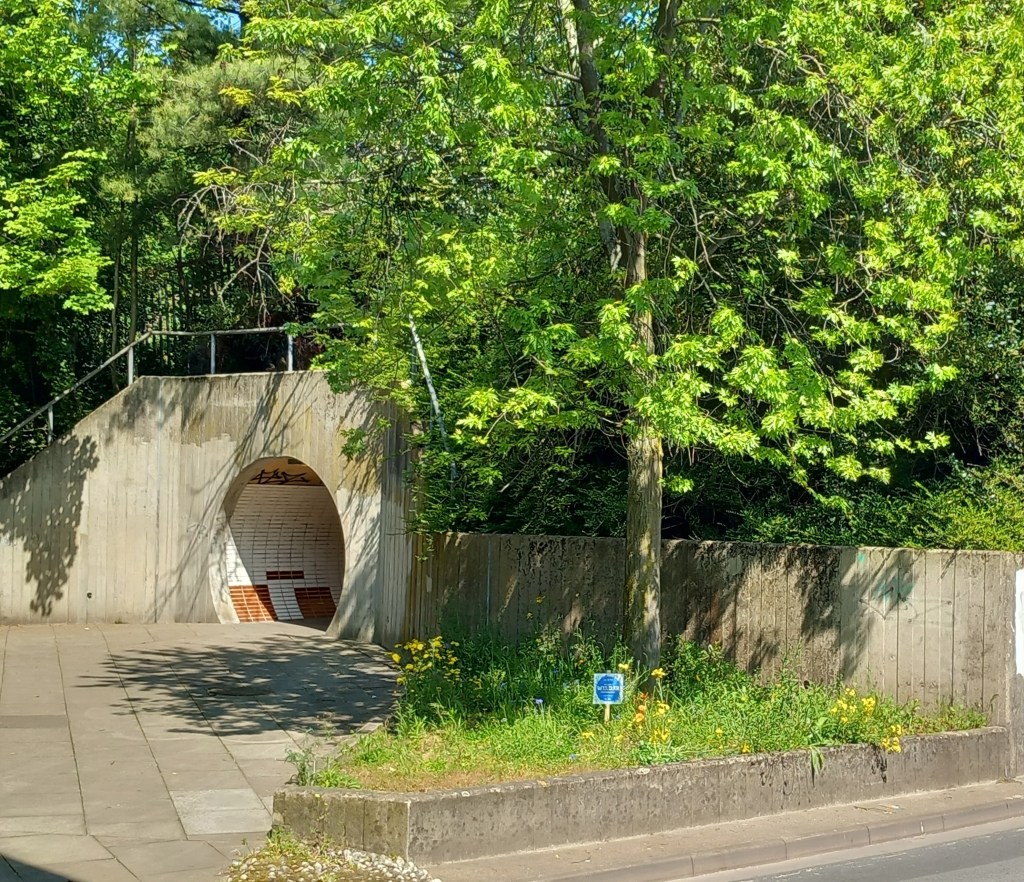
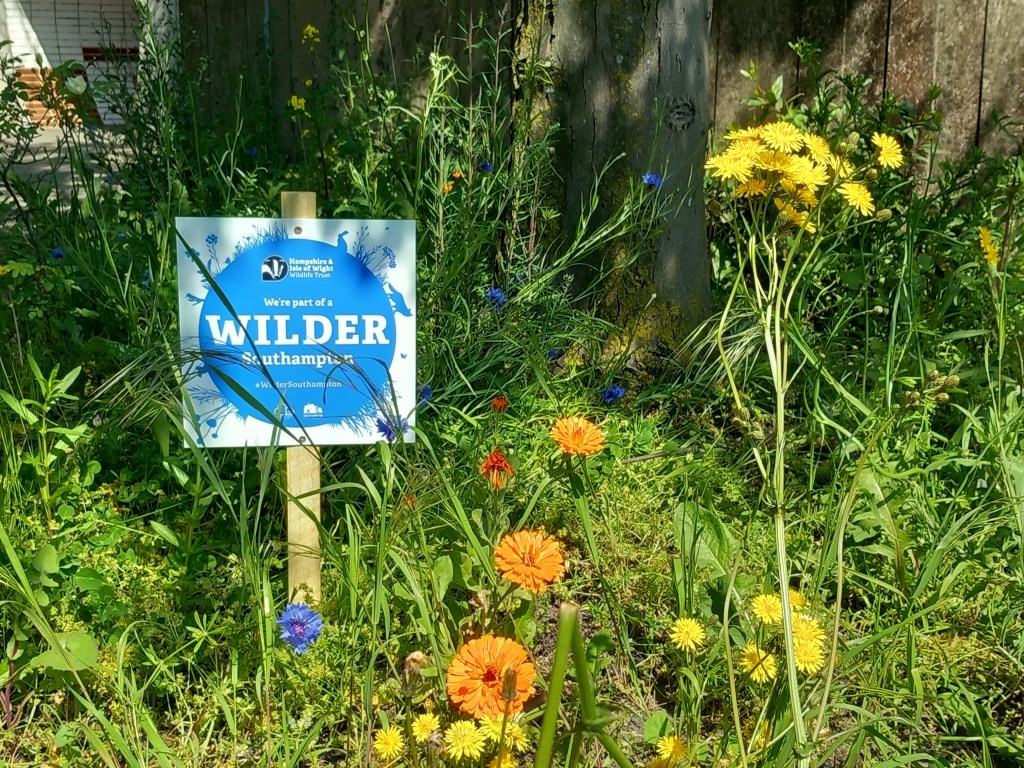
The bed actually looked quite green, and the close up shows some of the flowers, including blue cornflowers, orange marigolds and yellow something-in-the-dandelion family! During this fleeting period, passersby might admire it, but when it’s less attractive to humans, it’s still great for wildlife.
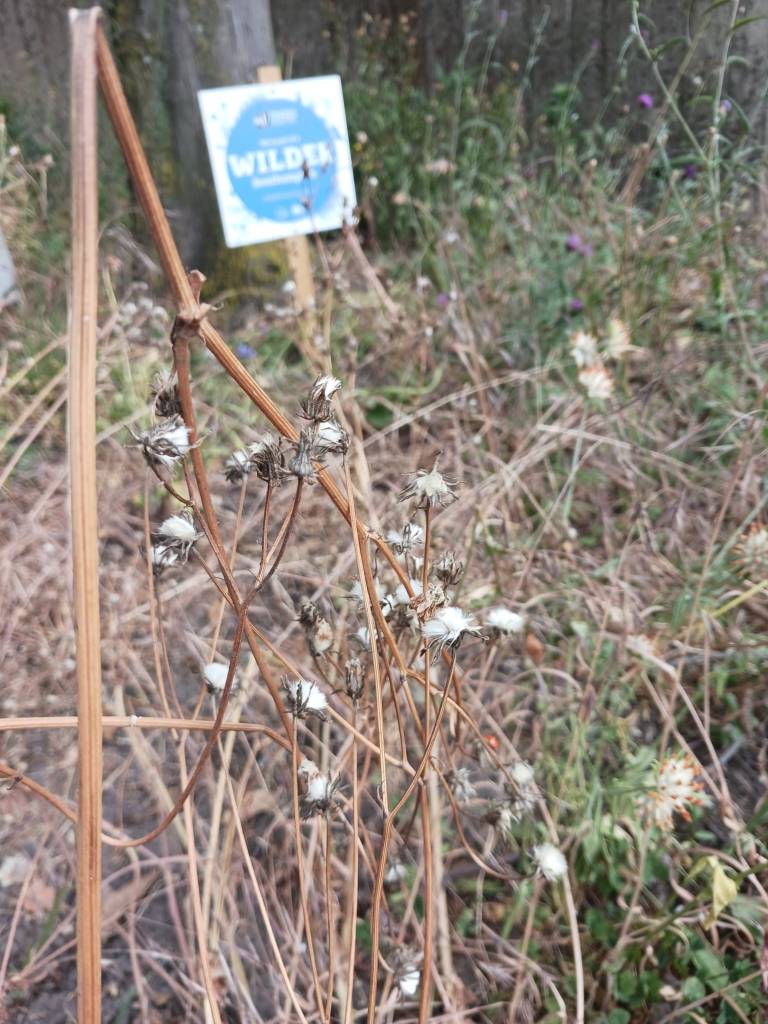
This picture, taken in July, shows those same yellow flowers now gone to seed. We left them so that birds could eat them. In the background you might just be able to see some purple flowers – those are Knapweed, also great for birds when they’ve gone to seed. You’ll meet a lot more of them in the next blog post, which is about the Subway Strip. This is the other Bridge Rd area. Walk through the subway under the railway line that you can see in a photo above, and you’ll find a very different patch, with its own challenges and joys.
A Tale of Toadflax

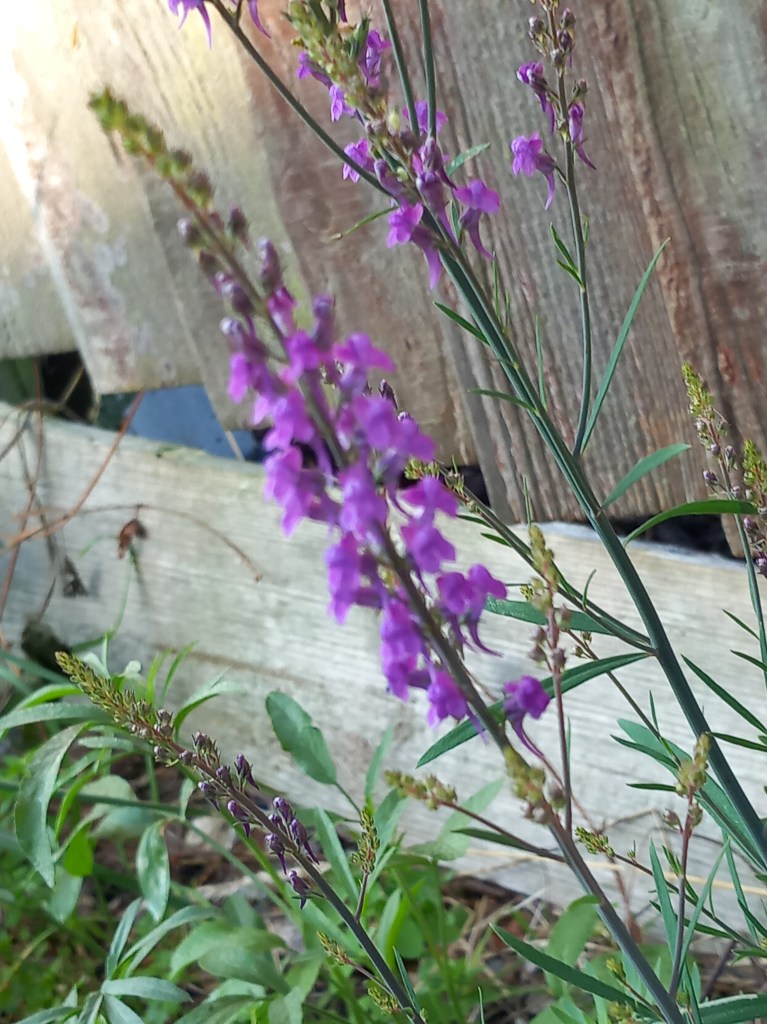
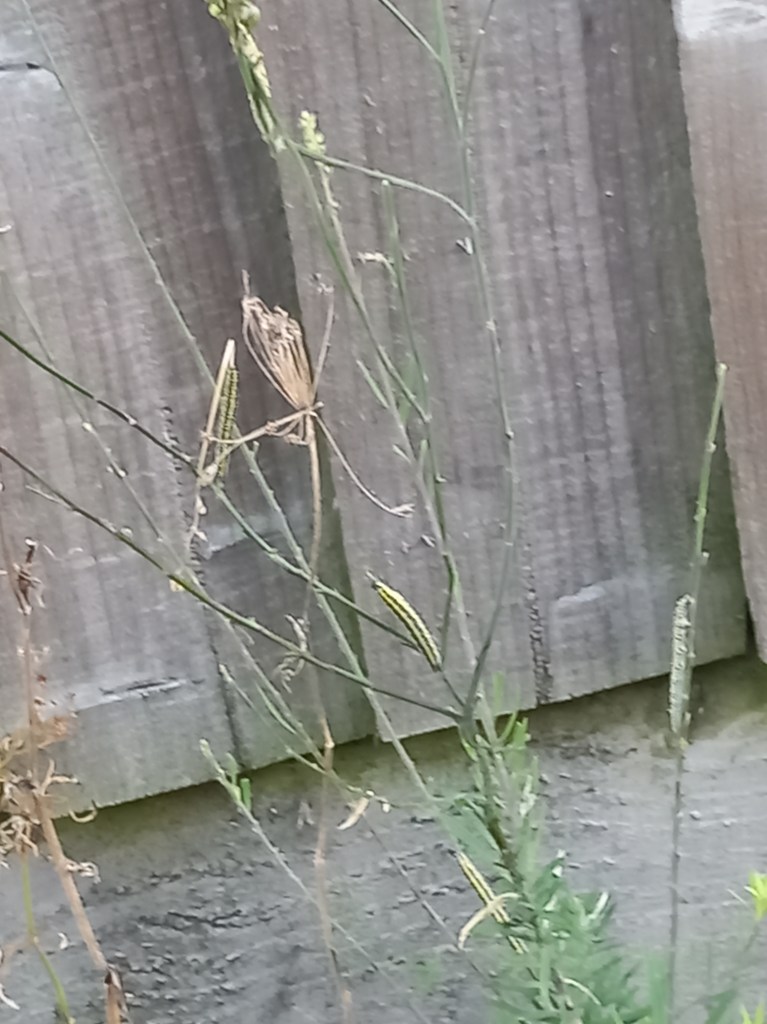
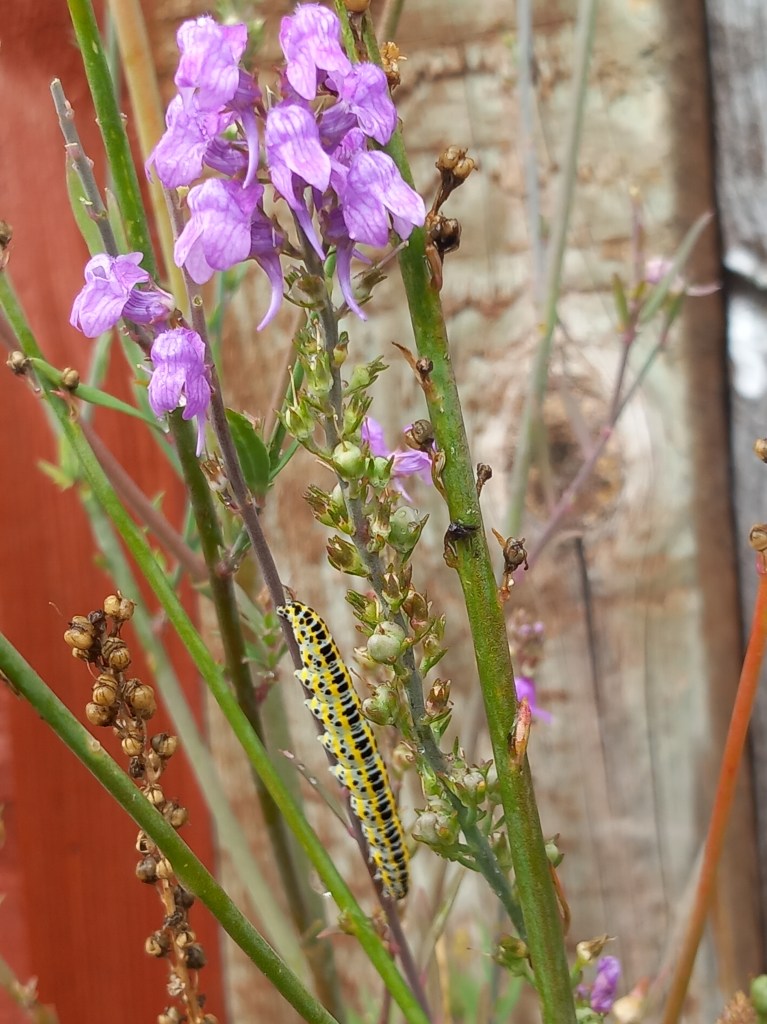
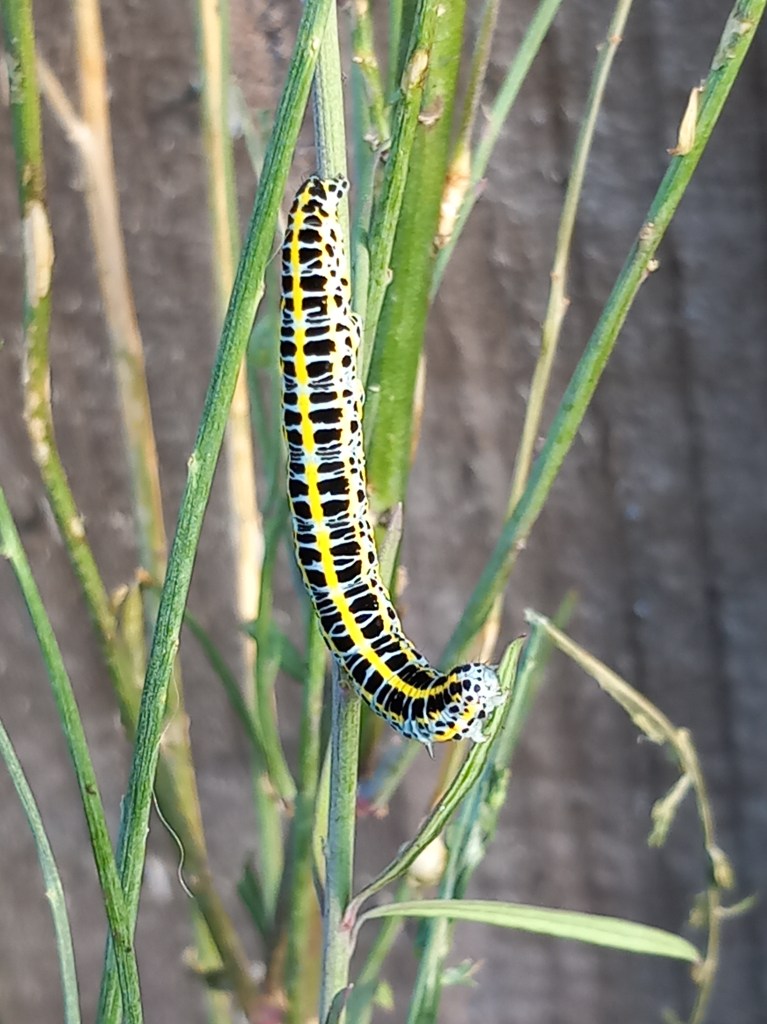
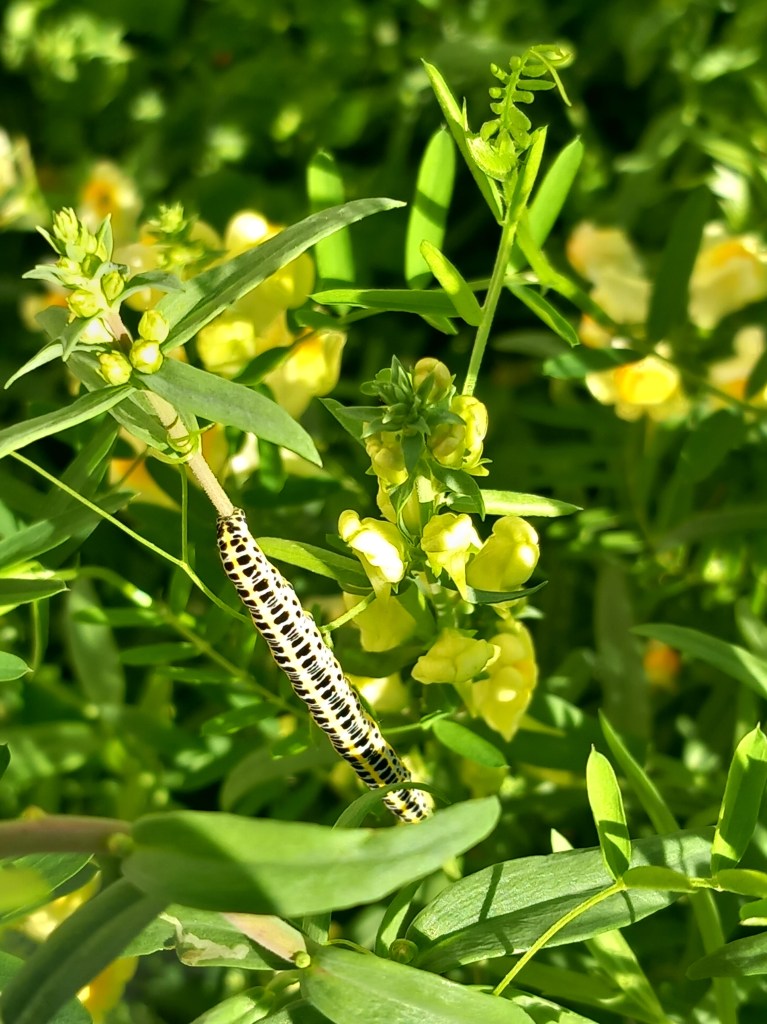
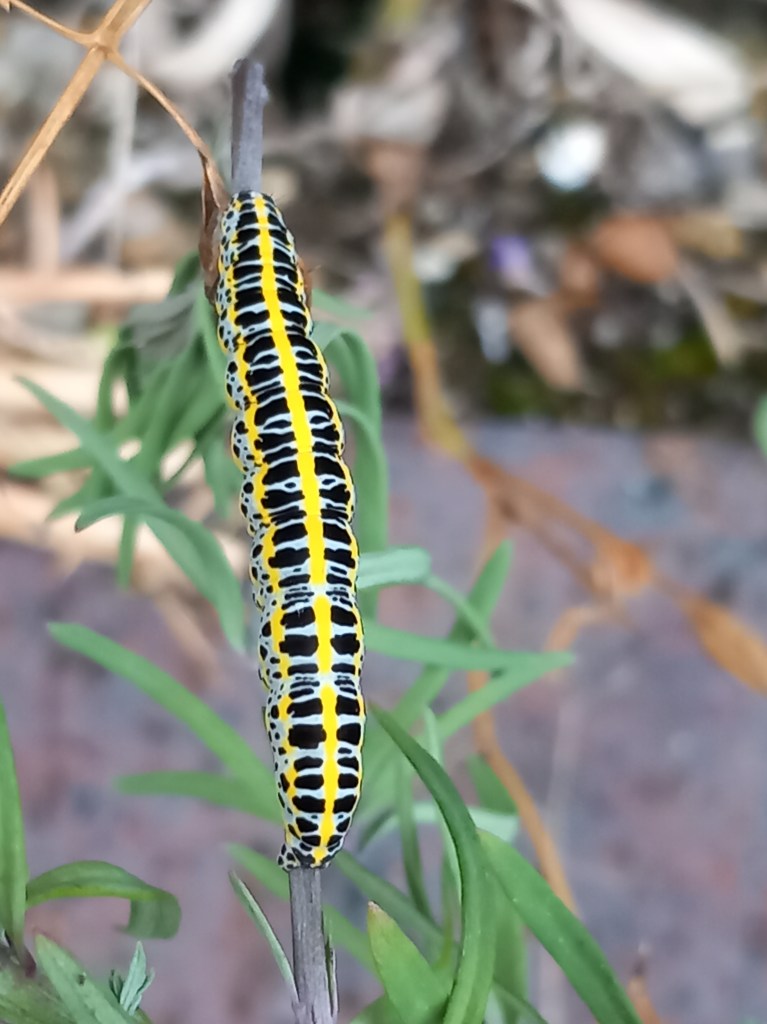
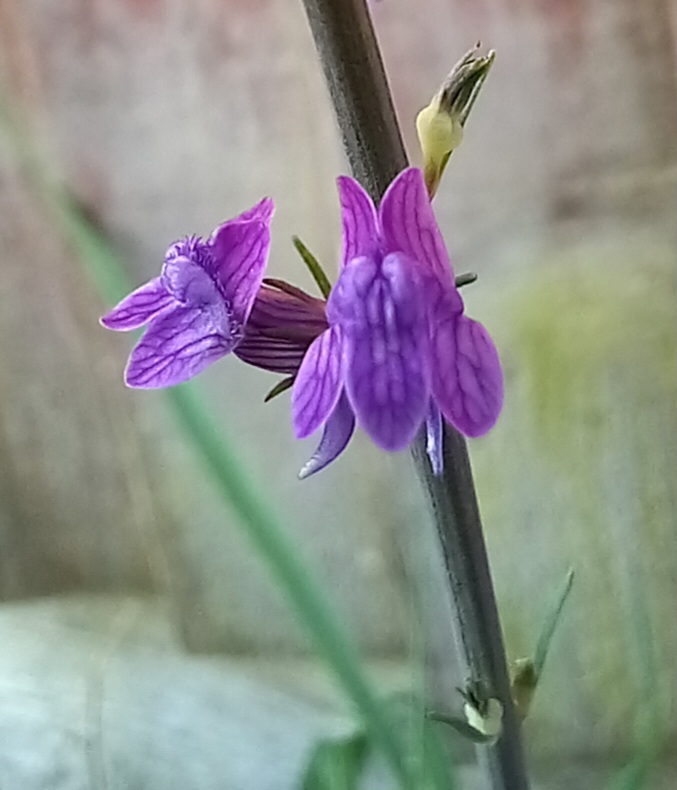
Meet the Toadflax Brocade moth caterpillar, which came into my life on Wednesday, 23 August 2023. They feed on Purple Toadflax, a plant that I first identified on Peartree Green a few years ago, and which is abundant in the alleys close to our garden. This post is about noticing wildlife in unexpected places and about the value of leaving wild edges – even if the flowers are garden escapes. Purple Toadflax was introduced to gardens from Italy and first noted in the wild around the 1830s. It thrives on walls, pavement cracks and rough ground, and is often found near houses. It’s also attractive. Look at the individual flowers in the photo below.
Bees love the flowers, so I’m happy that it self-seeds easily. I also collect seeds to scatter on my Pollinating Peartree wildflower patches. But while I’m familiar with the plant, I’d never seen the caterpillars before. Then I bent down to pick up some sultanas that had overshot the shed roof (bird food!) and noticed one, two, three … actually six caterpillars on one plant.

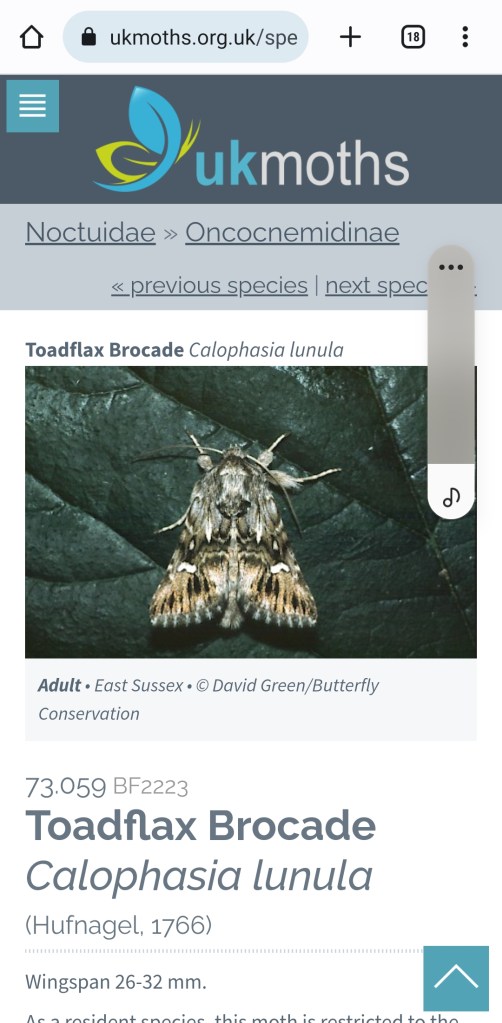
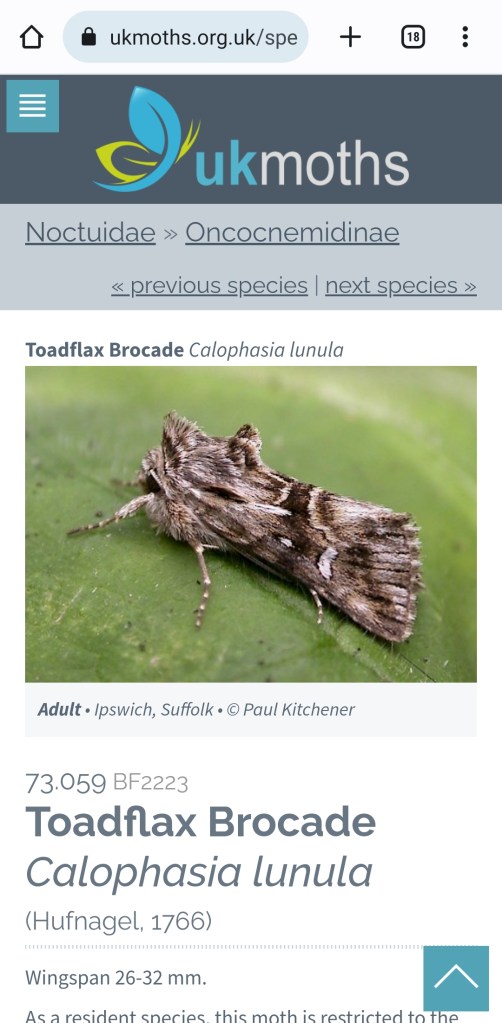
I thought the caterpillars were the larvae of Mullein moths, but it wasn’t an exact match, so I searched for ones that eat Purple Toadflax, and soon found the attractive Toadflax Brocade moth. According to Moths UK, it arrived in England in the 1950s, and is found around south-east and central southern coasts. I’m not far from the coast, but haven’t seen the moth so far, so here are two photos from the Moths UK website.

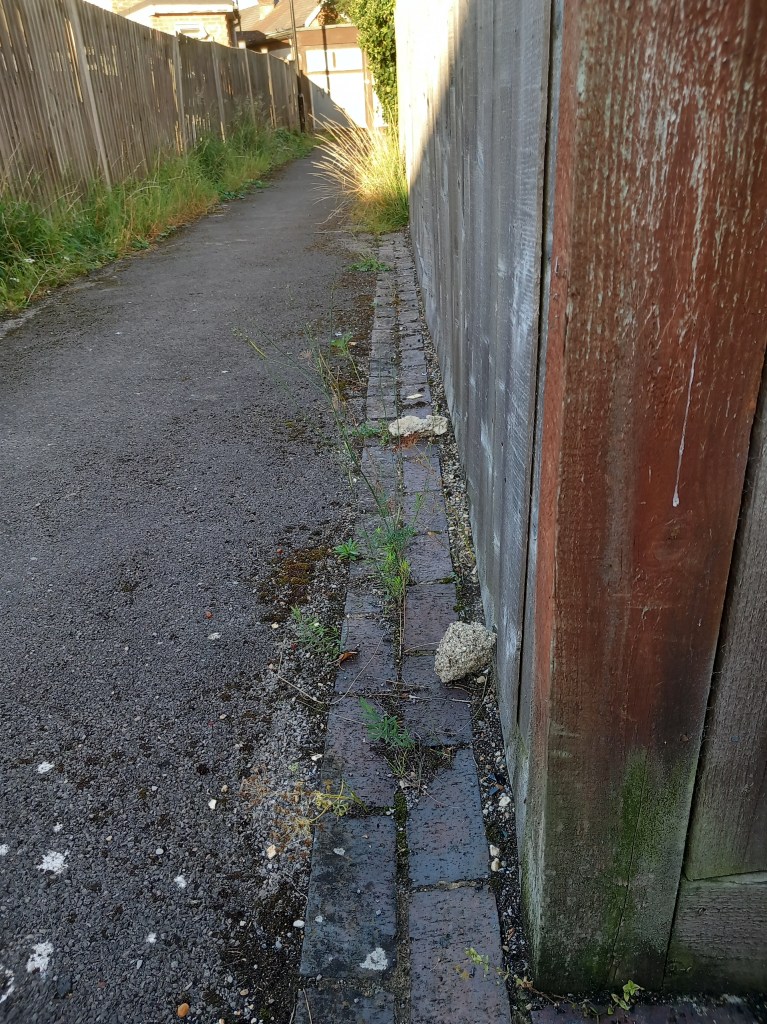
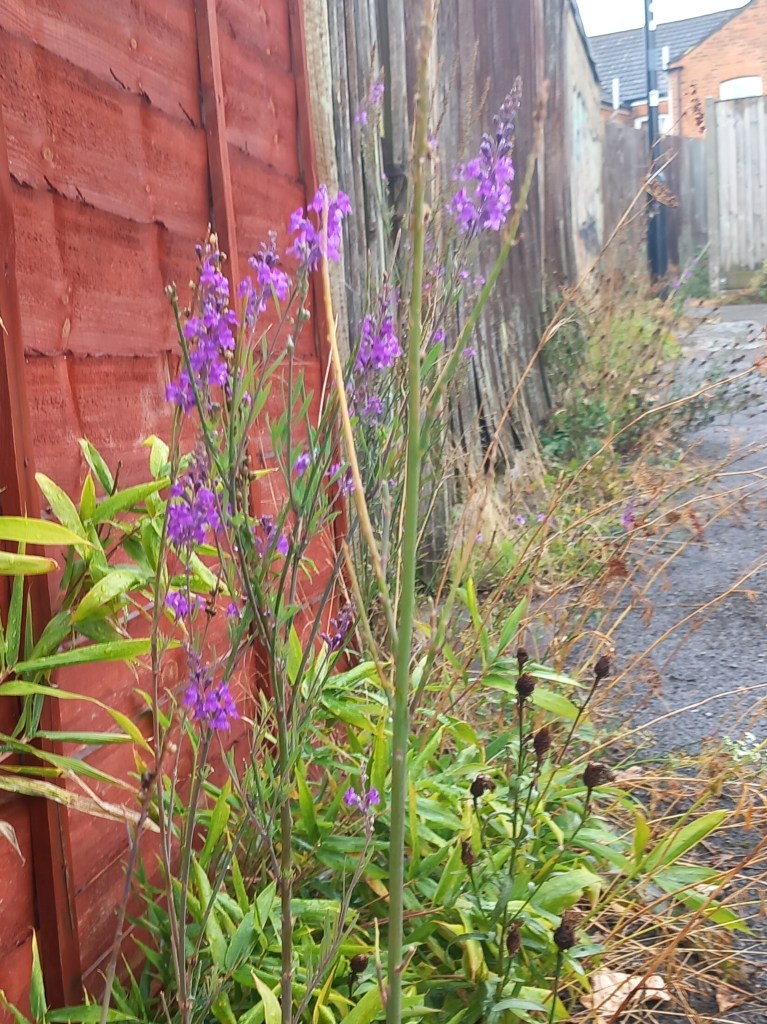
The plant was quite isolated, as the stretch of alley behind our shed is unusually clear. In the photo, you can see that, further along, there’s tall grass next to our neighbour’s fence, and opposite there are also plenty of places for little creatures to live. So it was quite a surprise to find a colony of caterpillars, but also a bit worrying – where would they go to eat once that plant was stripped? And where would they go to overwinter as chrysalises?

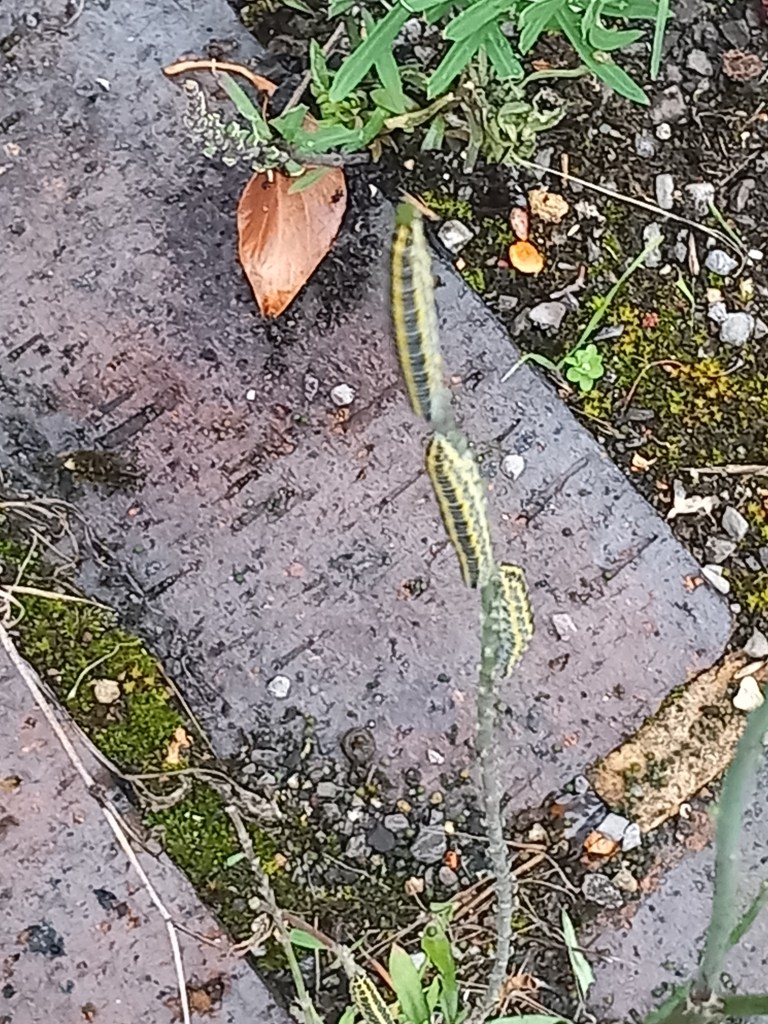
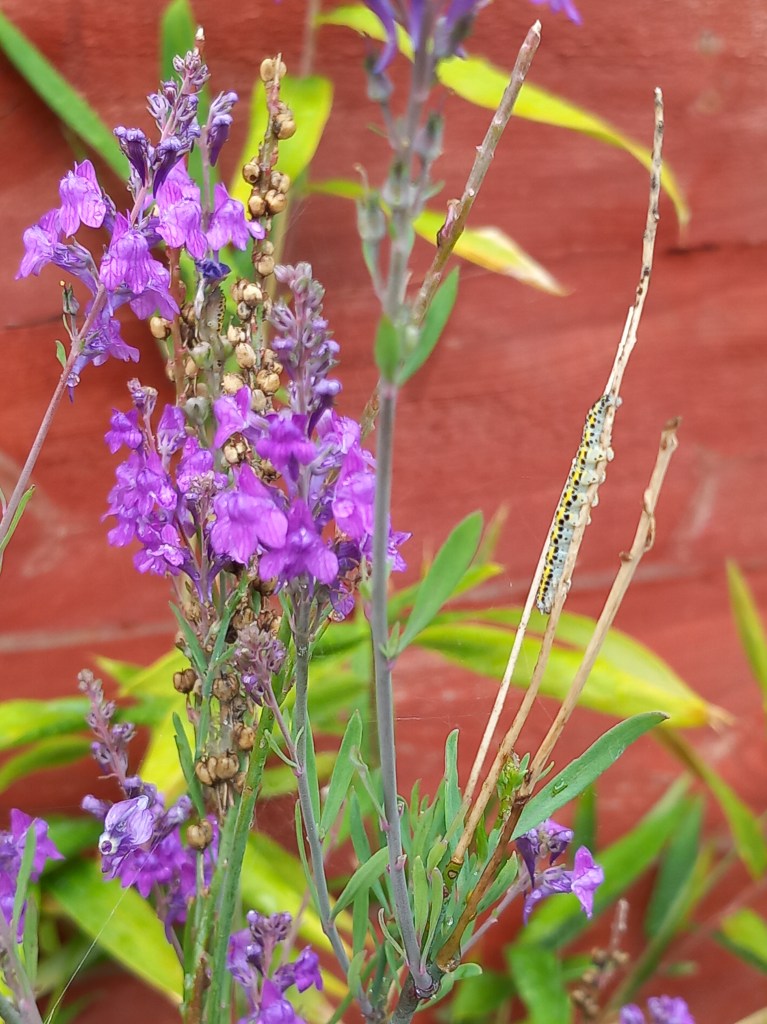
I surveyed the other plants nearby, including on the Alley Flowerbed, and found 8 more caterpillars on two other Toadflaxes. Next morning, I checked them again. I was alarmed to see that three of the six I’d first noticed were ‘queued up’ at the top of a stem, nose to tail, with nowhere to go!

That photo, taken from above, shows how little of the plant is left. It was tempting to stay and watch, to see what would happen next, but, fascinated as I was – I had other things to do. I pulled up a few unoccupied stems that had finished flowering and put them next to the isolated plant. When I had another look, around 10 hours later, I could only see these two on the fresh foliage, and one heading under the fence.

Where were the others? Eaten by birds? Under my shed? Or had they travelled across the alley to the other plants? There were now about 20 caterpillars of various sizes on several plants, but none on the flowerbed itself, nor on the spikes along the east-facing fence.

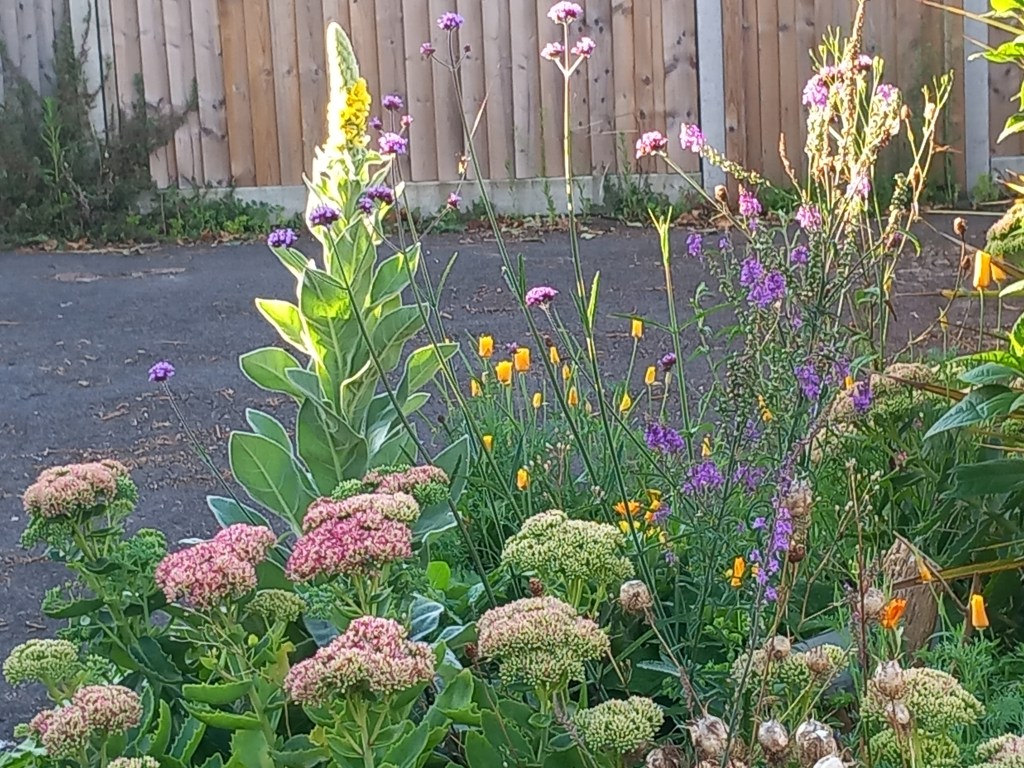
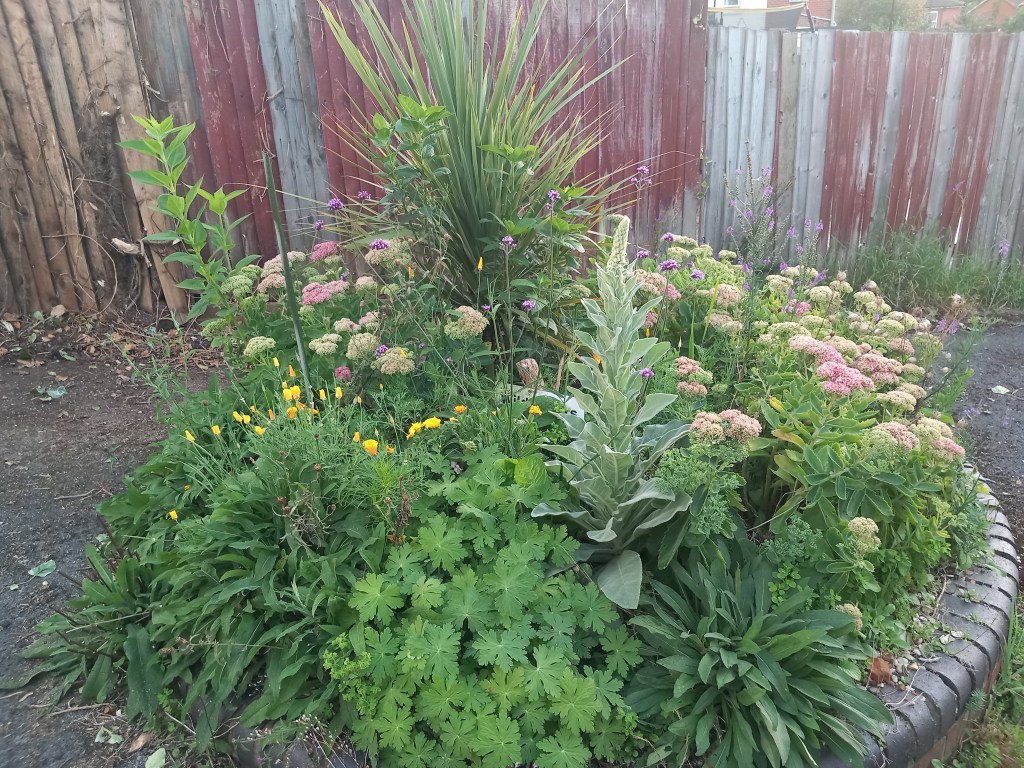
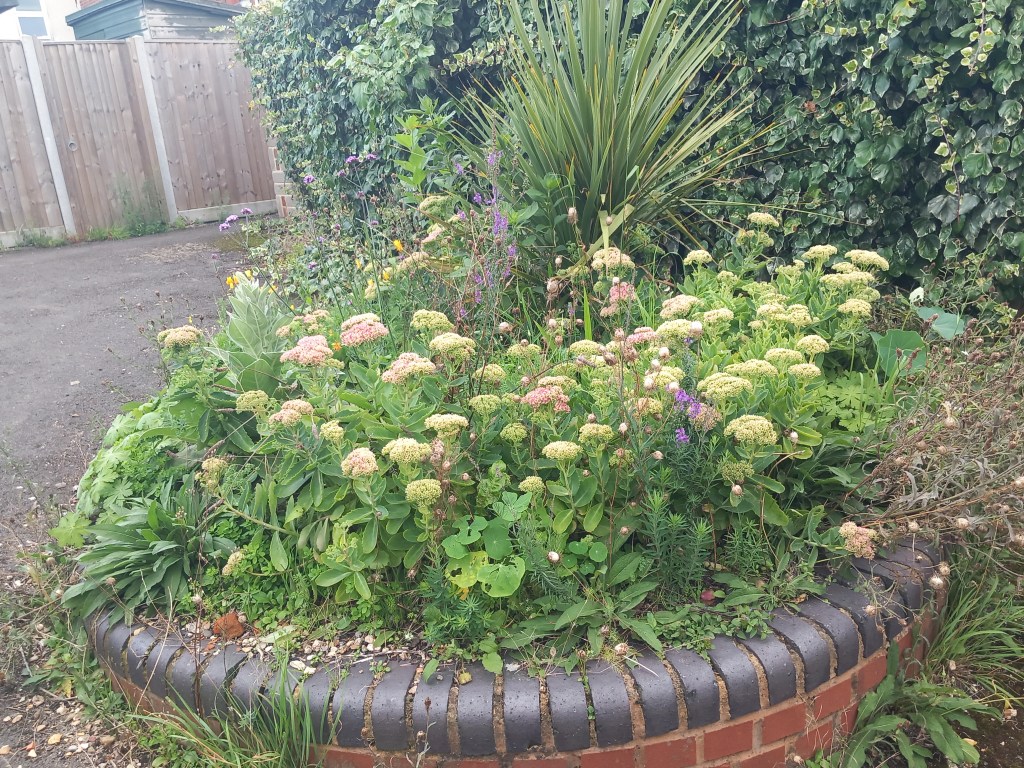
This photo shows a section of the Alley Flowerbed, with Sedum, Great Mullein, Verbena, Welsh Poppies and Marigolds, as well as the Purple Toadflax just right of centre. I have no idea if Toadflax Brocade larvae eat other plants, but I’m keeping a close eye out for them on there!

The fence behind the bed is north facing, with no Toadflaxes. The west-facing fence has several plants, and with some already occupied, I’m expecting to see more caterpillars appearing. I wonder how far north they’ll go though? Perhaps the moths prefer to lay their eggs on spikes oriented to the south or west?

Maybe the reason I’d not seen these caterpillars before is because the eggs hatch and the larvae grow over just a few days, and I hadn’t stopped and looked at the right time before. Now though, I know what’s caused the bare stems I’ve seen.

Day Three, 25 August, and the fun of seeing what would happen next – and wondering what else I might see – prompted me to spend several hours working around the alleys, litter picking and clearing some of the messier and dead vegetation. This was strategic – there is always a risk that someone will come along and scrape away the ‘weeds’, or – worse – spray them. The latter is a risk outside one particular house. So, I wanted to make the area reasonably looked after, and perhaps subconsciously, I wanted to be there in case anyone came along. That last point had only just occurred to me as I write, but the fact that the owner of the garden behind the east facing fence has ripped out a huge bank of ivy on the alley side this week probably put me on alert. You can see where the ivy was in the second photo below.

Later, I spotted two caterpillars climbing the fence. I watched as one moved sideways, onto another slat. It reached over with its head end, gripped with two pairs of feet, and swung the rest of its body over. Quite an impressive grip.

Day Four. No caterpillars on the fence, but still some on the plant. For a while, I watched one nibbling a leaf. You can see the head at the bottom of the picture.

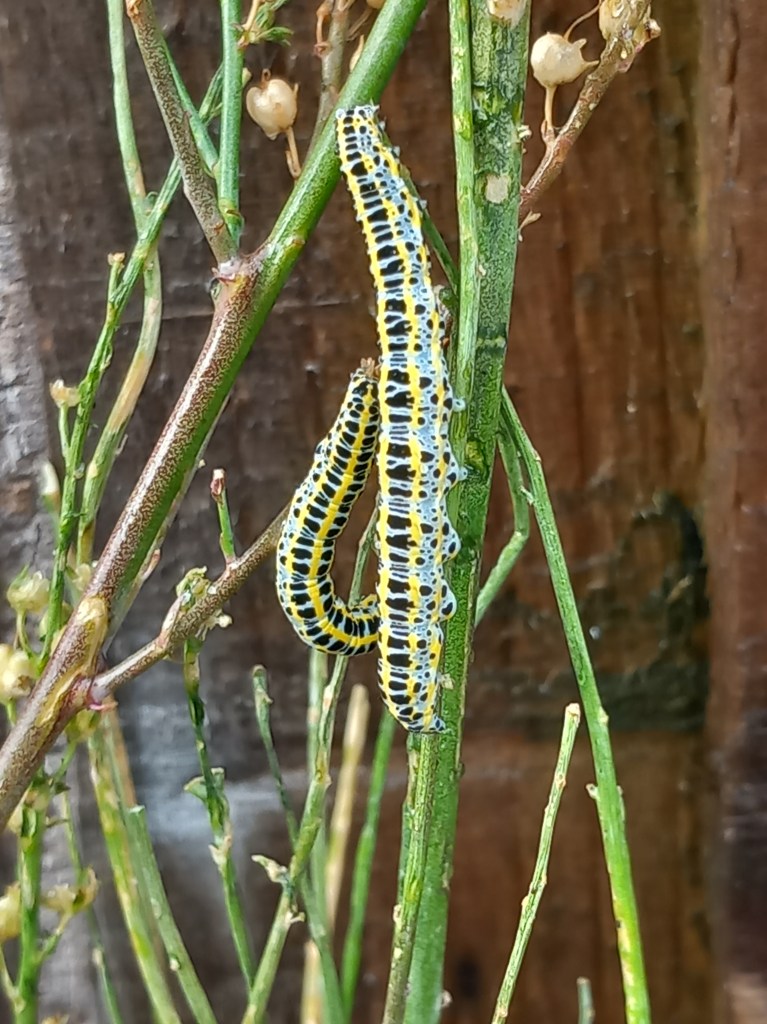
Then I noticed one on an east-facing plant. As I looked for a good angle to take a photo, I realised there were actually four of them. The colours and pattern that look so striking against a fence actually act as great camouflage against the food plant.

This camouflage is probably even more effective on the Common Toadflax, which is yellow. But now I have my eye in, so I easily spotted a couple on some plants on Victoria Road.

I’m aware that I may be a little unusual in paying so much attention to this caterpillar, but it goes to show what might be living right under your nose. The beauty of it is that no special equipment is needed, and it’s all happening ten paces from my door. Naturally, I’ll be continuing to observe these creatures, hoping to see a chrysalis and a moth one day. And I’ll be see looking and listening more carefully to see what else might be there. Watch this space!

A Swift Sandwich

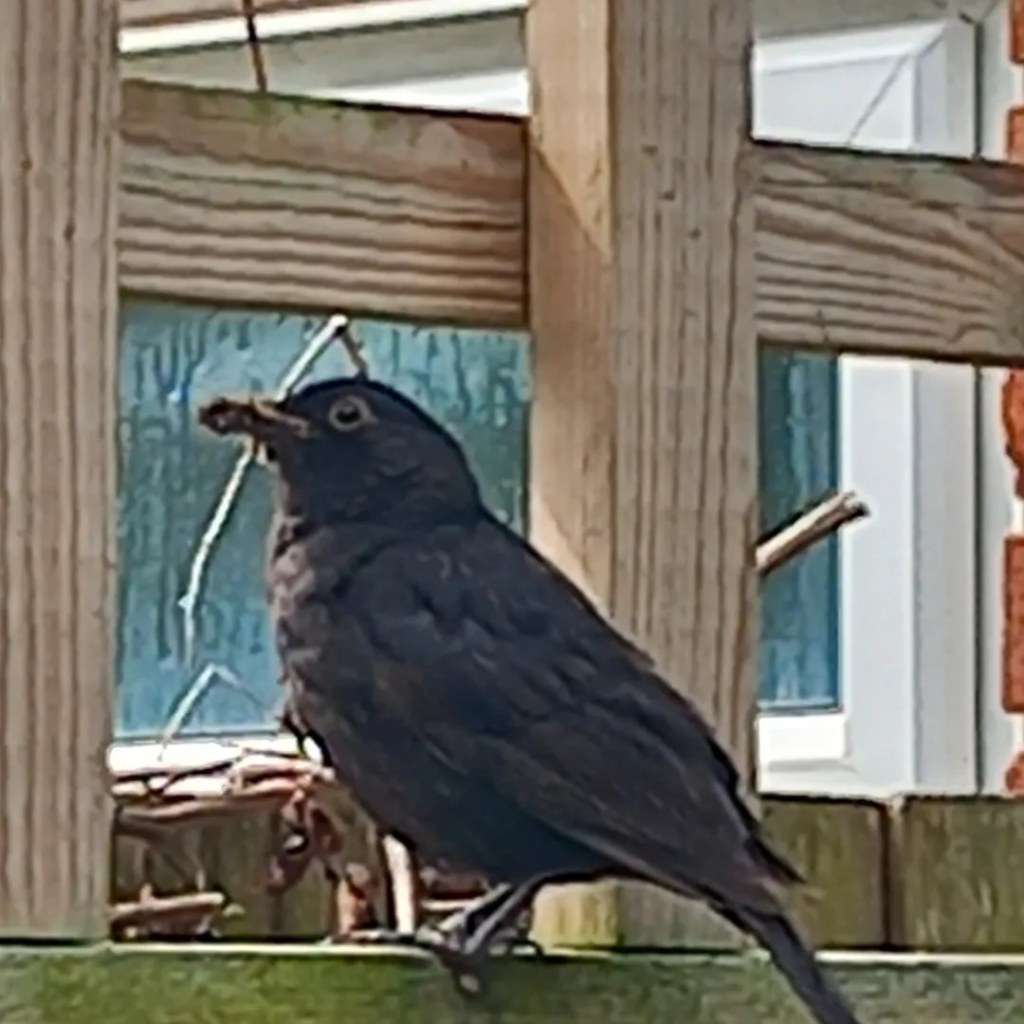
OK, that isn’t a swift, it’s a blackbird. But I think the title works better with ‘swift’, for the alliteration and the alternative meaning. This isn’t a blog post about eating a sandwich quickly, it’s me trying to come up with a title that’s more original than ‘A day in the life of my garden’. Blackbirds, like swifts, are often around at the start and end of the day, so they ‘sandwich’ the rest of the activity.

Swifts are only here from May to August, and I don’t always see or hear them. But if it’s fine and warm I’m lucky enough to have regular screaming parties, when they race low over the rooftops. On the day I wrote this, there were up to ten at a time, and they were still around at lunchtime. I think that’s when I decided to forget all the chores and tasks I’d set myself, and just hang out with the wildlife for a few hours. I thought I might read or snooze – but then I noticed the spiders.

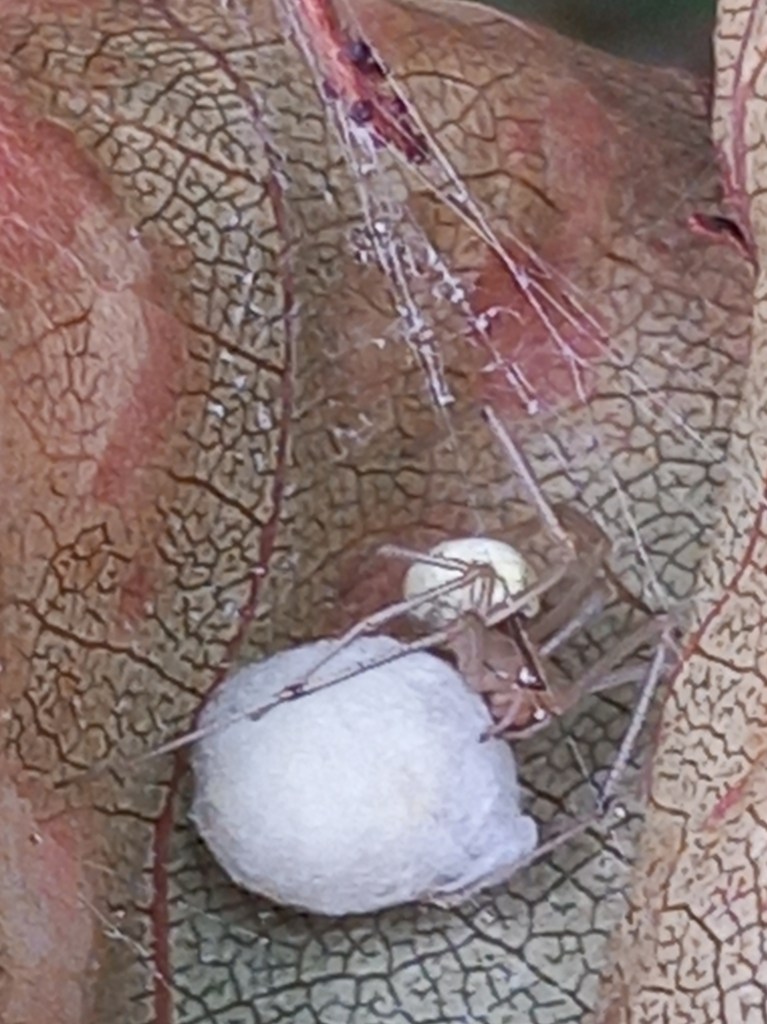
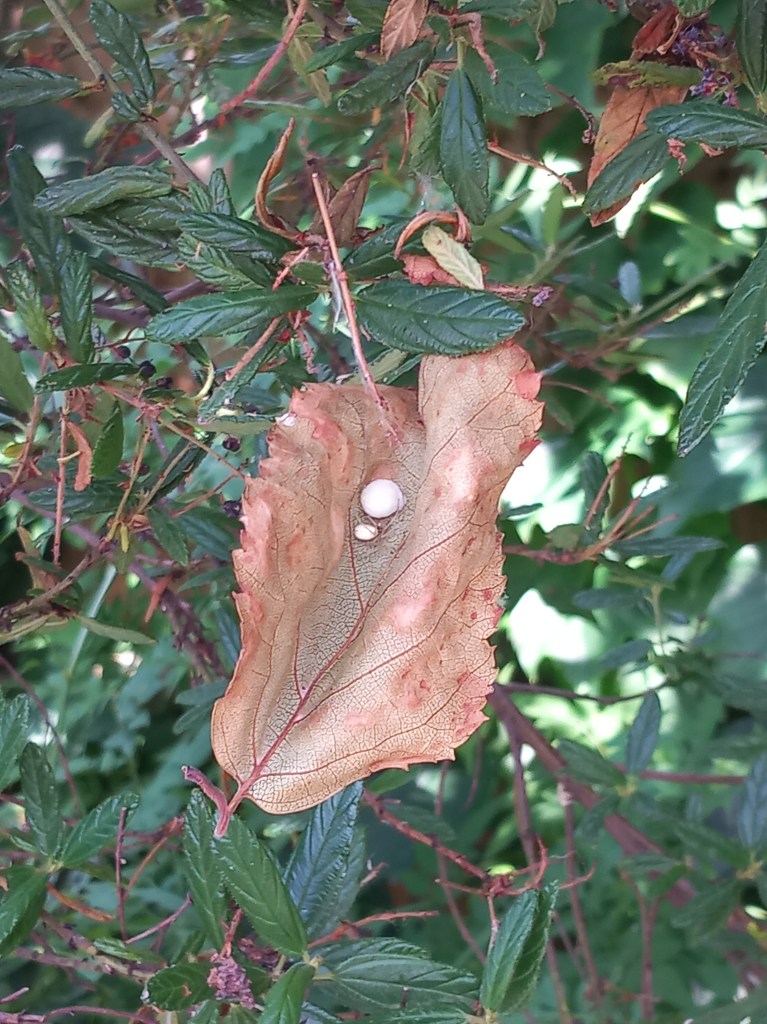
When I spotted a raspberry leaf folded over, I thought the caterpillars that decimated the plants last year were back, but it turned out to be a spider with a nest of eggs. On the other side of the garden, there was another one, this time in a dead leaf that was hanging in the lilac shrub. I got out my spider ID chart and I think it’s a comb-footed spider. It doesn’t really matter what we call it though, as I was just interested in looking at her and watching her methodically bring the edges of the leaf together to protect the eggs.

Meanwhile, the swifts were coming and going, but impossible for me to photograph. The day before, I’d done the Big Butterfly Count almost by accident. Eating lunch in the garden, I counted five different types in 15 minutes: comma, red admiral, small white, holly blue and gatekeeper, so later I logged the. There were lots of bees and hoverflies too, and I’d been thinking about how we’d provided more for pollinators this year. Some plants, such as verbena, thyme and marjoram, were deliberately added to the lavender and perennial wallflower we already had, but growing runner beans is an added bonus as the bright red flowers are popular with bees too. I also let the purple toadflax in from the alley.

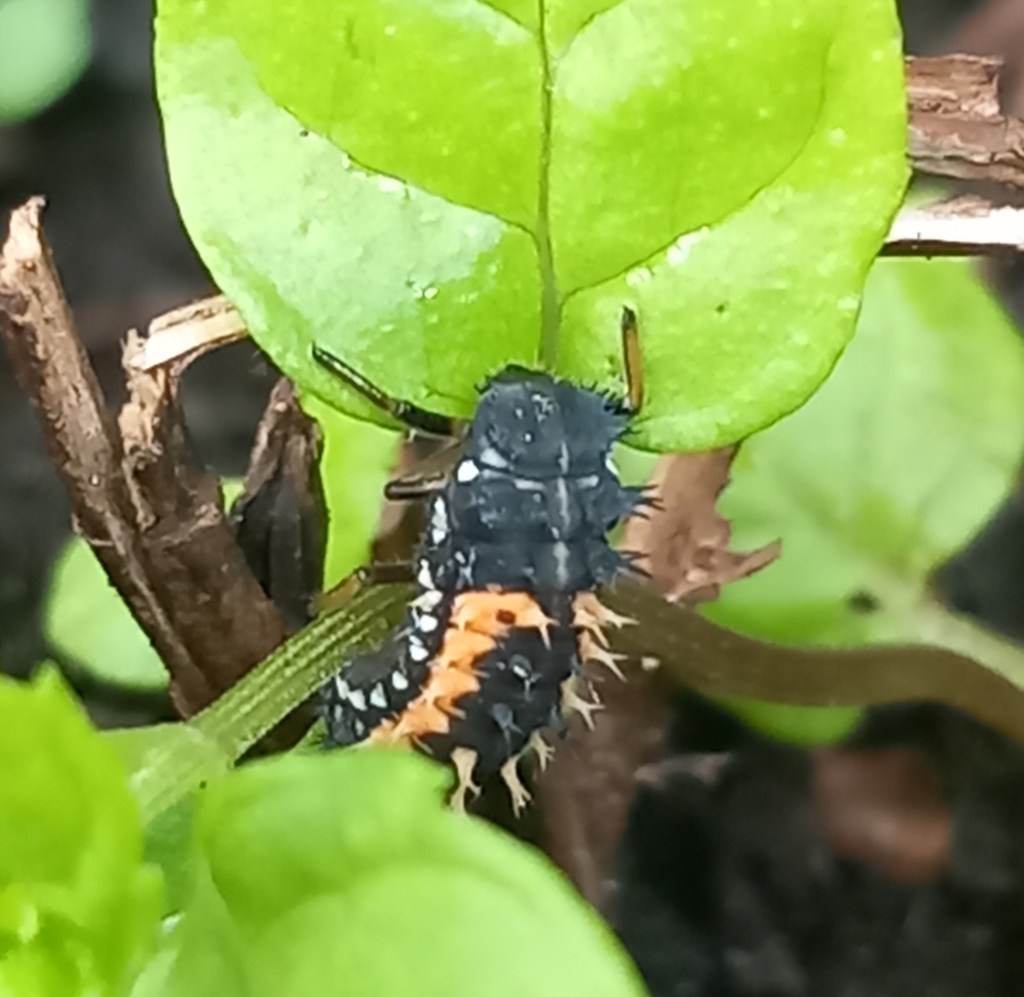
The next garden visitor to pop up was this ladybird larva. I know this is a harlequin because of how spiky it is – an indicator of its fearsomeness, perhaps. We’re not supposed to like them because they outcompete our native ladybirds, but I think the larvae look pretty striking. Reassuringly, I later found a 7-spot adult on the beans, then a 2-spot in the silver birch, and I’ve found a couple of 16-spots lately, so the balance seems ok in my garden.

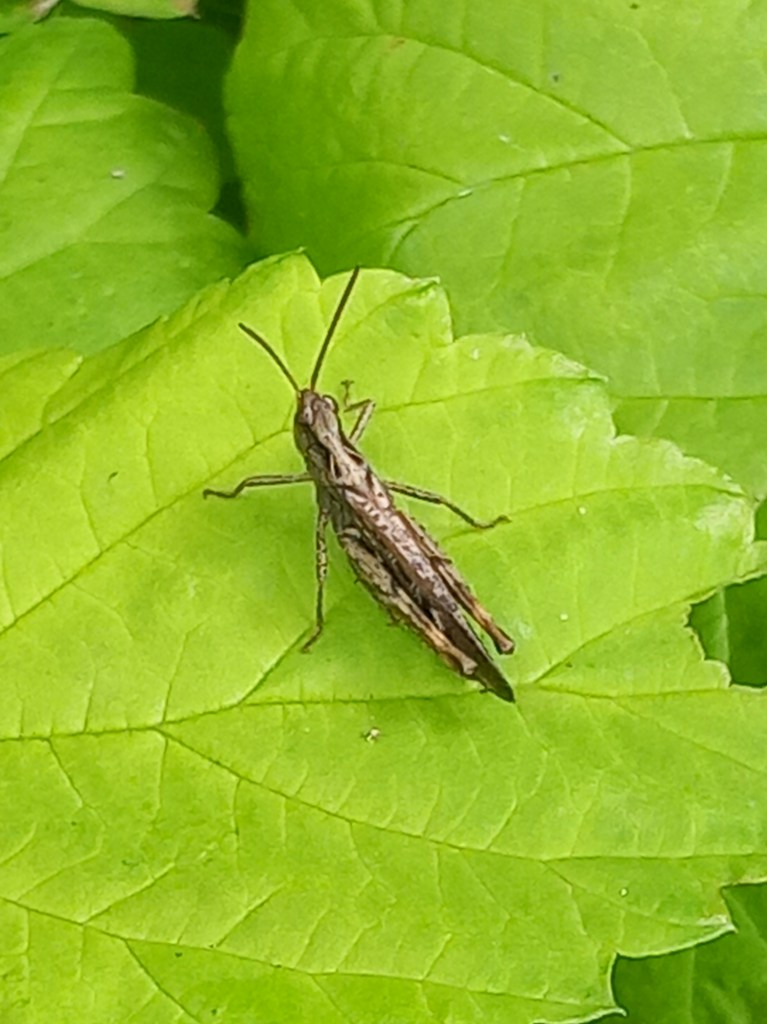
Next up, something less common. Surprising, in a way, given we don’t have any grass, but I’d already seen several in the alley edges near the flowerbed. Still, it took me a moment to realise what I was looking at – a grasshopper! Then a bit later, on the other side of the garden, there was a cricket. Look closely at the cricket (the green one, facing the opposite way to the grasshopper) and you can just see the long antenna extending beyond the leaf.

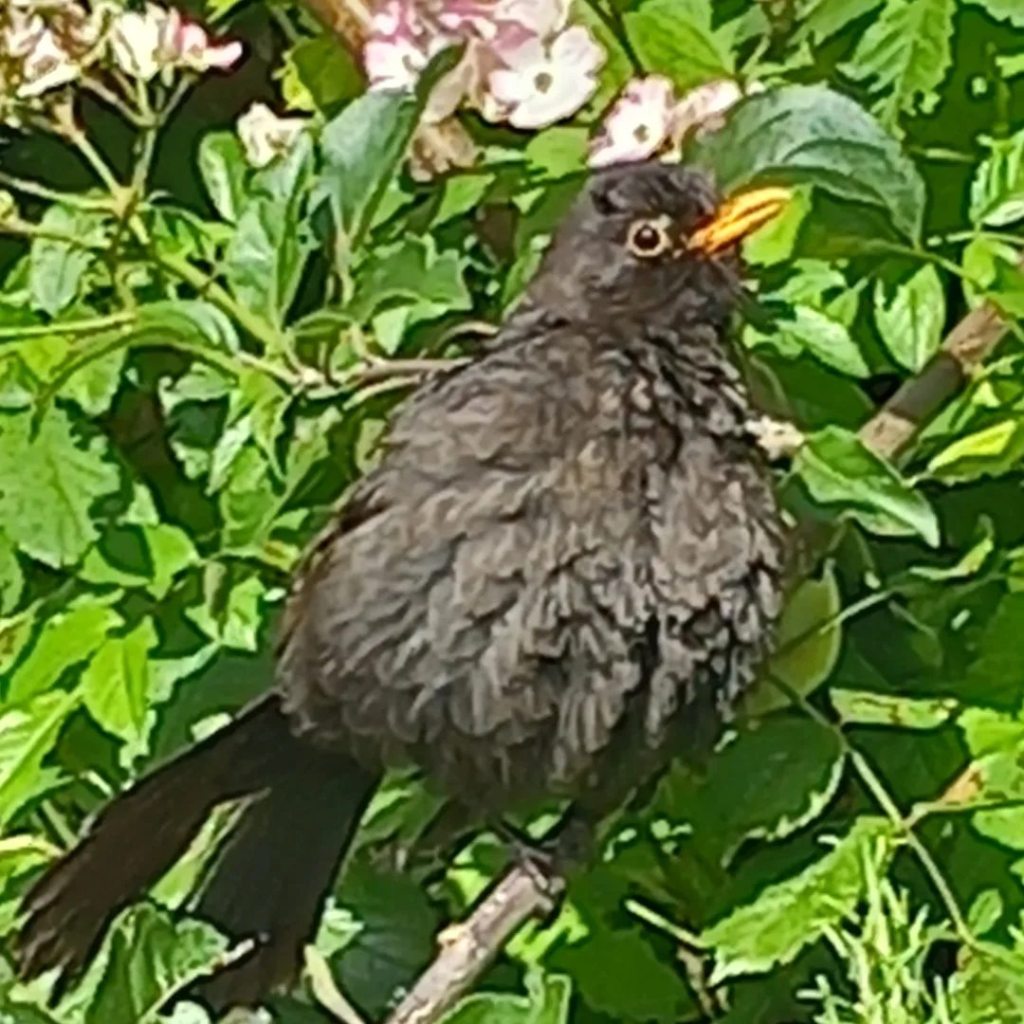
The grasshopper hopped off as soon as I photographed it, but the cricket was still there, in exactly the same position, three hours later. What was it doing? The next morning it had moved slightly, and after about 24 hours, I couldn’t find it any more. Talking of intriguing behaviour, that photo of the blackbird shows it in a typical pose, on its way to my neighbour’s garden with food for its chicks. Unusually though, he stayed there for a minute or two, then began quietly singing a short song. He was close enough that I could see his throat moving, but otherwise he was like a ventriloquist, with his beak shut. He kept an eye on me and kept singing while I got a bit closer, then moved to a different part of the garden. Soon, the female flew over from the direction of the nest, and landed on the opposite trellis. The male then flew over to her, there were some loud calls, and they both seemed to fall into the shrubs. All was quiet for what seemed like ages, then I heard some rustling. I was a bit concerned, so I crawled around, trying to peer under the shrubs. The female popped her head out, then retreated. A few more minutes and the male flew out and perched on the apple tree, beautifully posed with some roses behind him. He looked rather ruffled, but I guess he was trying to get rid of parasites.

After a bit of preening, he spotted something, and flew over to where I was sitting to grab a few flying ants that were crawling around near my feet. Then he was off. I didn’t see the female come out, so maybe she flew off while I was distracted watching him preen. It was all fascinating, and I’m glad I’d taken the time just to be there and observe.

After the blackbird, it was time to go in, but I put my camera out that night to see how many hedgehogs were visiting. At dusk there were still swifts overhead, and the blackbird singing his full song from a chimney pot nearby. Two hedgehogs came, and there was also a mouse, caught briefly on video three times – each time running off just after the camera triggered, into that mysterious shrubby underworld of slugs and snails, woodlice and worms, the odd grasshopper, and sometimes blackbirds doing who knows what?

30 Days Wild & the Five Pathways

The idea behind 30 Days Wild is to do one thing in nature each day in June. It takes place every year, and in this post I’m writing about my experiences in 2022. I think that year was the first time I logged something every day. Maybe that’s because it was easier in some ways, as I was working outdoors at Itchen Valley Country Park, surrounded by nature. But as my other recent blogs have shown, there is plenty of nature in urban and suburban areas, too.

When I took part, I didn’t think about the five pathways to nature connectedness, but now that I’m working for the Hampshire and Isle of Wight Wildlife Trust on the Wilder Southampton project, they’re on my mind much more. The pathways are: senses, emotion, beauty, meaning and compassion, and I thought it would be interesting to look back at my 30 things, to see if there were any pathways I’d taken more than others.

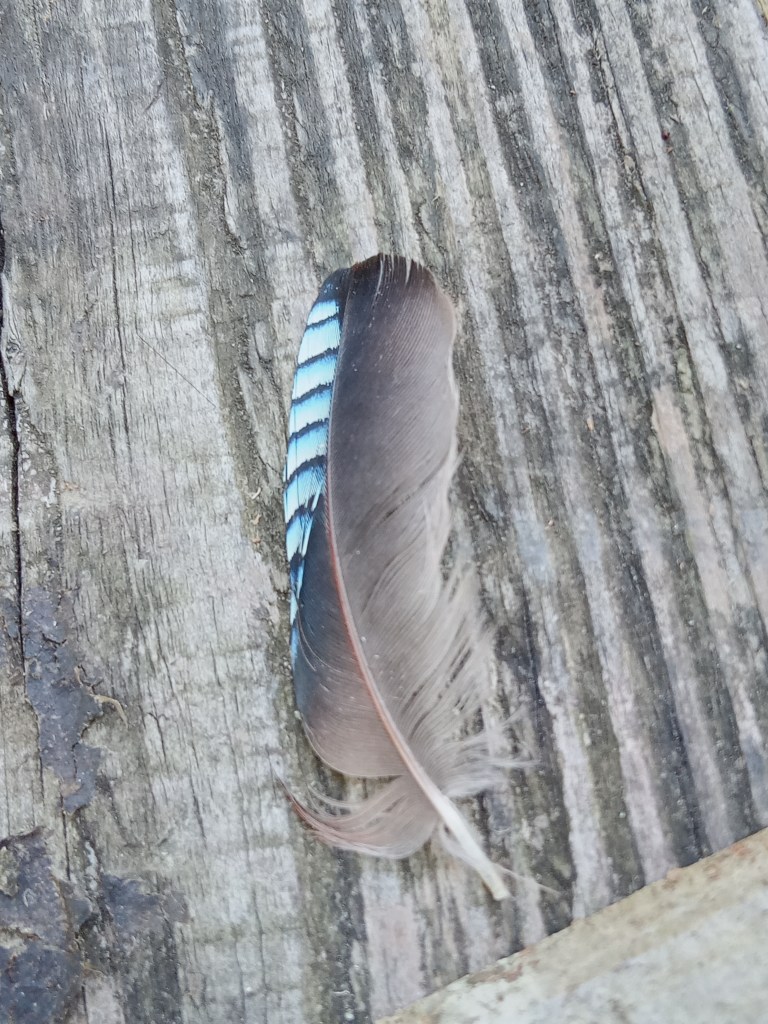
Some of the things meander across several pathways, such as this jay feather. Sense-wise, I saw and touched it, and it’s something I see beauty in. Possibly though, the most distinct path is emotion because it sparked a real ‘wow’ feeling, which for me is often brought on by something unusual. It also caused envy because someone else saw it first and I really wanted it!

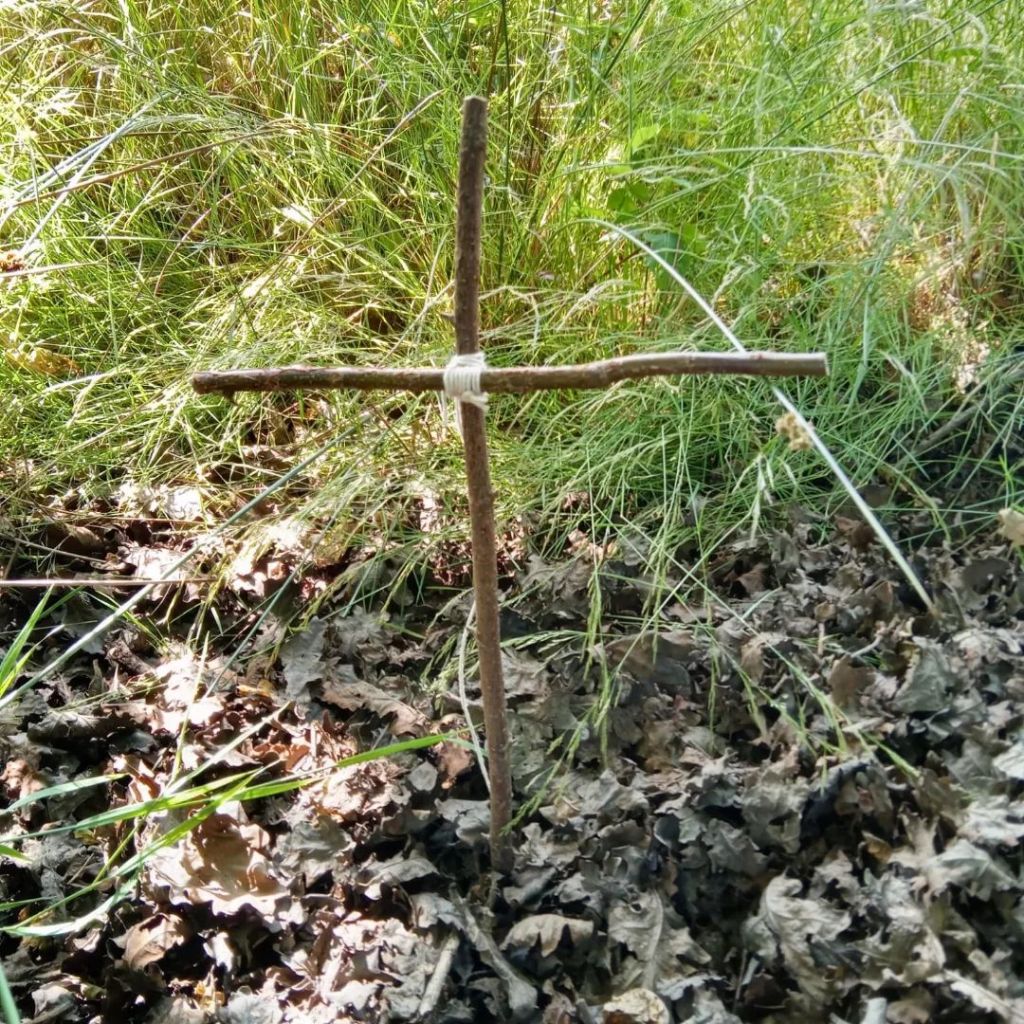
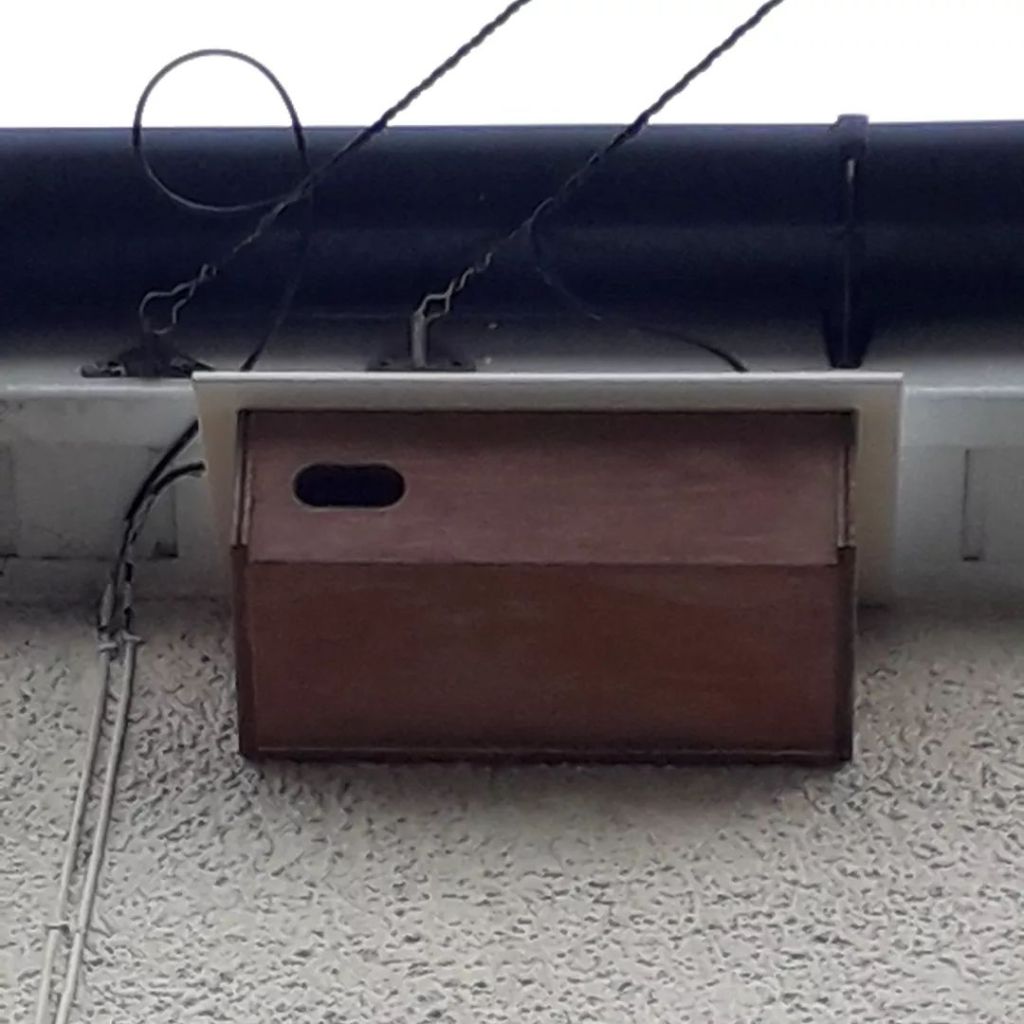
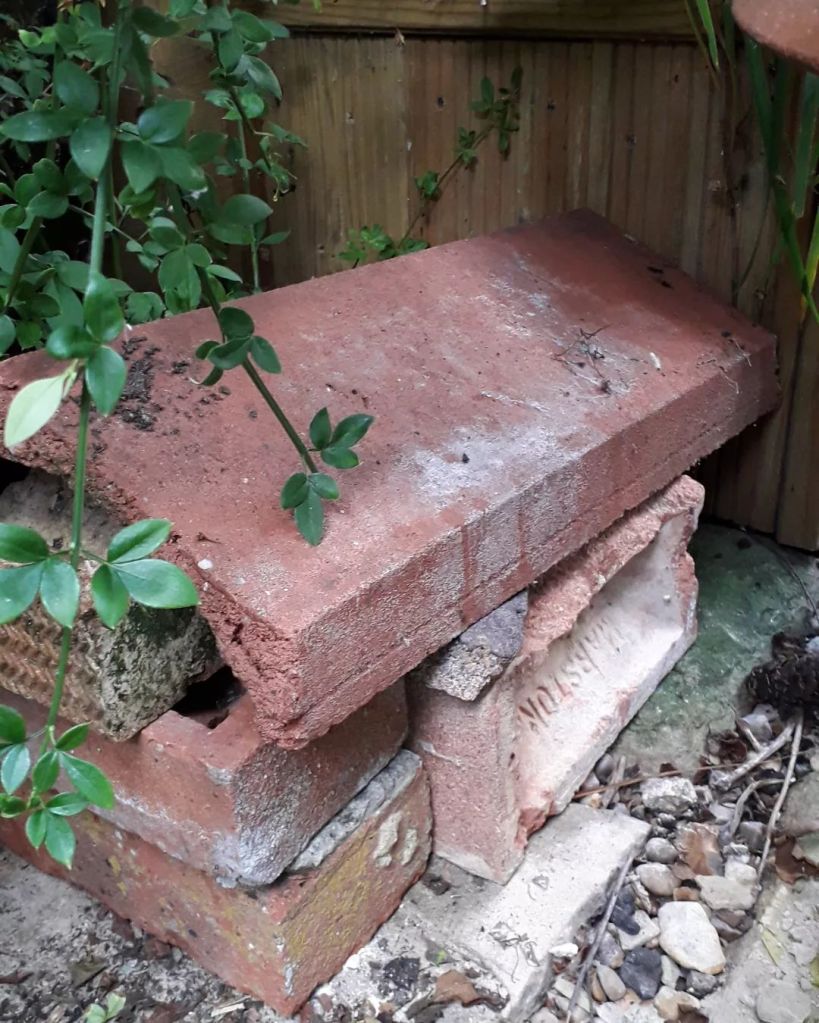
Quite a few of my acts of wildness reflected my compassion. Above you can see the grave I made for a dead mole, and on the first day, I rescued a bee from a cycle path. I recorded two litter picks of green places – litter picks for me are usually about making a place better for wildlife, such as by removing plastic bags and wrappers so birds, hedgehogs and foxes can forage. Providing homes for wildlife is another act of compassion, seen here in the swift nest box and the hedgehog shelter. I also created a stag beetle habitat by sinking logs into my garden, as the grubs need rotting wood. The eighth act of compassion was to make butterfly feeders.

The swift nest box also takes me along the pathway of meaning. Swifts returning in May are a part of nature’s calendar, and something I really look forward to, so even in April I’m checking the Hampshire Swifts group to see if they’ve started arriving. Then I add ‘mine’ to Swiftmapper, and look to see if there are nest sites in my area. They also evoke an emotional response, of anticipation and anxiousness, then excitement and sheer joy when I see they are back. It’s not only the seeing though, it’s the hearing those ‘screaming parties’ as they zoom over at roof height, so it’s also about senses. Because they’re only here for the summer, swifts carry added meaning. Given all this, it’s not surprising they featured three times in my 30 Days Wild.

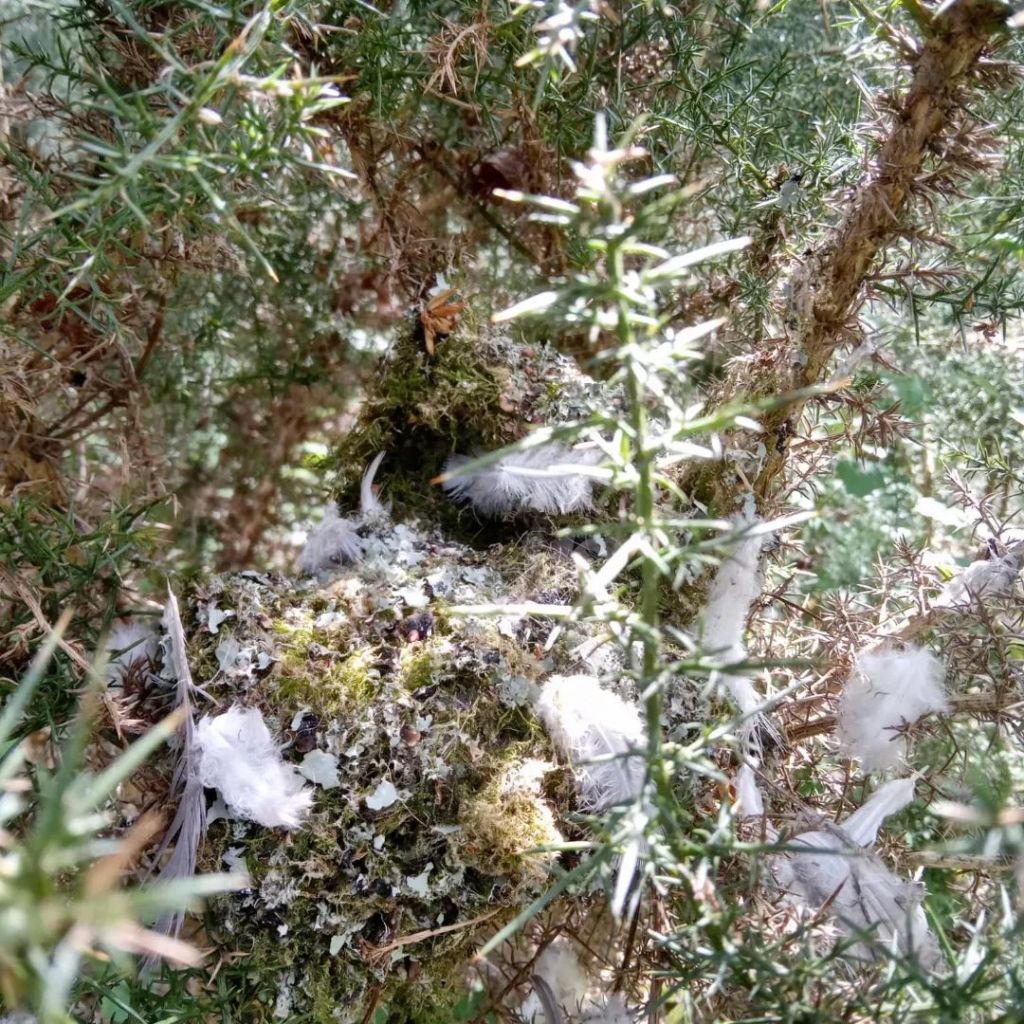
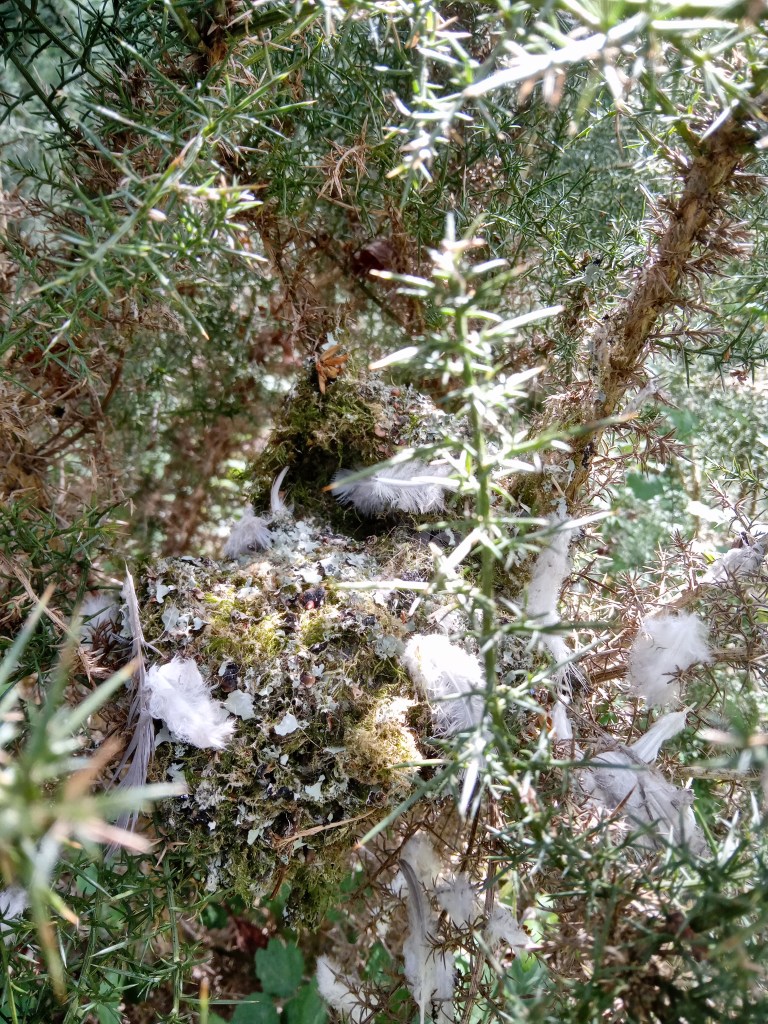
Looking through my photos, those related to senses were often about seeing, but four involved touch. This photo shows a damaged Long Tailed Tit nest. It was clearly destroyed, so I knew I wouldn’t be disturbing the birds by touching it. It was lined with hundreds of feathers, making it really soft, and the outside was made of moss and lichen, held together with spiders’ webs. Delicate, yet strong.

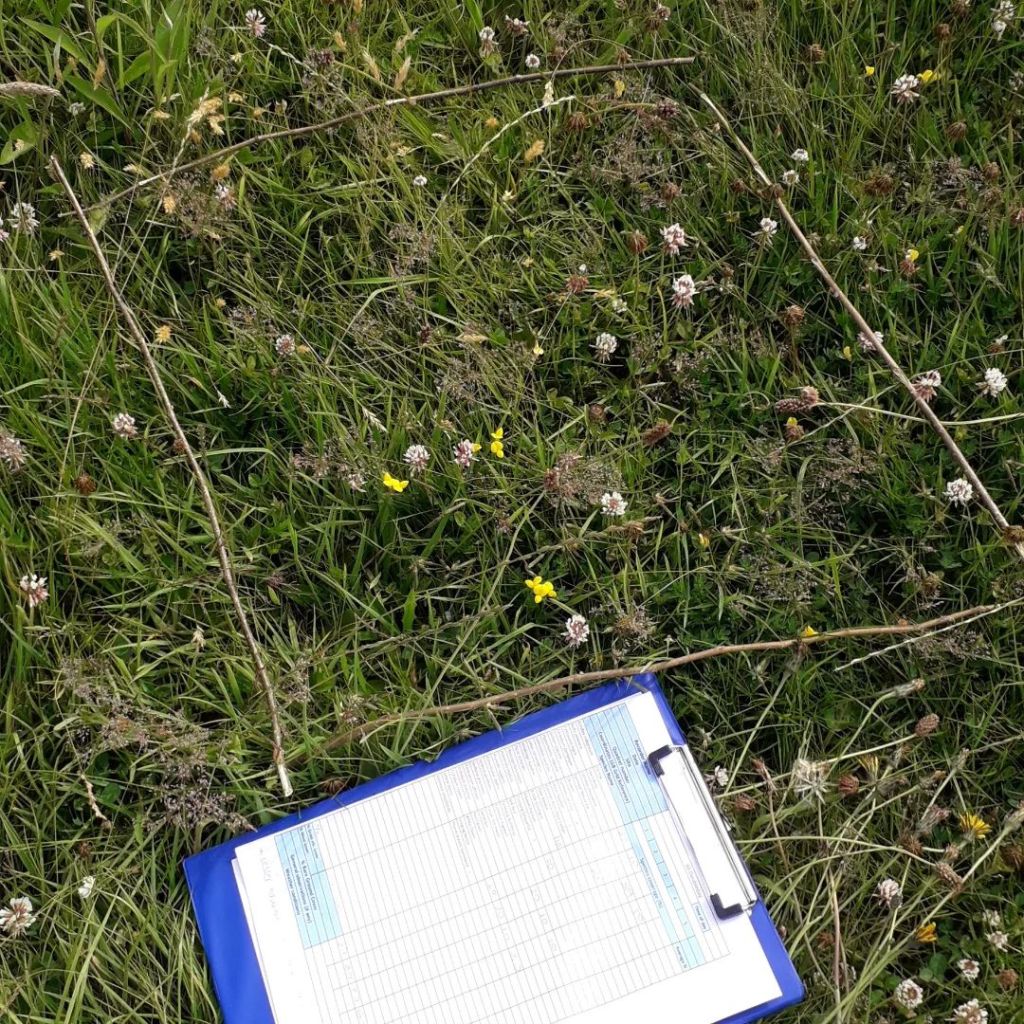
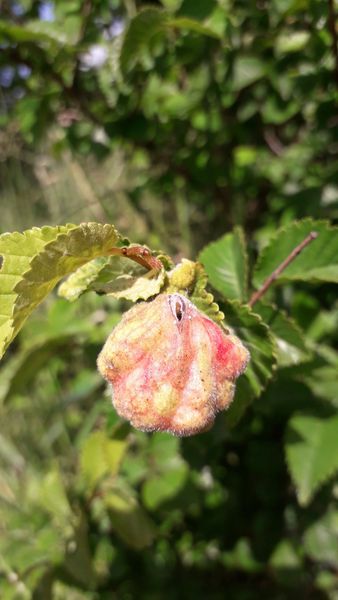
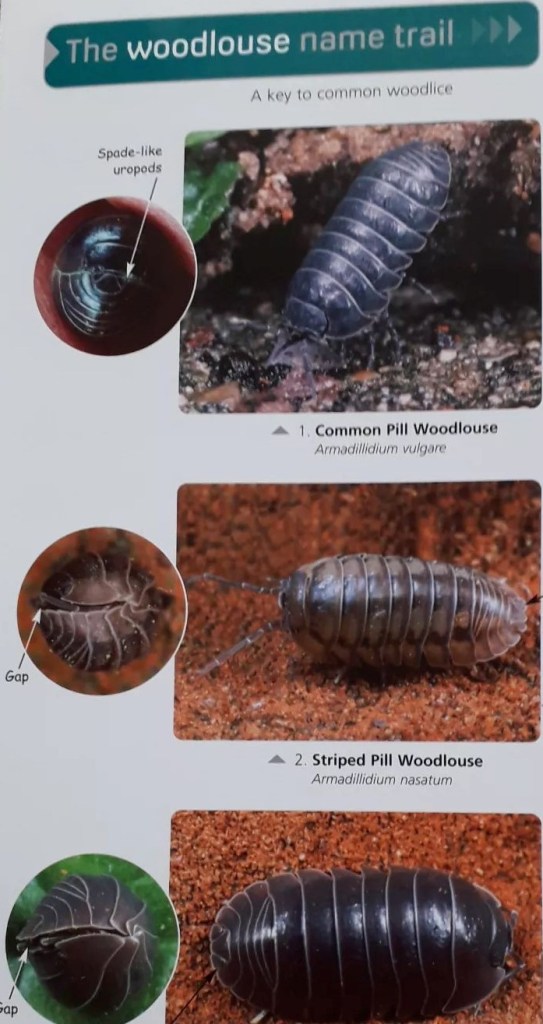
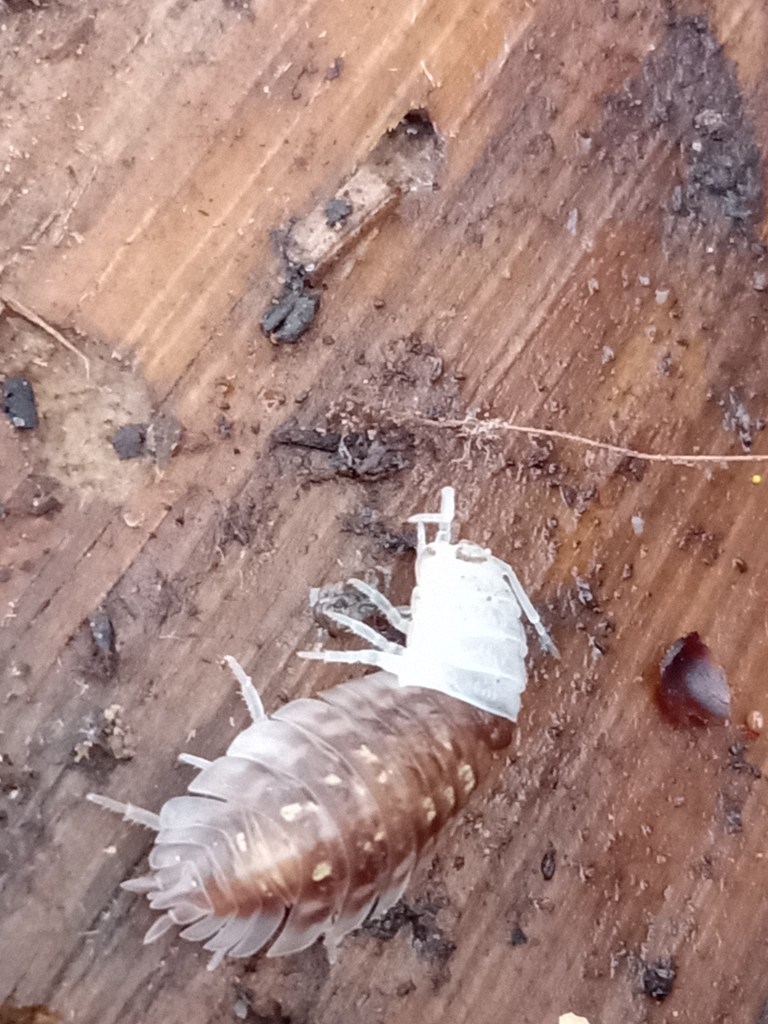
I also used touch during the wildflower surveying I took part in – some plants have rough or hairy leaves, for example, so this can help you to identify them. The five pathways don’t include naming and measuring – facts and figures – as these things alone aren’t always a way to a lasting connection with nature. But for me, part of surveying wildflowers, or taking part in a bioblitz at Peartree Green, is about looking closely – and touching, listening, and sometimes sniffing or tasting, appreciating the beauty and diversity, and just the sheer amazingness of nature! At the bioblitz, where people gather to log everything they can find in one day, if I find a fungus or a beetle that hasn’t been recorded before, I feel a rush of adrenalin. I might not know what it is, or be able to tell it apart from something similar, but that doesn’t matter to me – someone else can do that! So there is emotion there, and compassion too, because showing which species are present might be significant in protecting that place one day. Meaning is another pathway travelled through surveying or citizen science, because the time of year is significant in knowing what you might expect to see. And of course, there is beauty to be found in surveying, if you take a moment to just admire a flower as well as measuring it and counting its petals! Often though, if I see something new to me, I like to find out more about it, as was the case with the gall below (made by an aphid). The first time I saw a pill woodlouse rolled up, I thought it was a bead until I watched it uncurl. Amazing.

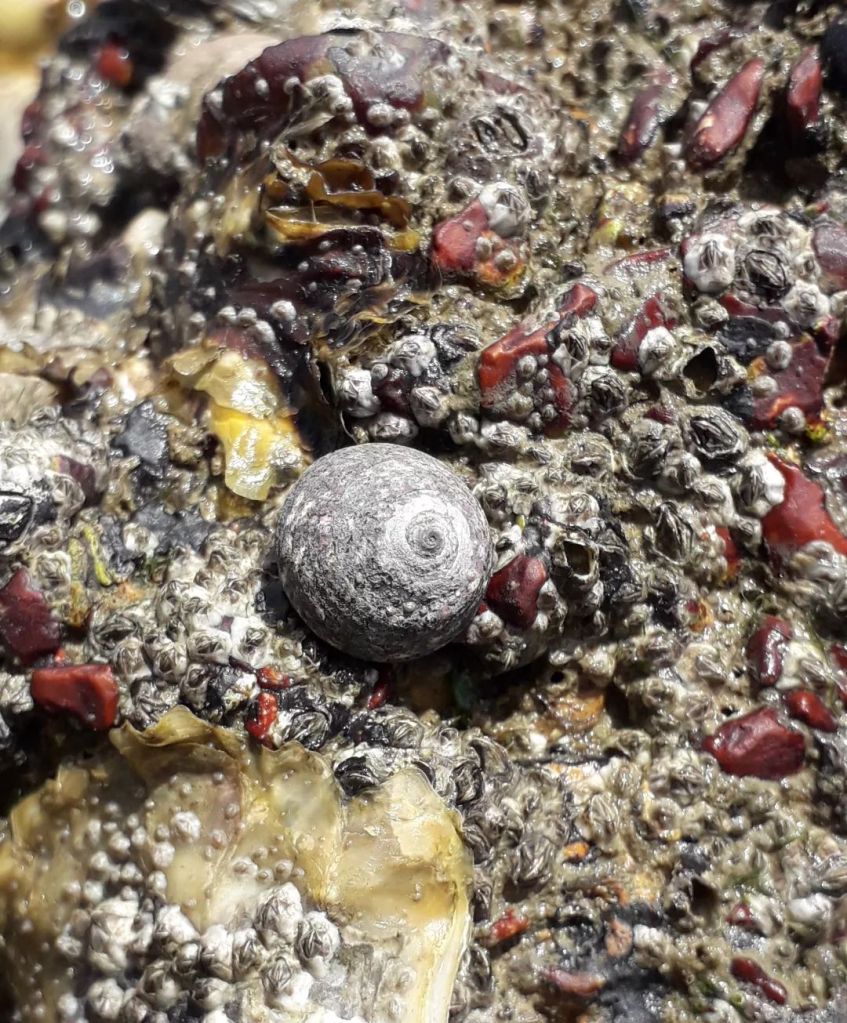
As I reflect on my 30 Days Wild, and read over this post, it seems that beauty might be my path less travelled. I think that’s because I’m curious and noticing something tends to sparks lots of questions, so out come the books. Perhaps it would be good for me to do more of this for 2023’s 30 Days Wild: crouch down and look at a rocky shore. The patterns, the colours, the shapes. This just caught my eye and I wanted to capture it. It’s still beautiful now.

Suburban Safari

Does this look like a wildlife haven to you? Does it even look like nature? Maybe not for many people. For some people in Southampton, ‘nature’ means the New Forest. For others it might mean one of our local nature reserves, such as Miller’s Pond, Peartree Green or Chessel Bay, or maybe a park. But I’d hazard a guess that not many people would spend time searching for wildlife on a verge like this. To be fair, I didn’t either – but I did get fed up seeing all the litter around our precious dandelions. So I put a post on the Woolston Wombles group to say I’d be doing a litter pick on Saturday 15 April. There were six of us on the day, and we started here, on the verge off Victoria Rd with the ongoing Centenary Quay development seen through the fence, and a little bit of the river visible too.

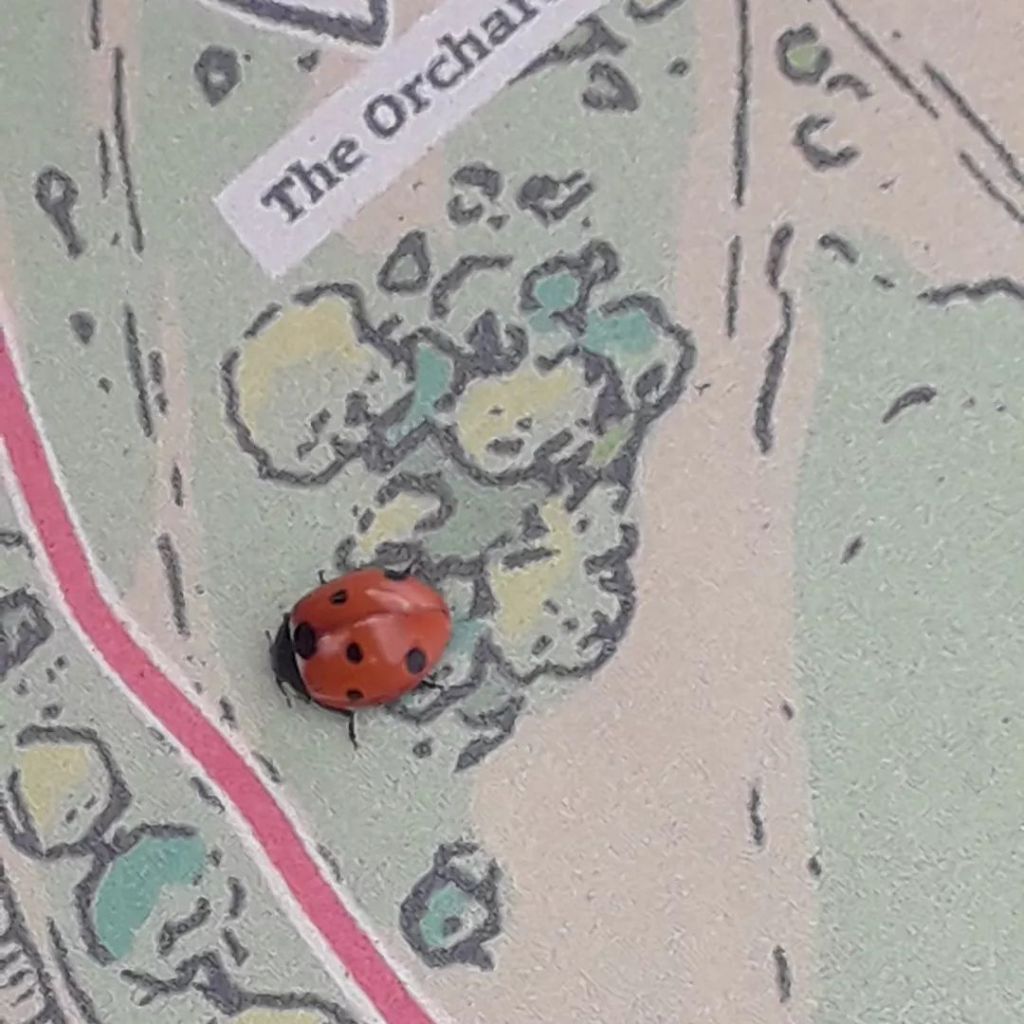
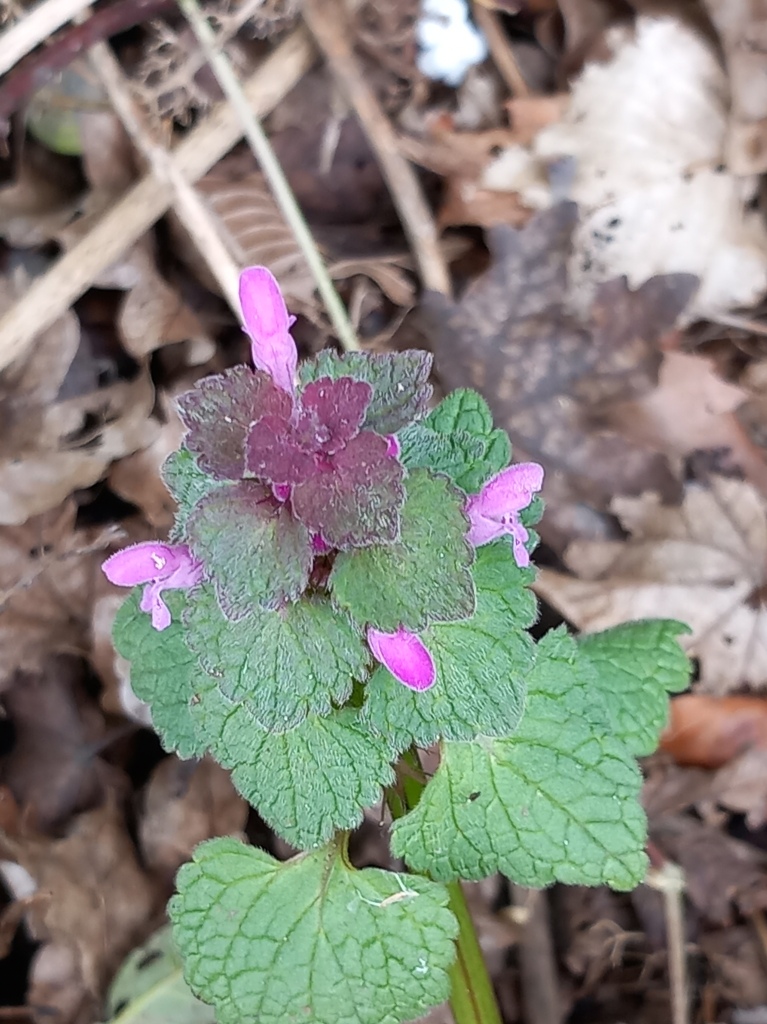
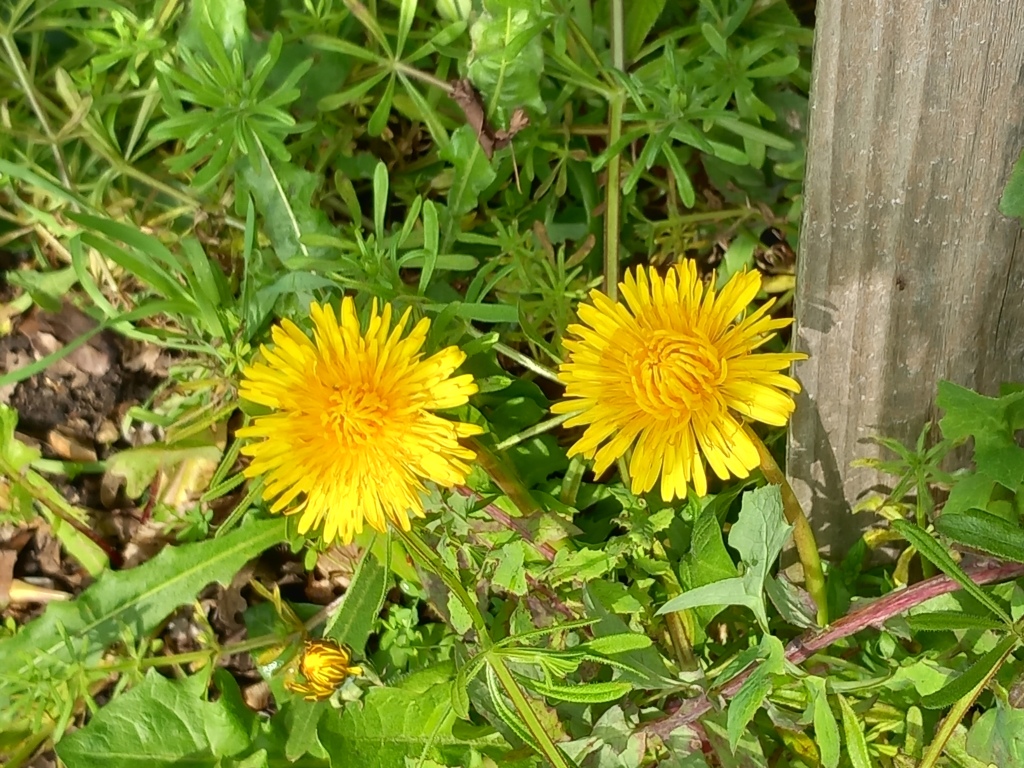
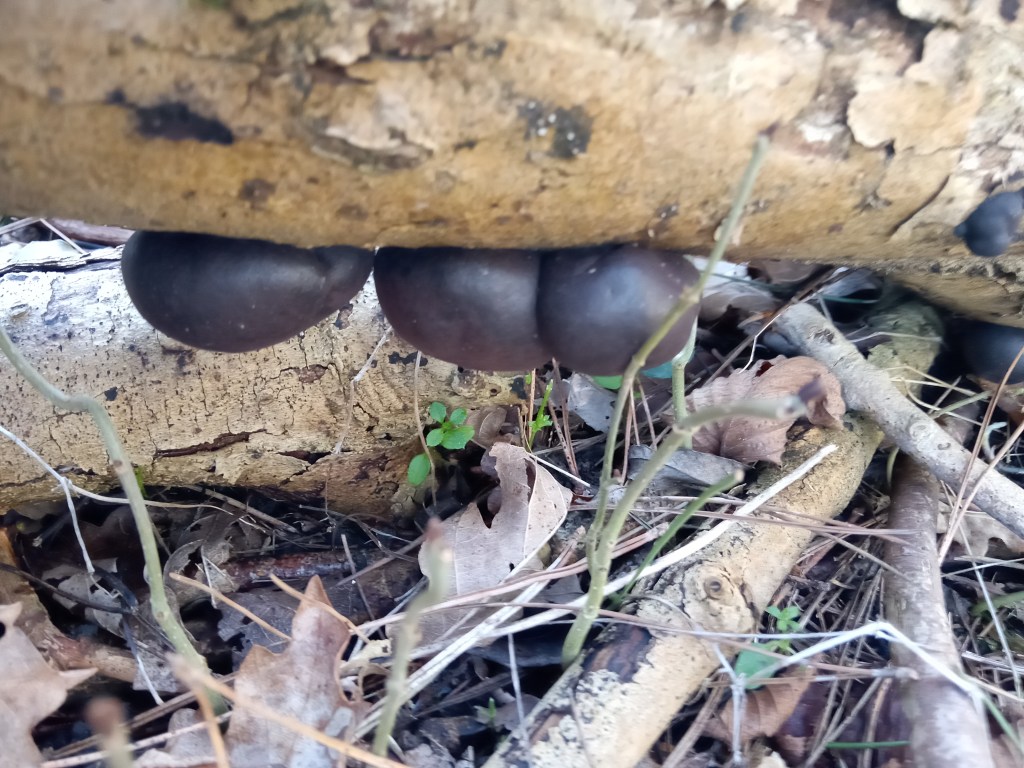
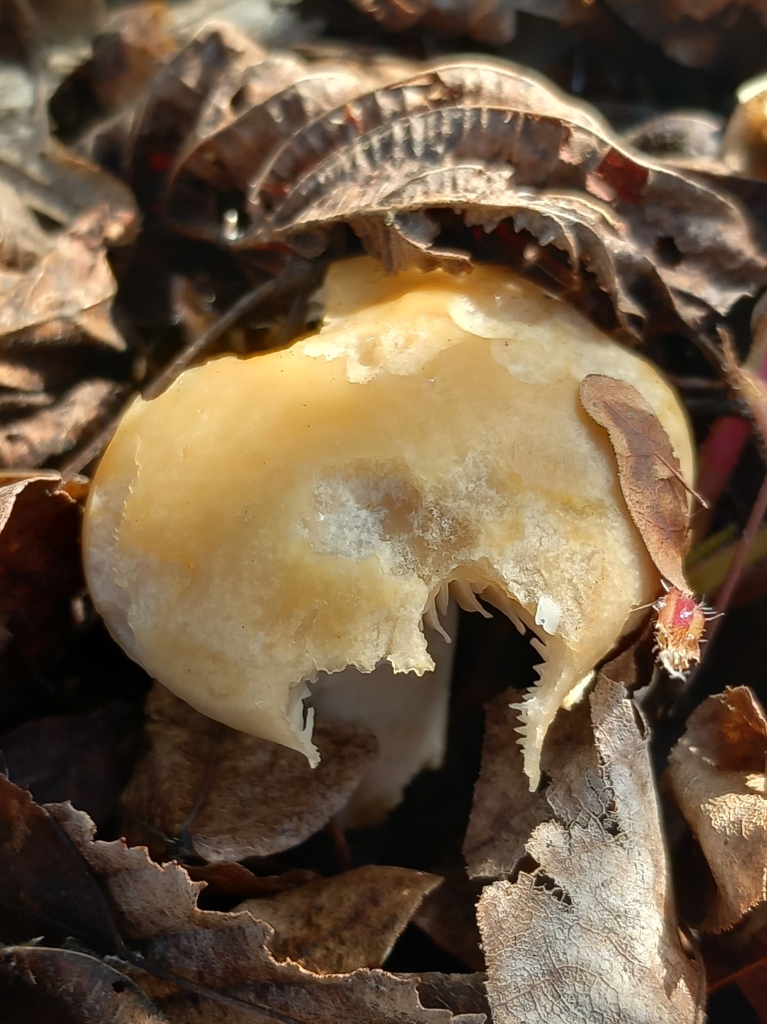
It was a gloriously sunny day, but a little chilly so I was surprised when very soon, I found a six-spot ladybird. I wasn’t sure it was alive, but carefully used a leaf to put it on this dandelion, and it soon perked up. After that, I decided to tread more carefully. I noticed a few mushrooms like the one below, most with chunks eaten. There were also red dead nettles and of course more dandelions.

Then we found a two-spot ladybird. Although common and widespread, numbers are dropping, so it was worth logging on iRecord, one of a number of recording schemes used by citizen scientists to monitor our wildlife. The RSPB’s Big Garden Birdwatch is probably the best known example.

Another interesting find along this stretch of verge was this hoverfly. When I worked in outdoor learning, I found that young people were often scared of hoverflies, thinking they were wasps and would sting. Some hoverflies have yellow and black markings to mimic wasps and therefore put off predators such as birds. But they are harmless to humans, and important pollinators. They’re also rather beautiful, I think.

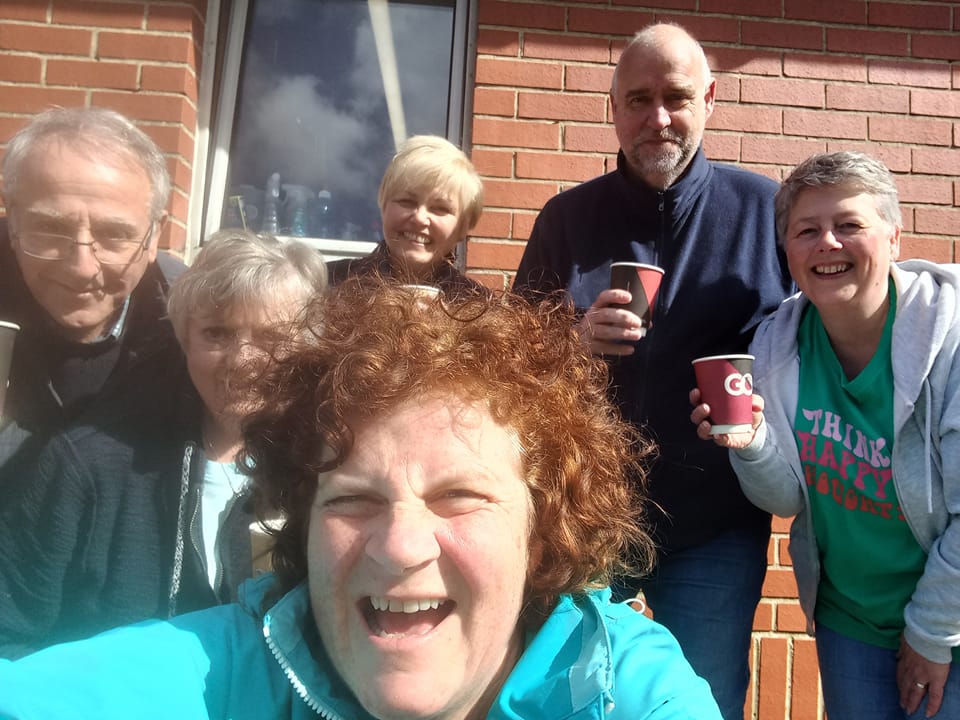
Where were we again? Oh yes, opposite a busy junction that leads from a shopping street to a large supermarket in one direction, with a housing development past the library in the other direction. In a few metres of verge strewn with plastic and other litter, we’d found these six wild species. Remarkable, isn’t it? We then turned the corner to go down Keswick Road to the verge I’d written about in an earlier blog post, A Sense of Place. Opposite is the Southampton Veterans Drop-in Centre, which was open, and the kind staff there made us tea and coffee. Here we are enjoying it – along with the sunshine, the company and the wildlife!

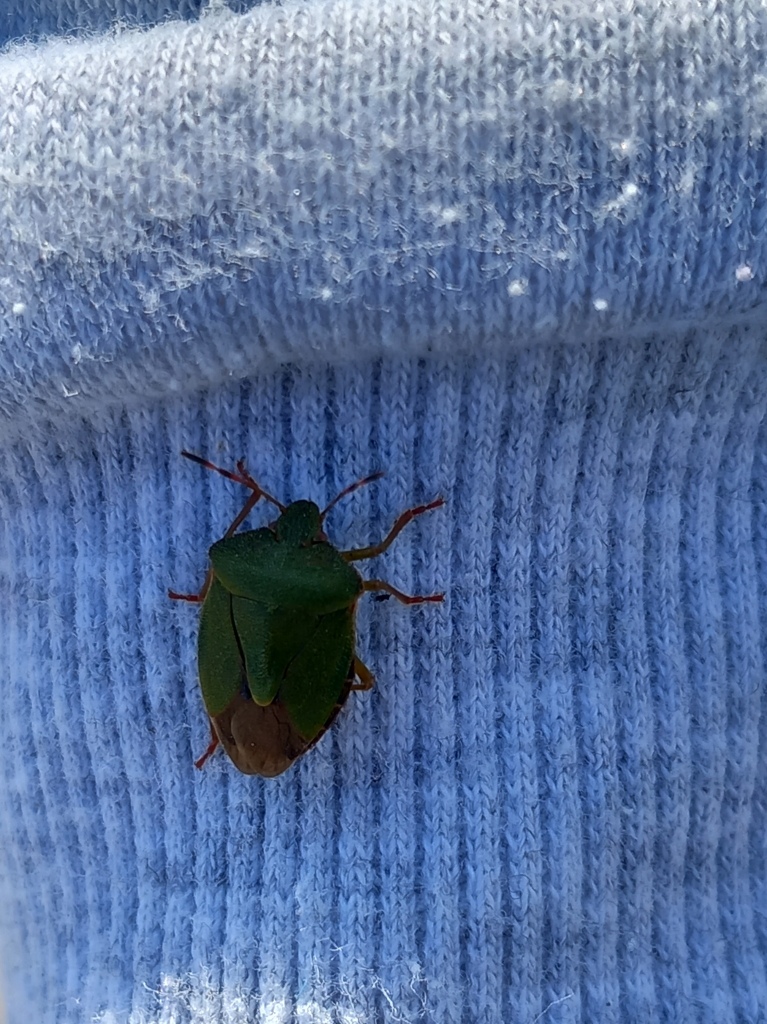
Naturally, we picked the shrubby area around the centre too to thank them, and there I found a bumblebee that moved before I could get a photo. Just across the road, Lisa was picking the shrubbery next to the car park (see A Sense of Place) and realised while drinking her coffee that she’d brought a guest along on her sleeve – a Common Green Shield Bug! She returned it before we moved on, as did Archie, when he later acquired one. Was it the same one? I’ve included both photos if you want to look closely and make your own mind 🙂

What made this hour-and-a-half so much fun? The sunshine helped, the company definitely did too (not to mention the coffee) but for me it was the unexpectedness of finding so much wildlife. My friends and colleagues are used to me singing the praises of urban wildlife, of the overlooked and underappreciated (dandelions, anyone?) but this experience really made me reflect on how much joy people can find if they notice the nature around them. I’d thought about creating Woolston treasure trail back in January when I wrote ‘A Sense of Place’, and now I have more to add to it.

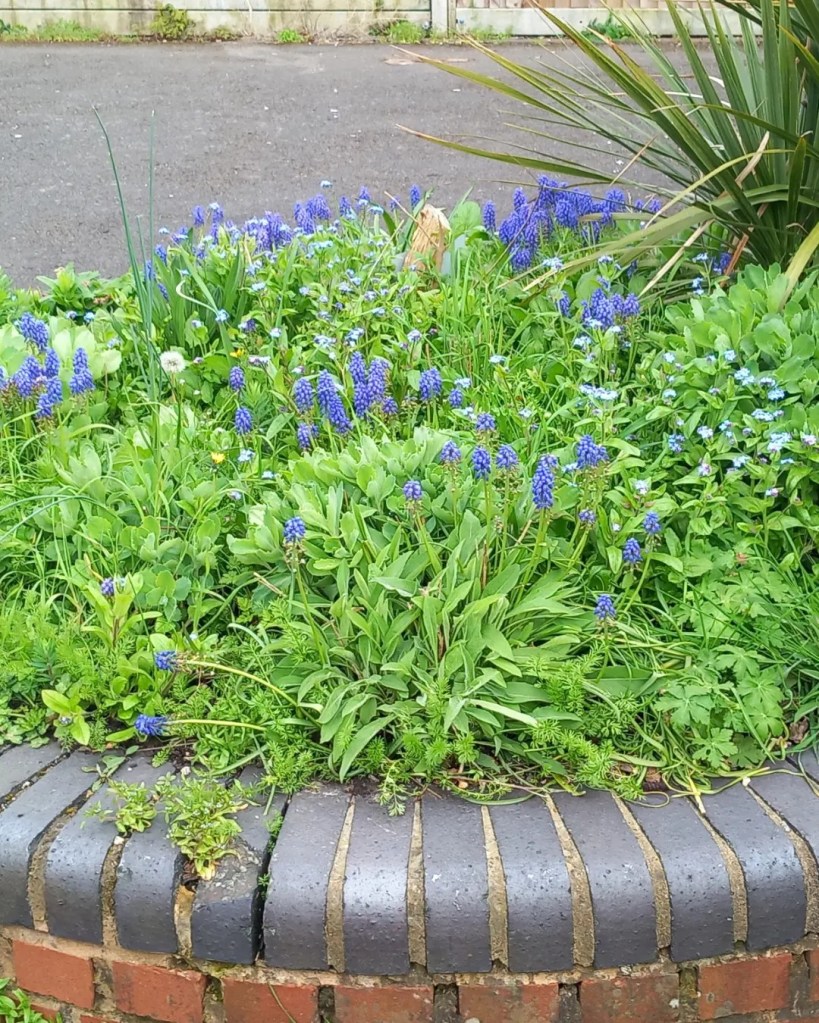
A footnote to this story: a few days later, I bumped into a neighbour who was recovering from surgery. Advised to take gentle exercise, she had for the first time walked through the alley behind our houses and come across the flowerbed that my partner and I look after. She was amazed, saying it really lifted her spirits. This is a bed currently dominated by Grape Hyacinth, nothing special. But it sits in a not-so-beautiful patch of tarmac and breezeblocks, and her comments made me realise what a difference even something like this can make. Just wait until you see in in summer, I thought!

The fruits of ignorance

Yesterday, I was really tired. I’d had a whole morning of working on my laptop and with three hours of online training still to come, I needed some ‘tree time’. So after eating lunch, I nipped over to Peartree Green, the local nature reserve I help to look after as a volunteer. I’m really lucky as it’s only 3 minutes from my house.

I thought I’d head down the track that marks the northern boundary, so I could check if there was any wild garlic coming up on the patch just past the the turnoff to the woodland path. Annoyingly there wasn’t much, partly because someone had flytipped garden waste on the patch where it grows (ironically, right below the sign that threatens fines for flytipping and dog mess).

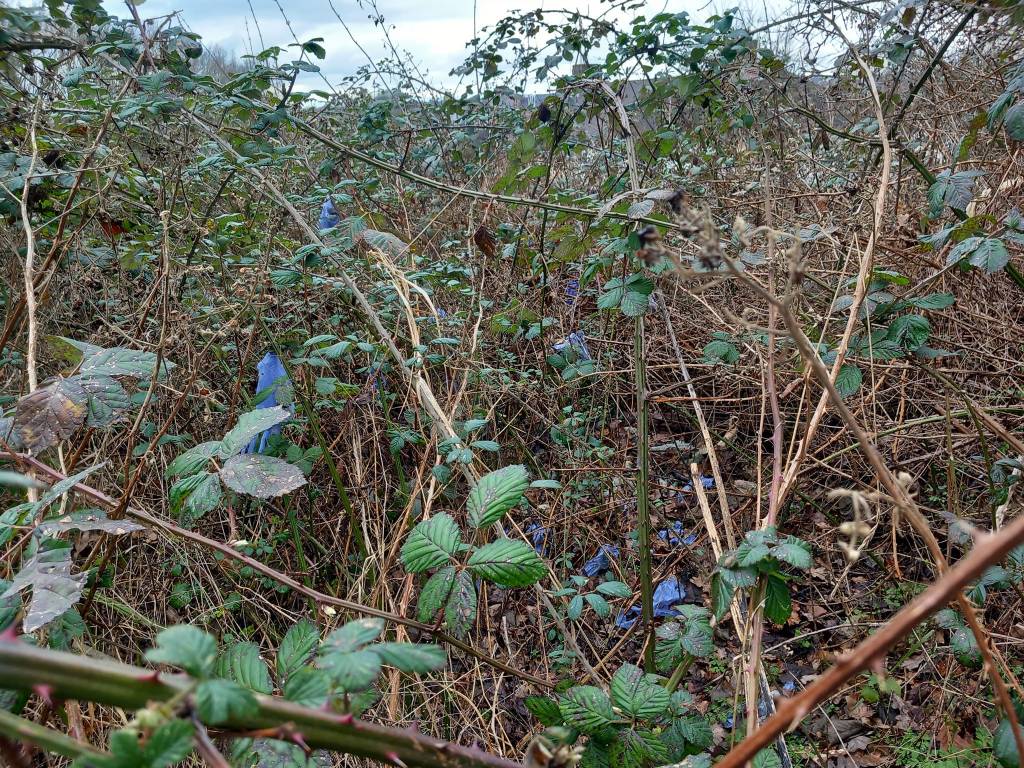
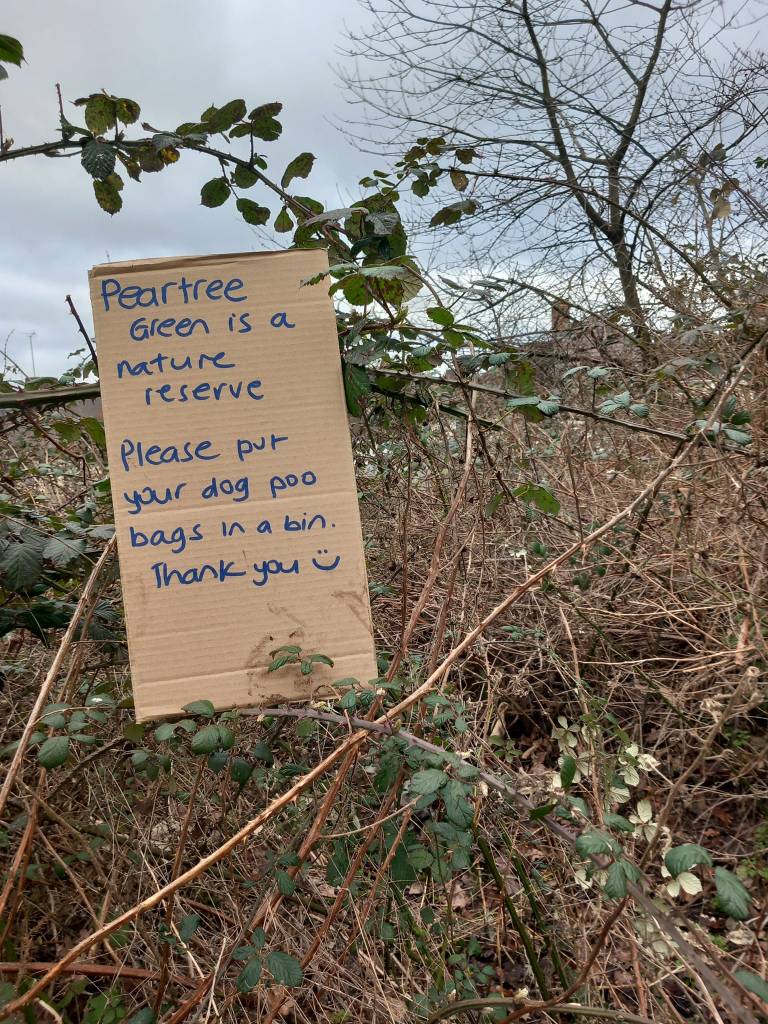
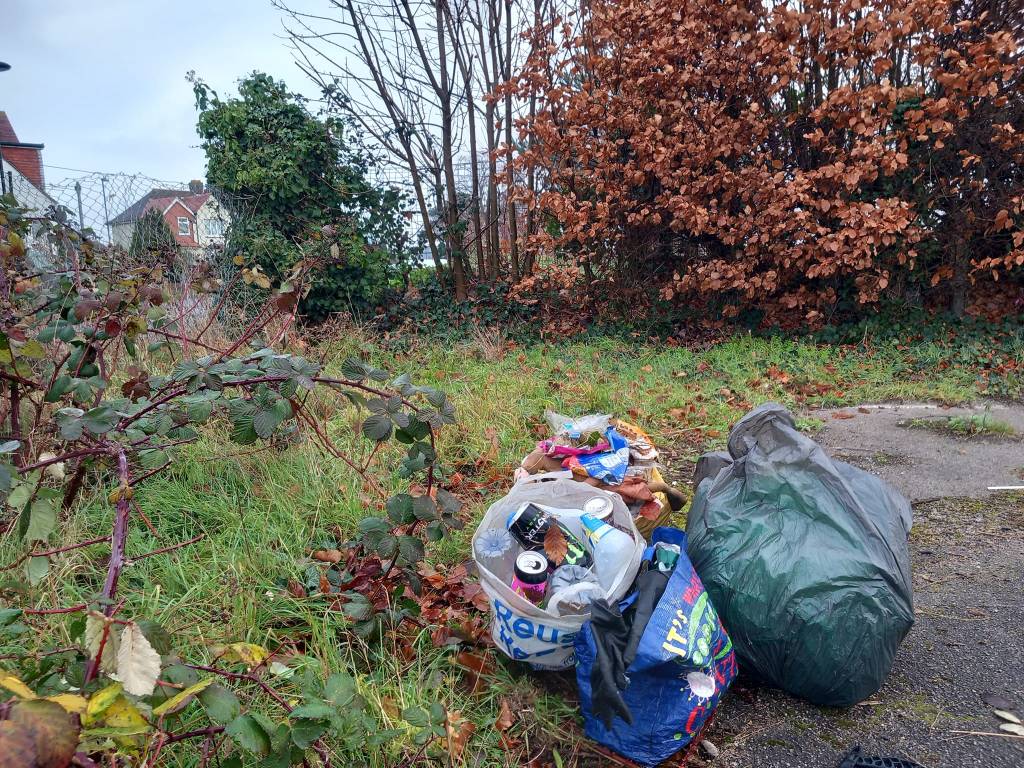
Before I reached that spot though, I’d noticed a lot of lilac-blue poo bags that had been flung into the brambles (see main picture). These are what the chair of the Friends of Peartree Green calls ‘the fruits of ignorance’. I just felt really sad, not only for the wildlife, but also for me and others who go for a walk to appreciate nature but have it spoiled by this kind of thing. So I decided to post about it on our Facebook page and then go back this morning to clear the bags and add a sign.

To many people, I’m sure a patch of scrubby bramble looks like wasteland and seems a reasonable place to throw rubbish, whether it’s poo bags, garden waste or bottles and cans. This patch of bramble includes quite a lot of dead stems as a result of previous cutting by our wonderful volunteers to retrieve beer cans. I’d like to think that if the person doing this understands it’s a nature reserve – and that they can put the bags in a bin (we have six) – they might stop. Or they might not. The ‘Carlsberg case’ has taught me that.

Over the past three years, we’ve removed thousands of beer cans, mostly Carlsberg, and finally one sunny Saturday morning we came across the drinkers during one of our litter picks. I chatted to them to explain it was a nature reserve, and asked them to take their cans home or to a bin. Oh yes, said one, I understand as I work at a country park. Later we walked past their bench, and there were the empty cans on the ground. And we continue to find fresh ones in huge quantities to this day. So why doesn’t a polite request work?

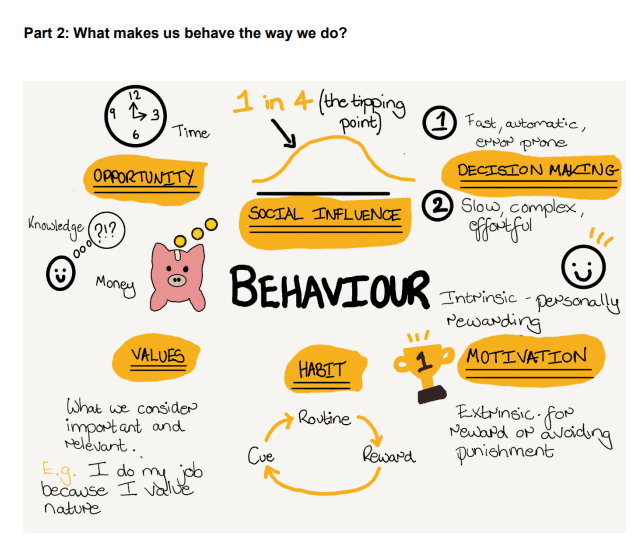
In 2020, during my time as a Wilder Community Leader with the Hampshire and Isle of Wight Wildlife Trust , I took an inspiring training course in Human Behaviour Change for Wildlife Conservation. This taught me that, in order to try to change behaviour, you need to understand what drives it. This graphic from that course, which was written by Becky Fisher (Deputy Director of Engagement) for the Hampshire and Isle of Wight Wildlife Trust, offers starting points, but without knowing who’s flinging those poo bags, we can only guess at the reason behind it. My sign attempts to cover two: one I suppose relates to values, as I hope that pointing out that the area is part of a nature reserve, the flinger might see those brambles as more important. The second relates to opportunity – there are bins, and you can put bagged poo in them. But this behaviour might be driven by time (the nearest bin is out of my way and I’m in a hurry) or habit (this is the way I walk and here is where my dog poos and I don’t want to change), or something else. I’m guessing. It’s all I can do for now.

Through the Friends of Peartree Gren’s Facebook page , though, there is opportunity for dialogue. We can exchange views and ideas about why people do this. Of course, the people using the page already know, and presumably care, that Peartree Green is a nature reserve. Still, some may not know why it’s important to bag and bin dog poo. As I was putting my bag of rubbish near a bin this morning, ready to ask the city council to collect it, a man put a bag of poo in the bin. I thanked him, and told him what I’d just been doing and why. Curiously, he asked what colour the bags were, and I told him, ‘Funnily enough, the same colour as yours’. He then wondered how long it might take for dog poo to break down, so I explained why we’d prefer it to be bagged and binned. Southampton City Council’s ecologists have told me that poo left on the ground alters the composition of the soil, in turn altering the flowers and plants that grow there. This was clearly new to this man. Hopefully, he’ll tell more people, spreading knowledge and reducing ignorance.

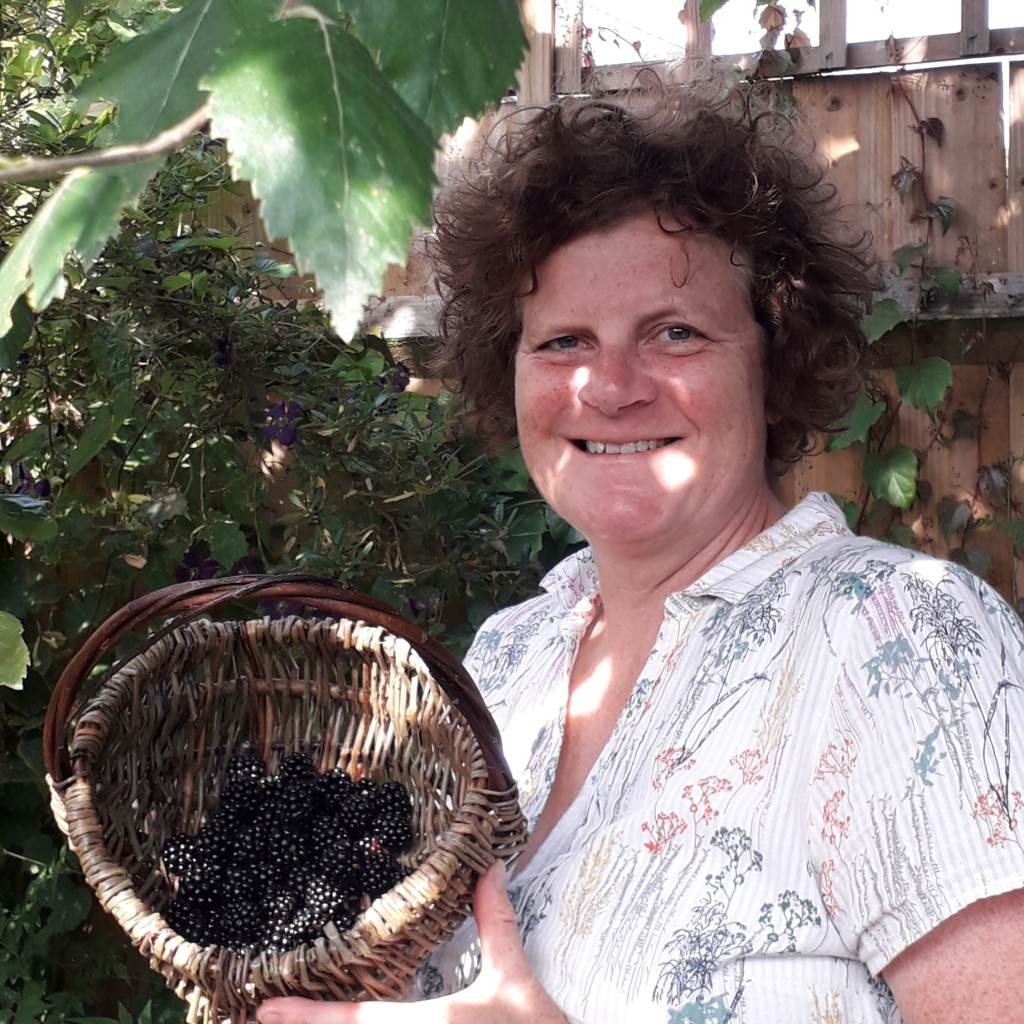
And one day, perhaps the only fruits we’ll see on Peartree Green will be apples and pears, haws and hips, and lots of juicy blackberries.

A sense of place

“What are you doing?” This was the question a little boy asked me on Christmas Eve morning. “Picking up rubbish so the birds can find some food”, I replied. “Okay!” he answered, and off he went. Moments later, a gull landed on the grass and started rooting around for worms, as if it had just been waiting for someone to remove the layers of plastic. The woman with the boy had said nothing, but adults usually say something like “Thank you for doing that” or “There’s no point, it’ll be just as bad tomorrow”. They don’t ask why, and nor had the boy – but it got me thinking about why I do it.

Recently I was talking to a friend who’s planning a research project on litter. One of the things we discussed was how litter picking can help you to notice aspects of nature that you might have overlooked, and how it can also inspire creativity. After our conversation, I walked along nearby Keswick Road in Woolston, one that I’ve been looking at in connection with my job as a Wilder Southampton project officer. My earlier impression was that there was litter along a whole stretch of fence leading down to the river. What I hadn’t noticed before was that there was a good-sized grass verge with three trees and several hazel shrubs on. There was a lot of litter on this verge too, and from a distance, it doesn’t look like anything special.

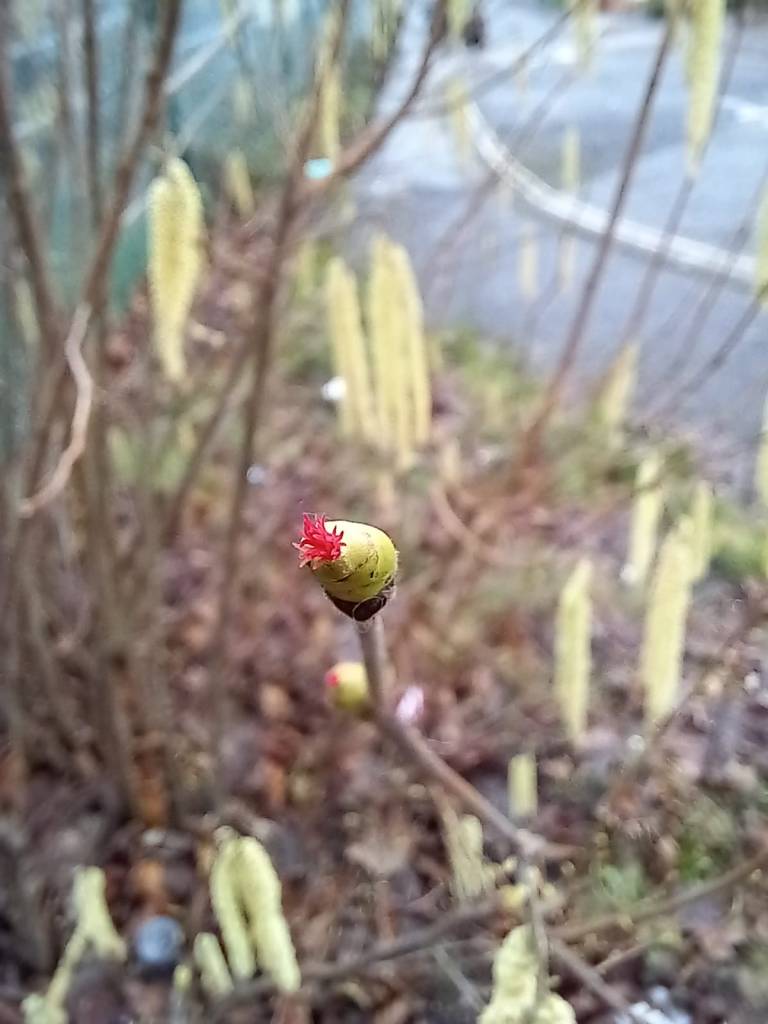
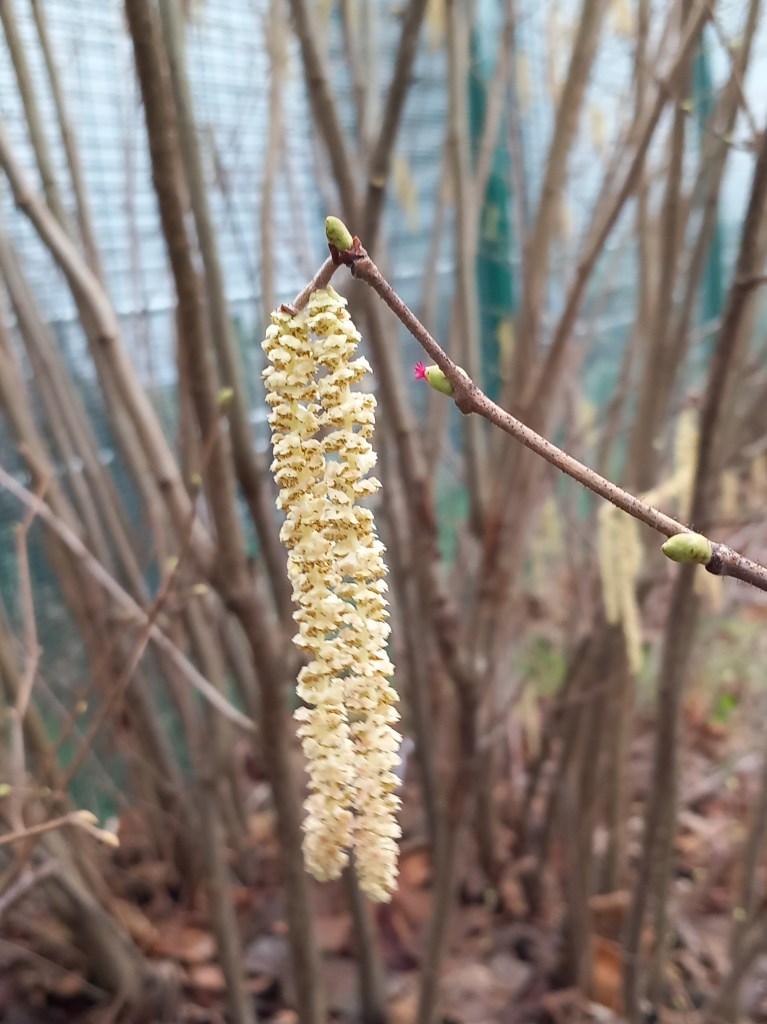
But up close there’s a lot to wonder at. That hazel shrub on the right, the one that barely reaches as high as the fence, is festooned with with male catkins, and if you look closely you’ll also spot the tiny female flowers.

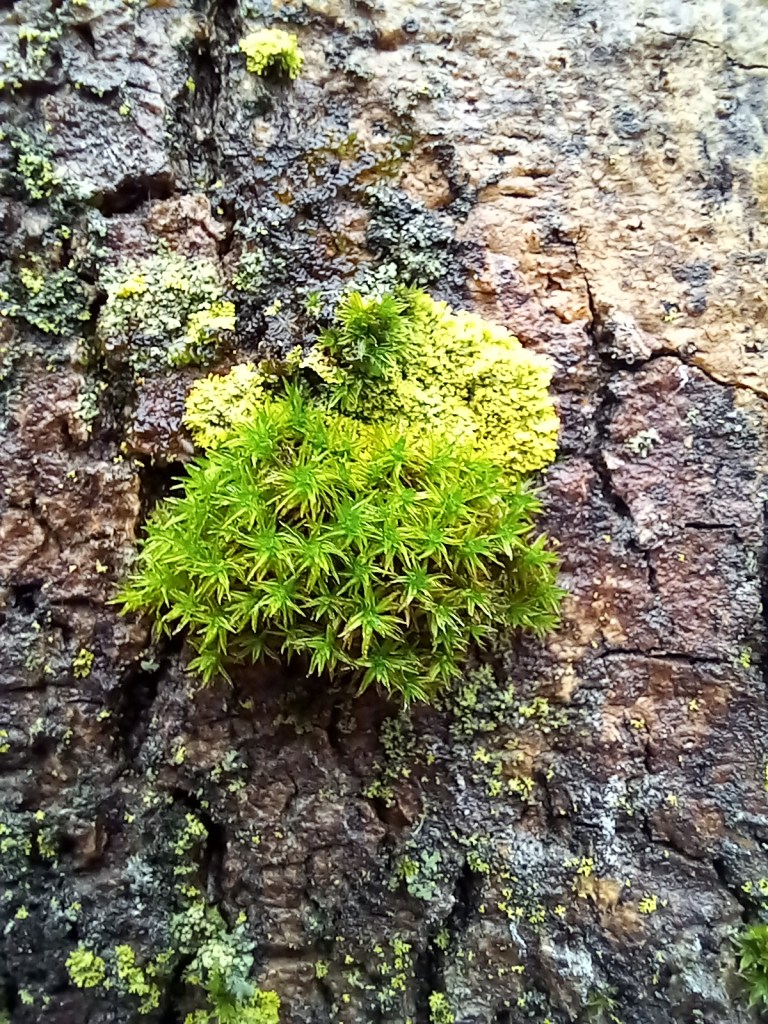
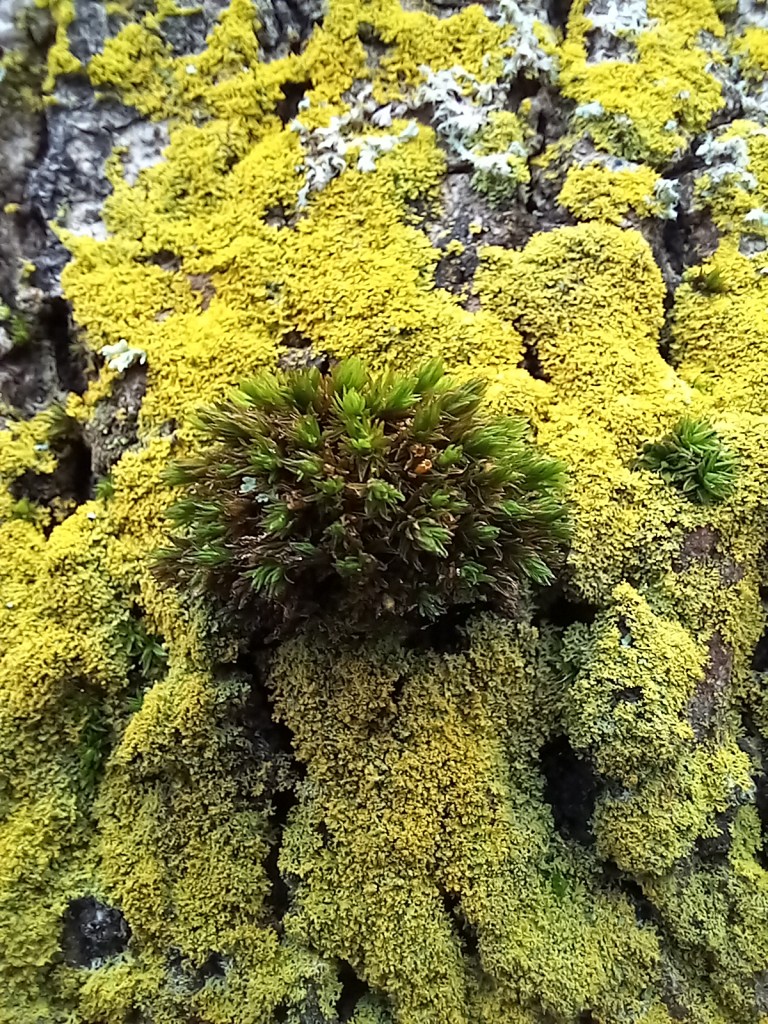
Seeing this made me want to clear the litter, so I went back a few days later with gloves and bags. I didn’t want something so beautiful and precious to be surrounded by discarded bottles and cans. And it is precious – I walked home that day via Peartree Green, which is a nature reserve, but the hazel shrubs there are quite dull in comparison, with barely a flower. This reminded me again that nature is everywhere, we just have to notice it. And litter picking can help us to do that. The three trees on the verge are sycamores, leafless now because it’s winter, with no remaining ‘helicopter’ seeds. But look at the moss and lichen growing on them! The vibrant green and yellow was all the better because of the grey skies.

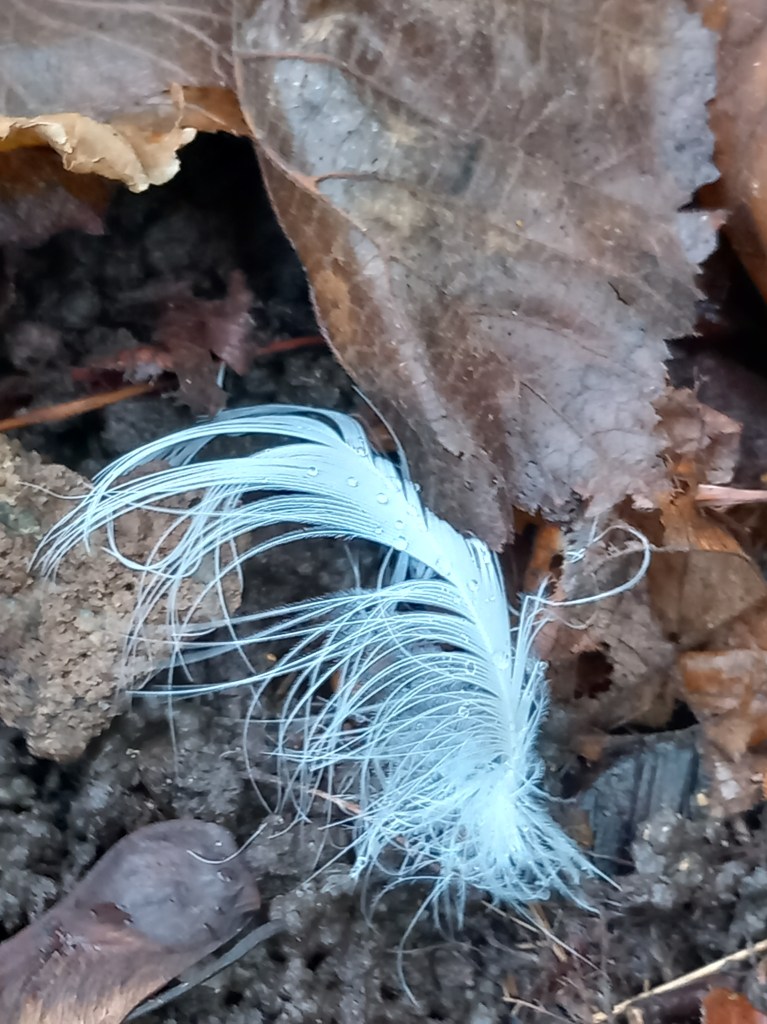
There was treasure to be found on the ground too, treasure that I would never have seen if I hadn’t been litter-picking. I thought this was a bit of plastic at first, then realised it was a feather, probably from a swan. I left it there for someone else to find. I walked on, past the car park on Woodley Road. Here there are verges and raised flower beds, and most are badly littered, so I decided to come back to those another day. I realised I was starting to develop a connection to this unloved and overlooked patch, in the same way I had with the corner of the car park I’d been litter picking on Christmas Eve. That car park is next to a beech hedge that provides shelter to birds and I suppose hedgehogs might snuffle along it looking for food, in another season. That’s why I’d litter picked it before, with a friend of mine. There are wild flowers there in spring and summer too. For me, it had grown from being a ‘space’ to a ‘place’, and the same was happening with the Woolston patch.

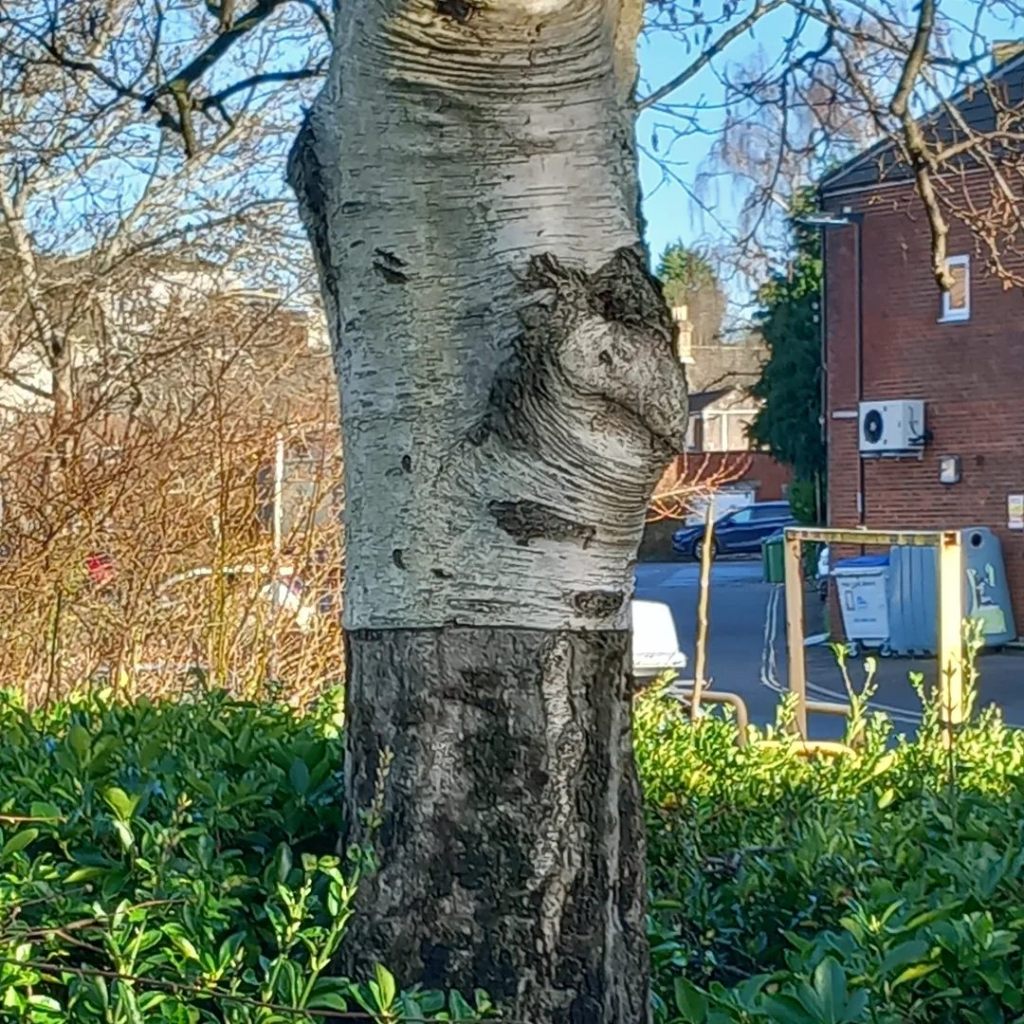
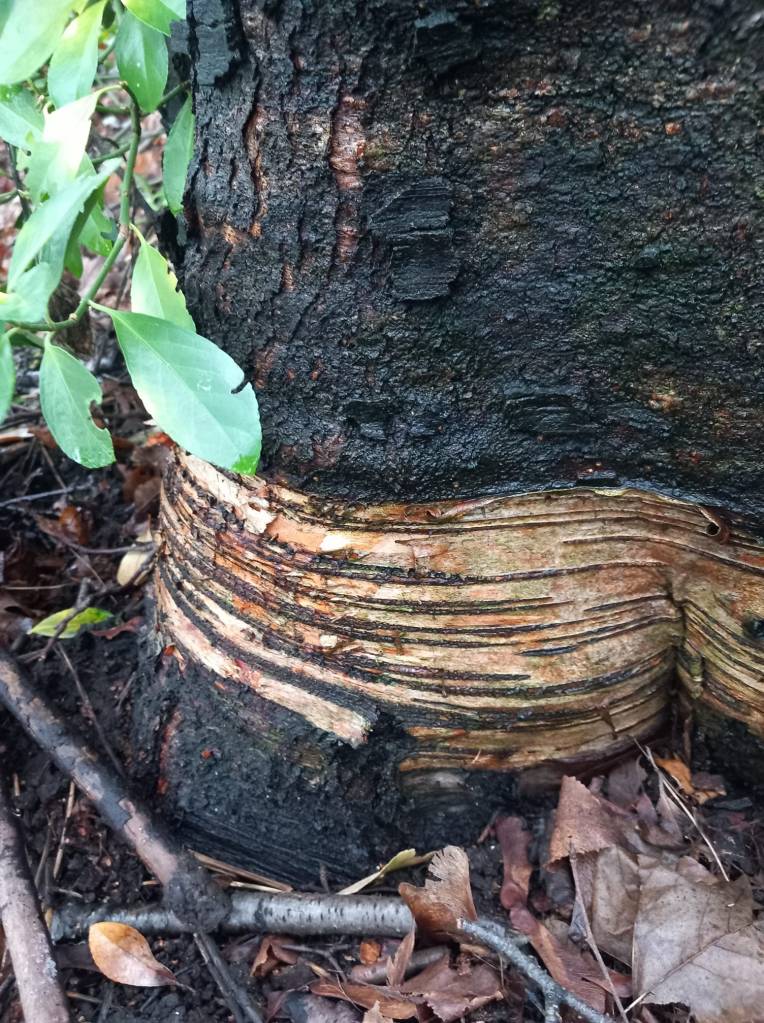
What do you think of the phrase ‘green space’ ? Some months ago, I’d heard someone say they disliked it, but I don’t know why. I hadn’t thought about it much until I started reading a book by Philip Marsden called ‘Rising Ground: A Search for the Spirit of Place’. In it he refers to academic debates about the difference between ‘space’ and ‘place’, and says that ‘place’ is somewhere distinctive, somewhere people react to and live with. ‘Space’, in contrast, isn’t real, it’s more of an ideal, so we can end up with housing estates or high streets or parks that all look the same – you could be anywhere. Connection is the thing here, I think. Feeling a connection to somewhere can turn it into a place, and connection needs familiarity I’m familiar with that car park patch because I’ve looked at it many times, and thought about the creatures that might live there. I know Peartree Green really well because I’ve walked it hundreds of times, I’ve taken thousand of photographs, I’ve studied the flowers and the trees – and I pick up litter all the time, because I care about the place. Philip Marsden’s book is about Cornwall, and he explores areas like Bodmin Moor, huge areas of wild country. Where I am in Southampton, to some, ‘nature’ means the New Forest, a national park. They probably wouldn’t give my verge on Keswick Road a second glance, but they would be missing a treat. I was going to say it would be their loss, but the sad thing is that their loss would be nature’s loss too. If people don’t notice the treasures all around them, they won’t care because they won’t feel a connection. Noticing is about more than just seeing, of course, but that’s another blog post. For this one I’ll end with this mysterious tree, which is on the verge opposite my hazel-moss-feather treasure zone. Notice how the bark changes, and when I was picking up litter (obviously!) I noticed that it changes again at the base. How curious! There has to be a story to this tree. Any ideas?

Favourites and familiars

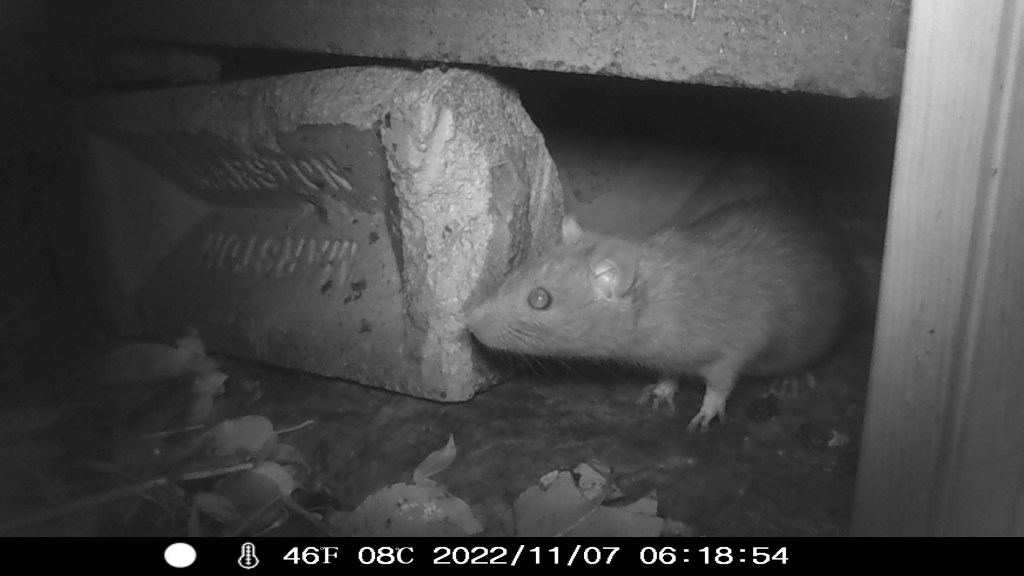
This post was inspired by something that happened a few months ago. I’ve sometimes found run-over hedgehogs on the road near my house, and I usually bury them. I can’t bear the thought of a hog just lying there like a piece of rubbish. So one morning when I saw a brownish shape in the road, I assumed another hog had been hit by a car, but as I walked towards it I realised it was actually a rat. I felt relieved, but then questioned my reaction. I felt guilty for being glad it wasn’t a hedgehog, but that didn’t seem fair. The rat was also once living, after all, and it didn’t deserve to be left there either, so I picked it up and buried it.

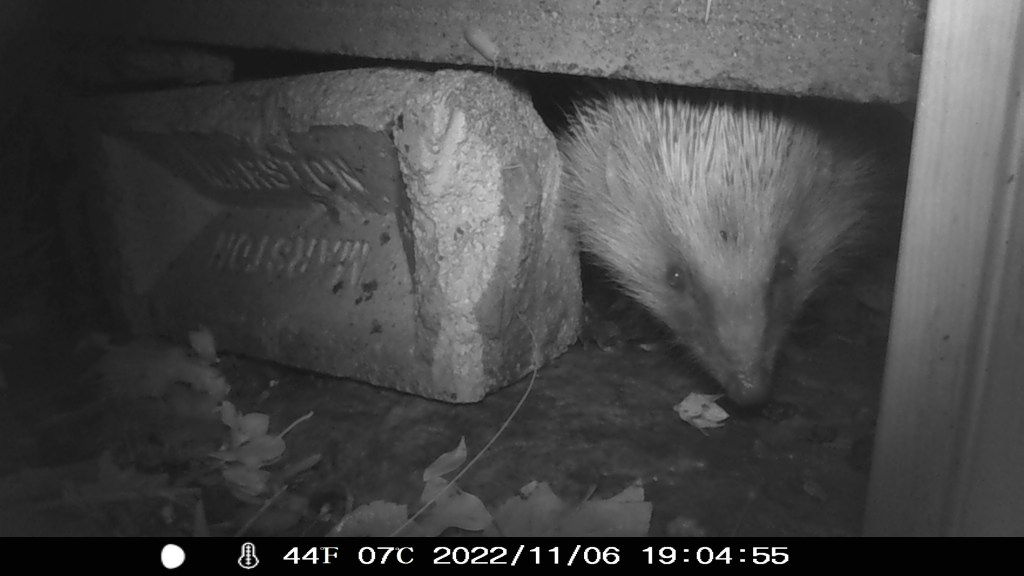
This got me thinking about why some creatures are more popular than others. Rats are despised by many people, but is there anyone who doesn’t like hedgehogs? Why is that? Perhaps it’s because people generally think hedgehogs pose no risk to humans, whereas rats are connected with the bubonic plague (probably incorrectly, according to this article). Or do hedgehogs just look cuter, as they’re rounded and seem to waddle along, whereas rats can move fast and have that long tail? What about the eyes? Big eyes usually trigger cute-alerts in humans, but if you look at the pictures above, is there any difference?

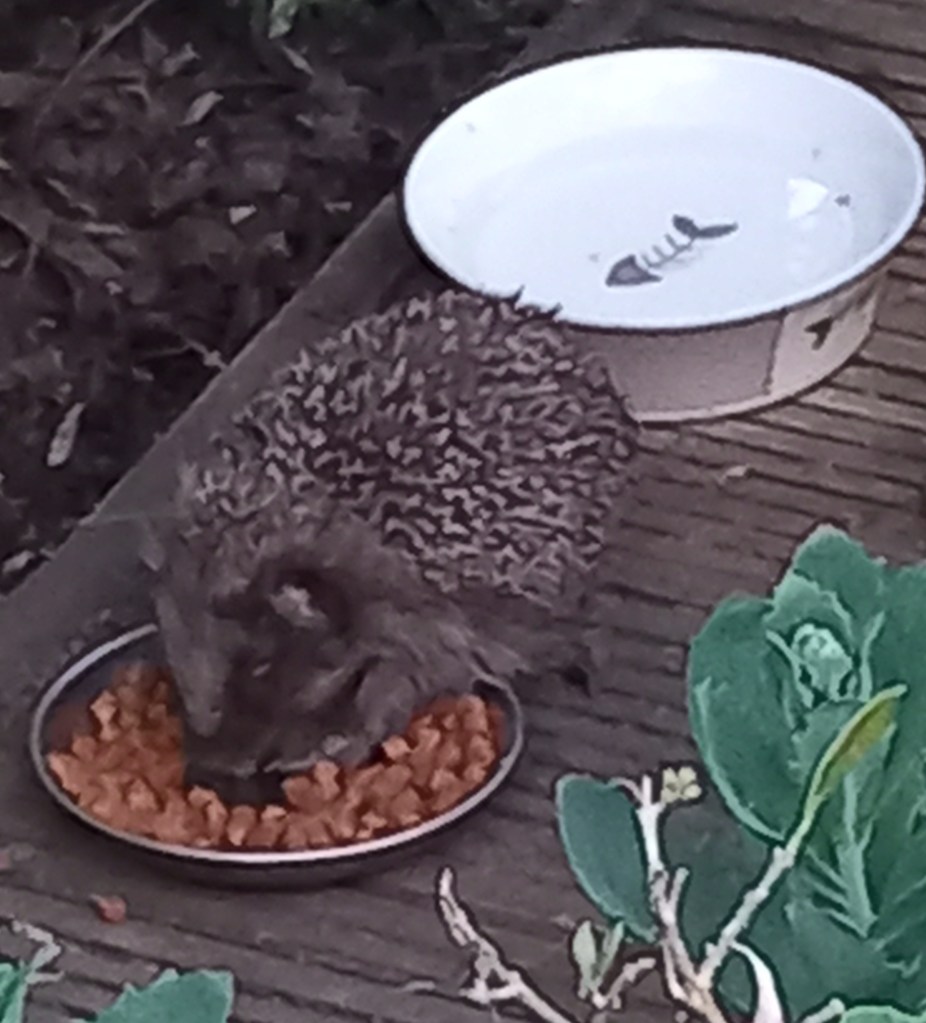
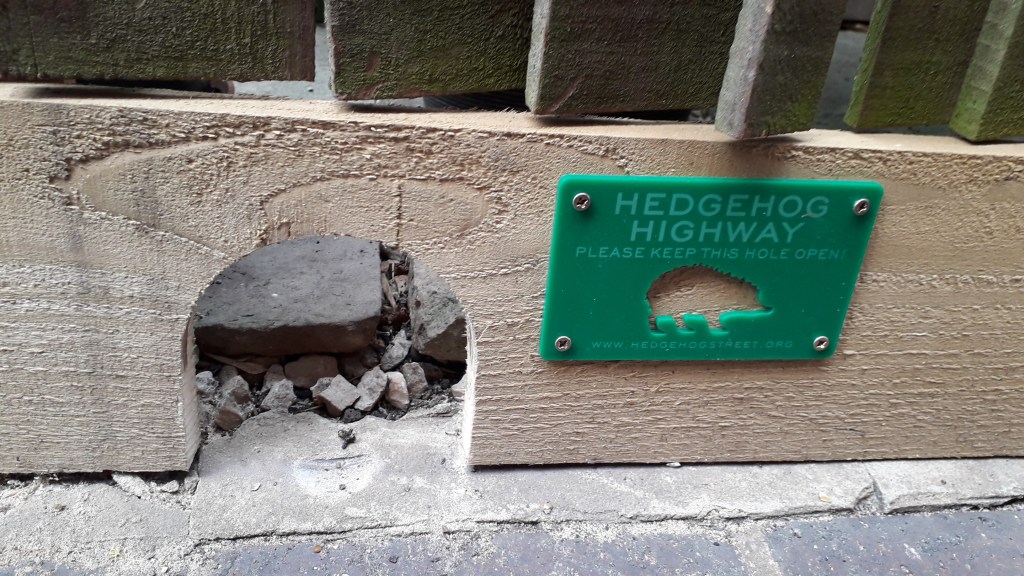
I think maybe it’s the fact that hedgehogs are just not as easy to see, being not only nocturnal but also endangered. So when you see one, you feel honoured. When my neighbour’s daughter spotted one in the alley next to my garden in August 2020, that was the first one I’d seen since I can’t remember when. Realising they were around, I got a hedgehog hole put in my fence and started putting food out. I also made little log piles for insects to shelter in, to provide the hogs with a natural source of food. Over two years after seeing that first one, I’m used to them now, and I love hearing them crunching biscuits or ‘chuffing’ when they’re mating. But to some extent the novelty of having a wild animal visiting the garden has worn off – or at least, that particular wild animal. Enter the fox!

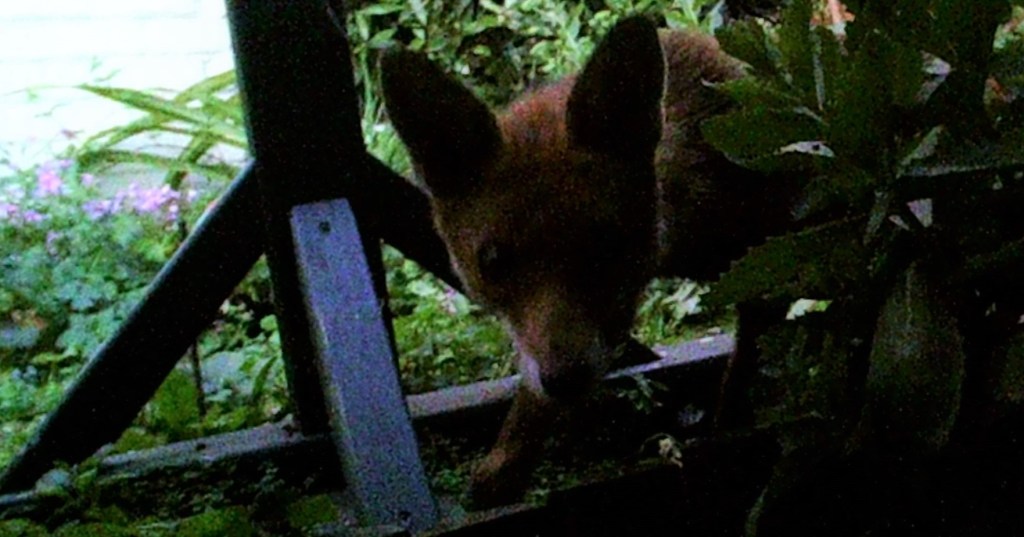
Foxes fascinate me, probably because I rarely see them. I still remember how exciting it was when I realised there was one in my front garden early one winter morning, when it was still dark. Our cat Sidney obviously heard it and was scrabbling to get onto the window sill, so I opened the curtains a tiny bit to see what was there. As my eyes adjusted to the dark, I saw movement and then, after a while, the fox. Very exciting! I wasn’t quite running around like Sidney was, but I couldn’t believe it. Another time I discovered a hole had been dug partly under a slab in my front garden, and assumed a fox had been trying to get at a rat or a mouse. I’ve since bought a trailcam so often catch them on that, but it’s unusual to get a daylight picture like this one. It’s something of a myth that they’re nocturnal, according to Adele Brand, but in built up areas with a lot of traffic, I suppose they find it safer to come out after dark. When I worked at Itchen Valley Country Park I had several daytime sightings.

Sometimes I see this, a fox and a hedgehog together. I assumed foxes didn’t attack hedgehogs because of all those spines. In early October though, I had an upsetting few days when I kept finding young hedgehogs in the alley that looked like they’d been killed by a bite to the neck. I found four in three days and wondered if an inexperienced, desperate fox had tried to eat them. I was a bit torn then about how I felt about foxes, and I wondered if it was a mistake to attract hedgehogs to my garden. I still don’t know who or what was killing the hogs, but thankfully I didn’t find any more.

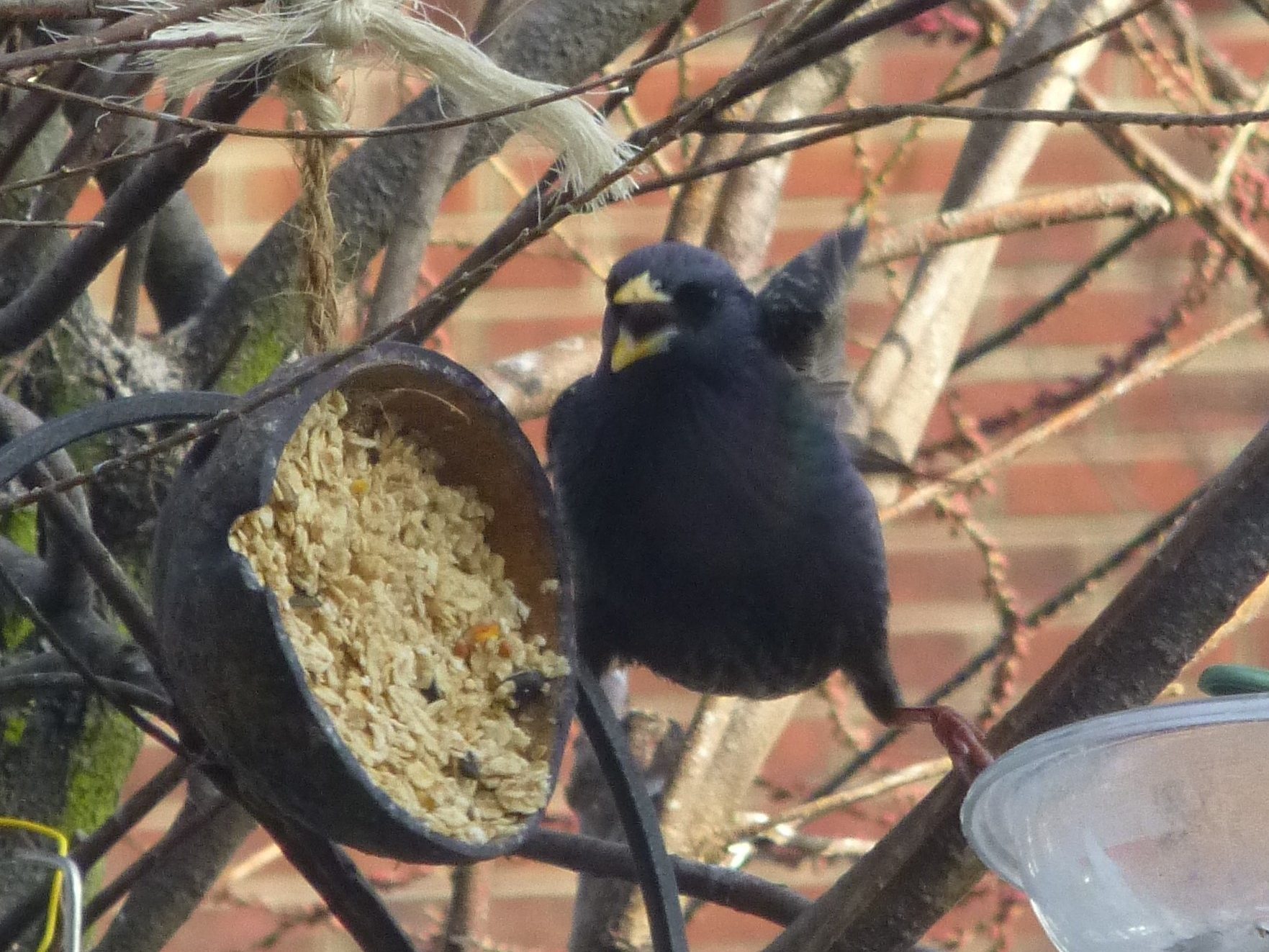
When it comes to birds, I also have my favourites. I love starlings – for their murmurmations, their looks, their character and their ability to mimic. Some of my local starlings do pretty good impressions of our cat and our squeaky front gate. They’re raucous and noisy – often I hear what I think must be 6 or 7 birds, and look up to see just one, going through its repertoire of whistles and pops. They are also precious, as their numbers are in critical decline, making them a red-listed bird. So I feed them, but as the days get shorter and the sunrise gets later, they take longer to arrive from their roost, meaning I have to wait – if I don’t, the magpies get all the food. But what’s wrong with magpies? Don’t they have to eat too? Well yes they do, but they seem rowdy, even though they hang out in small ‘gangs’ compared to starlings. To me, they just look suspicious, like they’re plotting something. They’re kind of shifty – I haven’t got a photo because they’re off as soon as you look at them. And then there’s their harsh call. They do have beautiful iridescent tail feathers, but that’s about it on the good points as far as I can see. They seem to be everywhere, but then they are green-listed, so not in decline at the moment. The starlings need the food more than they do, I reckon.

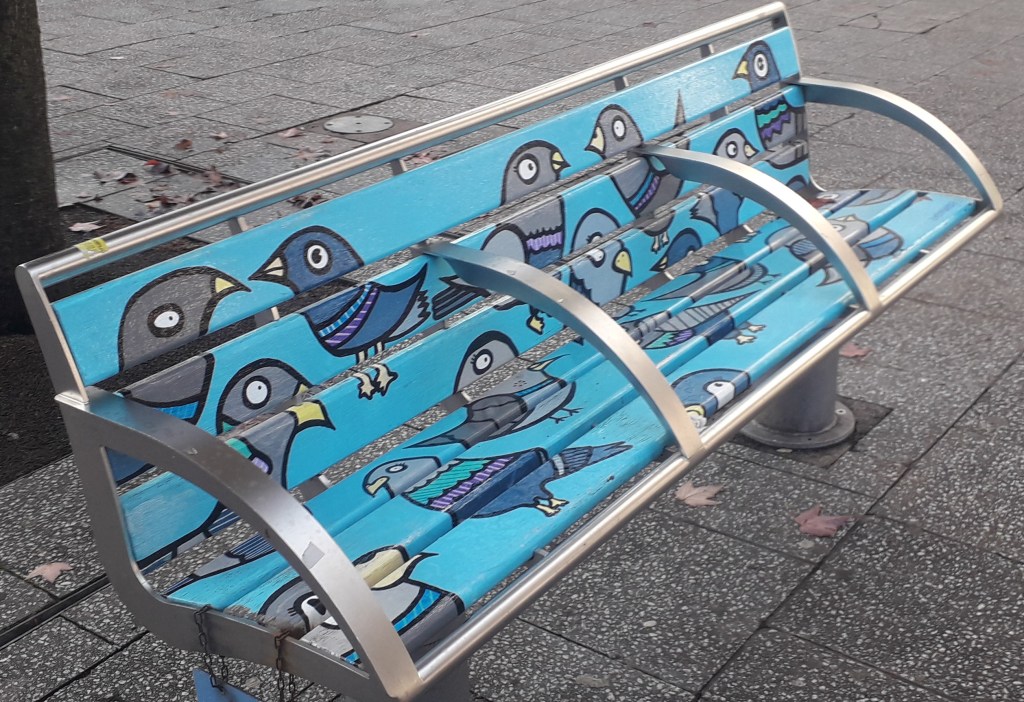
Pigeons. How do we feel about them? Or, more specifically, feral pigeons as opposed to wood pigeons. Feral pigeons are the ones depicted above on a bench in Southampton city centre by Kev Munday, what the artist calls a ‘lighthearted take on Southampton’s feathered friends’. ‘Feral’ itself has negative connotations, which doesn’t help their reputation (think of people describing ‘feral kids’ to mean running wild, being uncivilised, not like the Victorian ideal of children). The RSPB calls them ‘Rock doves/feral pigeons‘ but I’m not sure how many people would think of them as rock doves. Some people call them ‘flying rats’, but let’s not get back to rats again! Another inspiration for this post was David Lindo’s recent column on feral pigeons in my RSPB magazine, in which he ran through their plus points – they’re intelligent, ‘incredible flyers’ and attractive. On that last one, notice the striking purple-green sheen around their neck, captured well by Kev Munday in his painting. Not all of them are that colour of course – locally I’ve seen some that are more brown and white. David Lindo also points out something I didn’t know – feral pigeons are nowhere near as numerous as it seems. There are thought to be only 550,000 pairs, compared with 6 million pairs of wood pigeons. They may be familiar, and thought of as a nuisance by some, but their numbers are dropping. Apparently they can recognise the faces of people who feed them, so I think I’ll return the favour and pay closer attention to them. It’ll be interesting to see how many individuals visit my garden – I’ll probably realise there are nowhere near as many as I thought.

Peartree Green: after the fire

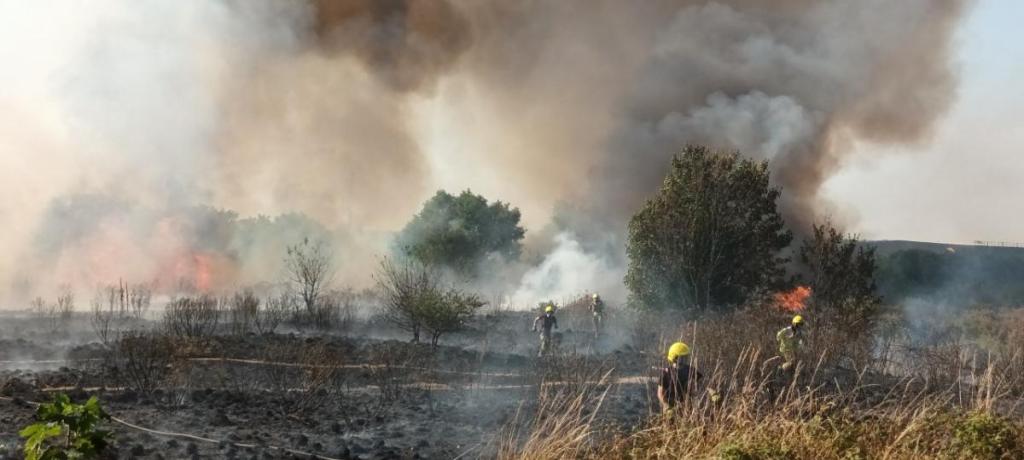
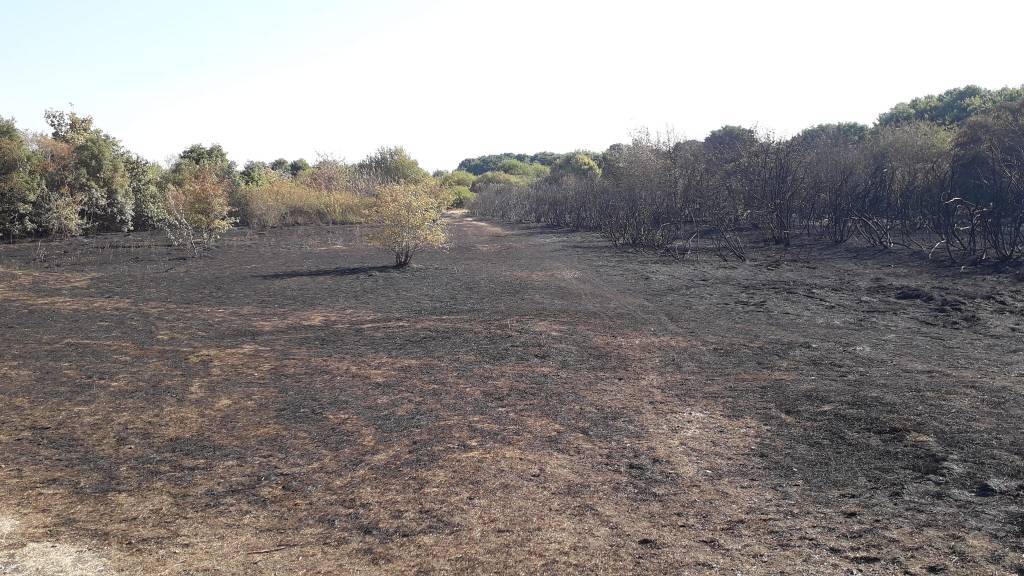
On 12 August 2022, after weeks of dry, hot weather, the inevitable happened: there was a serious fire on Peartree Green local nature reserve. I was sitting in our garden when my partner came out around 5 pm and said, “Something’s on fire over there”. I turned to look and said, “Oh my god, that looks like the Green”. It was. It took the fire crews several hours to bring it under control, and around a quarter of the reserve was damaged. The picture below, by Sherin Sullivan and reproduced in the Southern Daily Echo story, gives a taste of how bad it was.

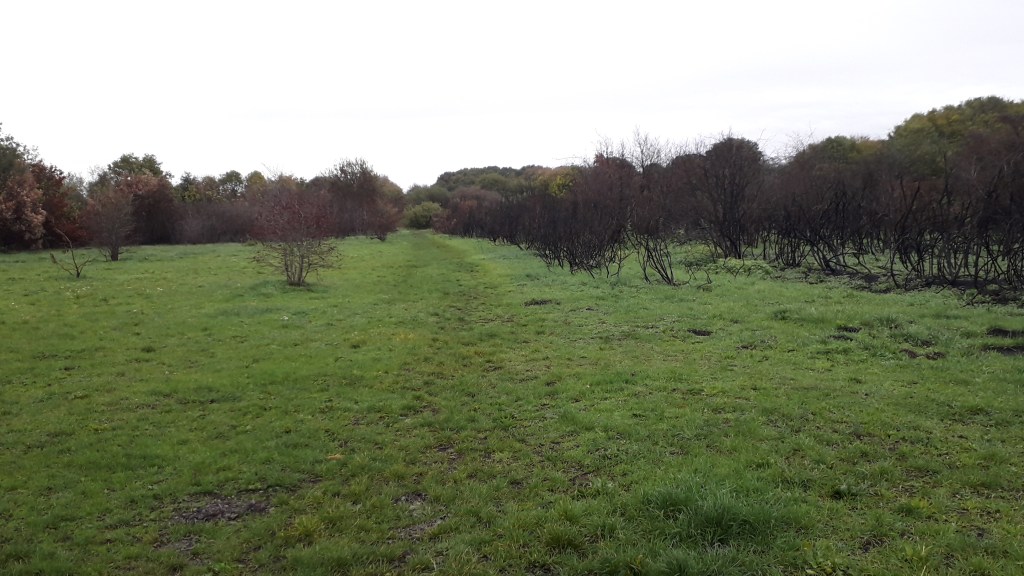
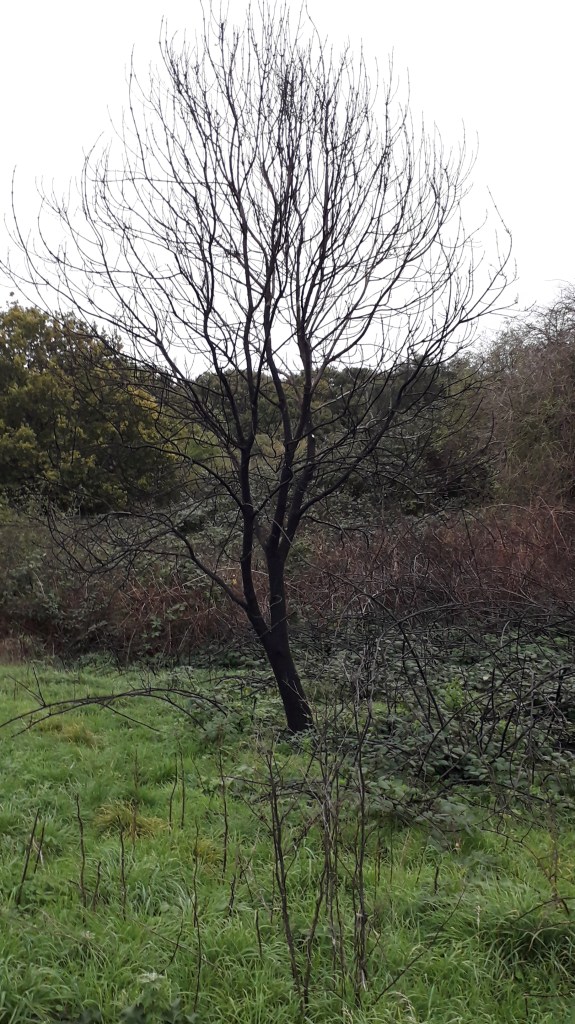
Much of the Southern Hill, an area of long grass that provided a home to small mammals such as mice and voles, as well as to grasshoppers and crickets, butterflies and ladybirds, was burnt. The fire spread down onto the southern plain as far as Phil’s Hill, so we lost the blackthorn stand, several apple trees and a thicket of gorse, on the right of both pictures below. The second photo below was taken on 28 October, eleven weeks later.

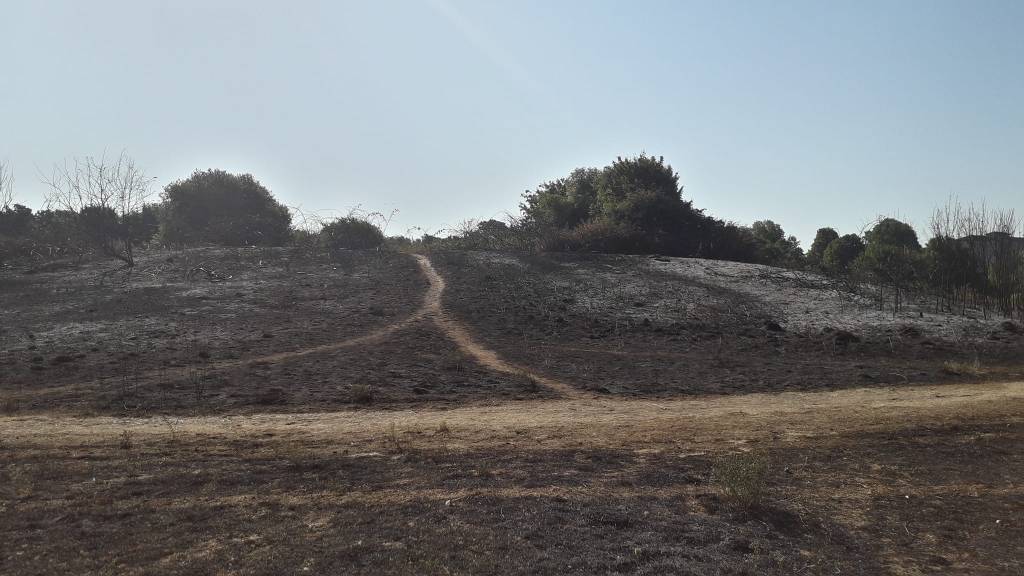
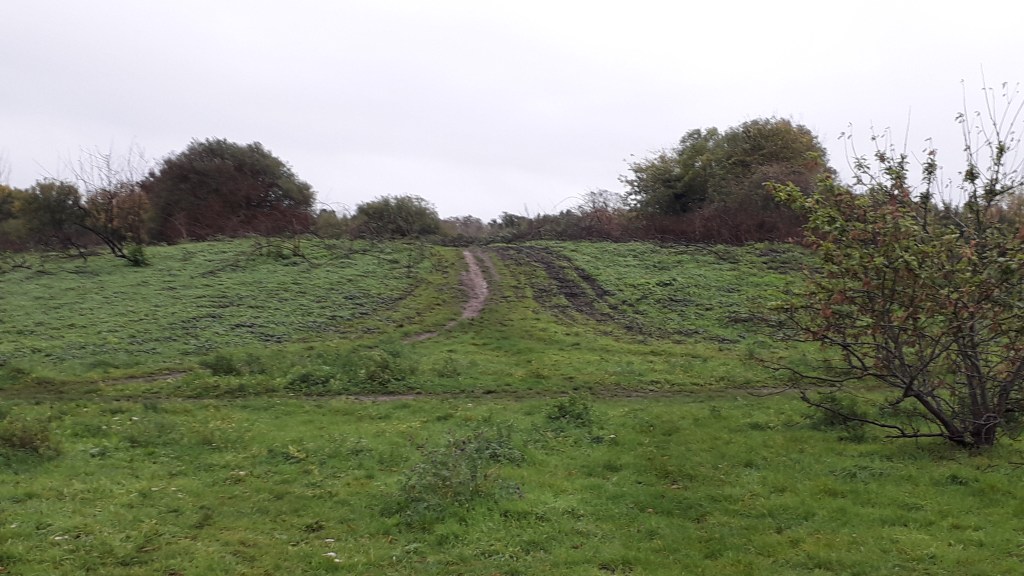
The western slope of Phil’s Hill was also badly burnt, but is recovering well, as the pictures below show. Both were taken with my back to the railway line which forms the western boundary of the nature reserve.

The fire swept along much of that western boundary, meaning you can now see trains clearly as they pass. And this is one of the positive outcomes of the fire, as sightlines have been improved, meaning that people feel safer. There are fewer places to hide too – in the past, there have been camps and dens built along here. These have caused damage to the nature reserve, especially to the trees and plants, through littering, camp fires, and structures being attached to branches with nails and screws. Another positive was that Phil Budd, the Chair of both Friends of Peartree Green and Southampton Natural History Society felt that in most places the fire damage was quite shallow, as the fire had swept through quickly. The burning of large areas of brambles and other scrub has opened up areas for grasses and flowers to come through, and it will be interesting to see what we get.

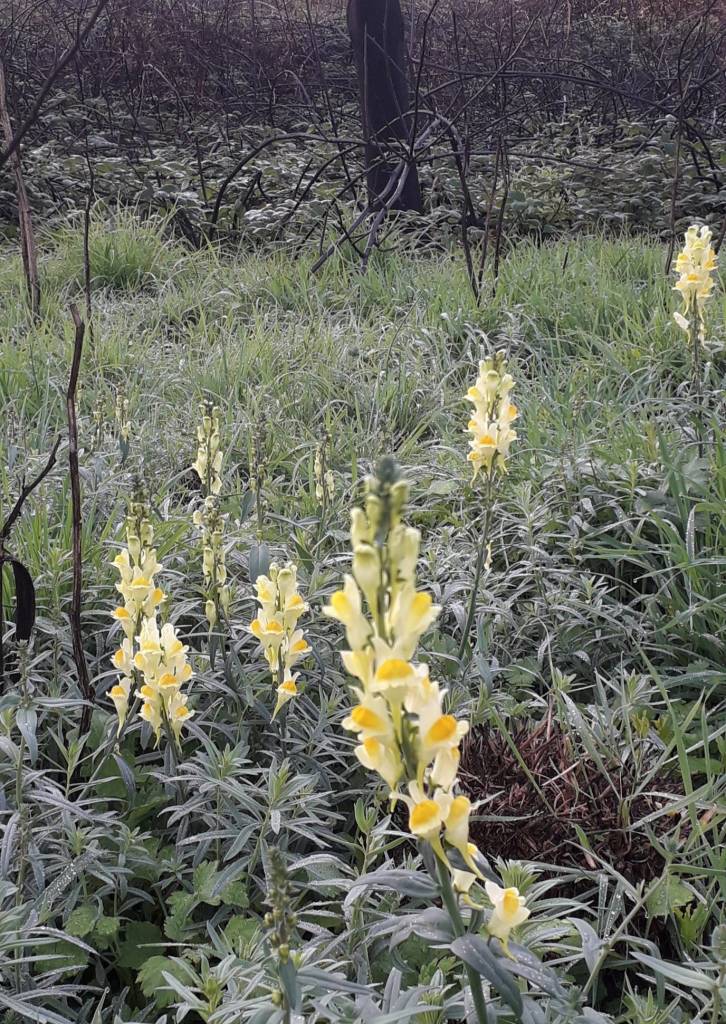
When I had a look around the day after the fire, I just cried. This is a place I know really well, having walked around it hundreds of times since moving to the area six years ago. I’m lucky to live only three minutes’ walk away, and the reserve has been my “nature classroom”, as I’ve learned about the wildlife it supports – 1,340 species, at the last count. We have a fantastic range of wildflowers, and I’ve enjoyed working out what they are, sometimes with a book, sometimes on a guided walk with Phil. The young Ash tree below marks the extent of the fire on the western stretch of the circular path, heading north. I’m not sure it’ll survive, which is sad for me as it’s one that helped me learn what an Ash looks like. On the bright side – literally, as well as figuratively – a patch of Common Toadflax came up around the base – and in fact this flower seems to be almost everywhere the fire was. Previously I only saw it in one particular place on the reserve.

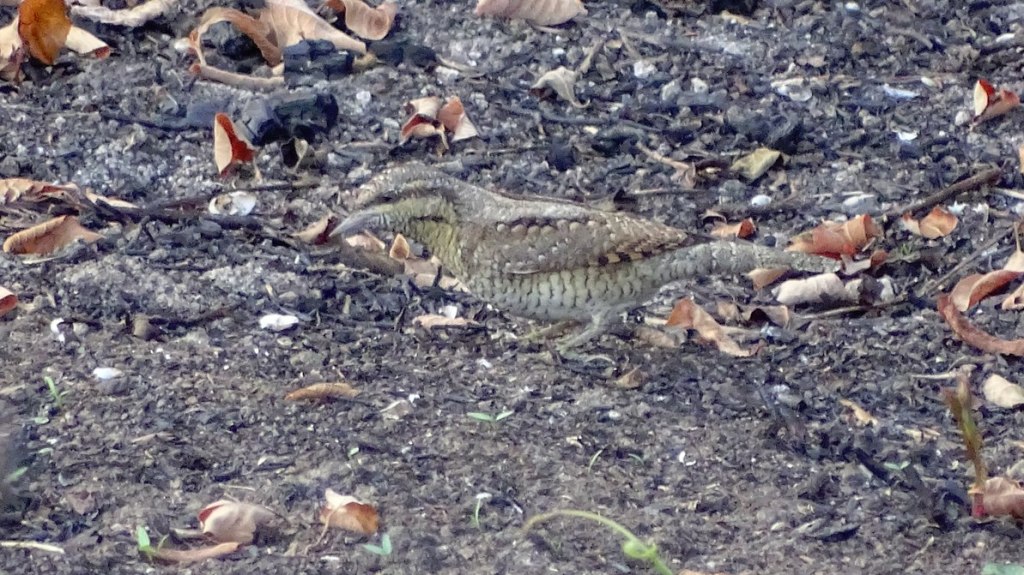
Bird watching became more interesting after the fire. One local resident, Ian, was there most days and spotted some species not seen often, and in a couple of cases, never recorded before. On 1 September, for example, he noted “A new species for the autumn here was a juvenile Wheatear while a second juvenile Whinchat showed well. A Lesser Whitethroat fed in the open and there were still 3 Spotted Flycatchers. Also seen were 2 brightly plumaged Chiffchaffs and a male Great-Spotted Woodpecker”. I wondered if there were more birds than usual, or if it was just that they were more visible, with the scrub reduced. Ian felt it was a bit of both. Then on 2 September came the bird he’d been hoping to see, a Wryneck. The photo below is by Ian, and you can see why this bird, a type of woodpecker, is hard to spot. This one stayed around for a few days and attracted people who’d never been to Peartree Green before.

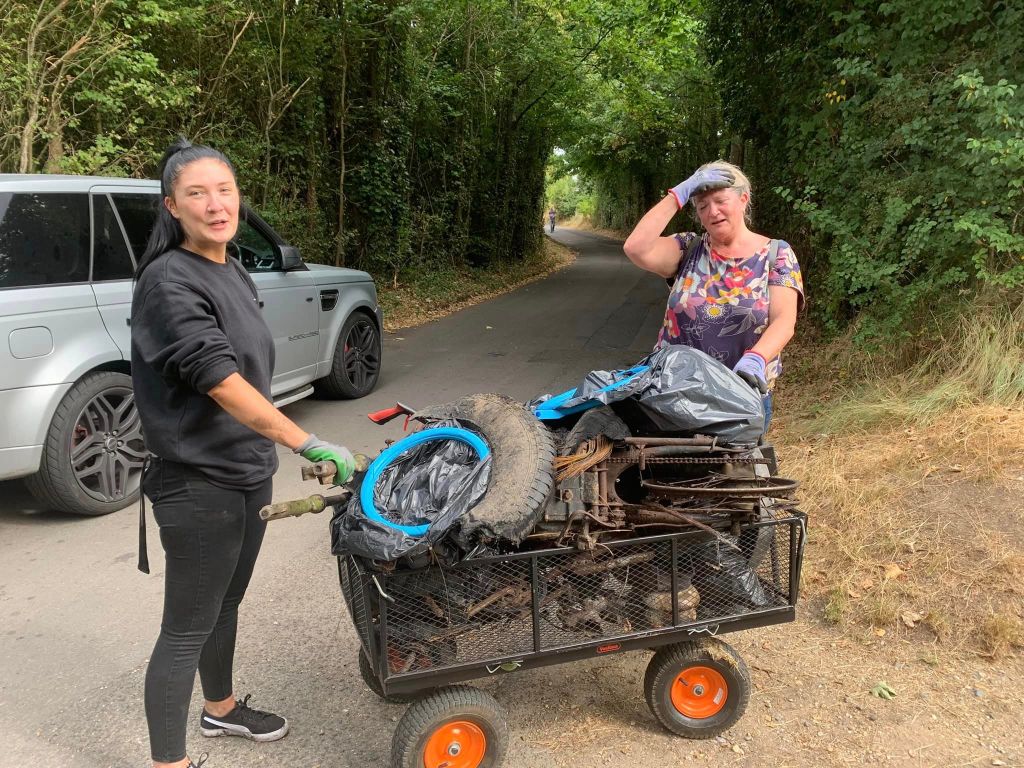
We also had an astonishing number of supportive messages and offers of help from the local community. The picture below shows two of the wonderful people who joined a litter pick on 21 August to clear items revealed by the fire. You can see what a difficult job this was! Southampton City Council also sent a team with a truck to remove the rubbish. As well as the 20 or so people who joined this effort, other local residents also organised themselves to clear litter. We are very grateful to them all, and it shows how special the reserve is for local residents. We are fortunate to have it in Peartree, and we are very lucky to have so many people who clearly treasure it. Even though our wonderful volunteers are the reason we were awarded Wilder Group of the Year from the Hampshire and Isle of Wight Wildlife Trust, I hadn’t realised just how much support there was. Thank you everyone.

Outdoor Learning: Noticing Nature

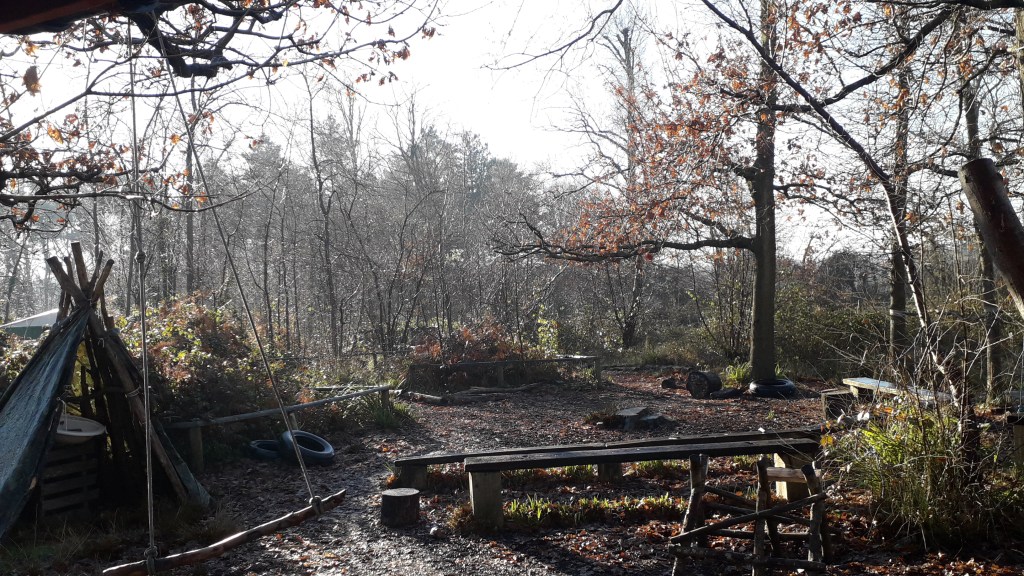
Not surprisingly for a nature-lover, one of my favourite parts of working in outdoor learning at Youth Options was when young people showed an interest in the natural world around them. Sometimes this was in the forest school area, and other times it was out on a walk around Itchen Valley Country Park, where we were based. The place I visited most often, with both groups and individuals, was the woodland behind the Little Owls pre-school. One particular person also loved this place, and visibly relaxed when we got there. It is a very calming space thanks to all those trees and the fact no-one else much seemed to go there. This particular person relaxed so much that they suggested a game of hide and seek! They won, but I like to blame my bright blue uniform, which made it quite hard to hide!

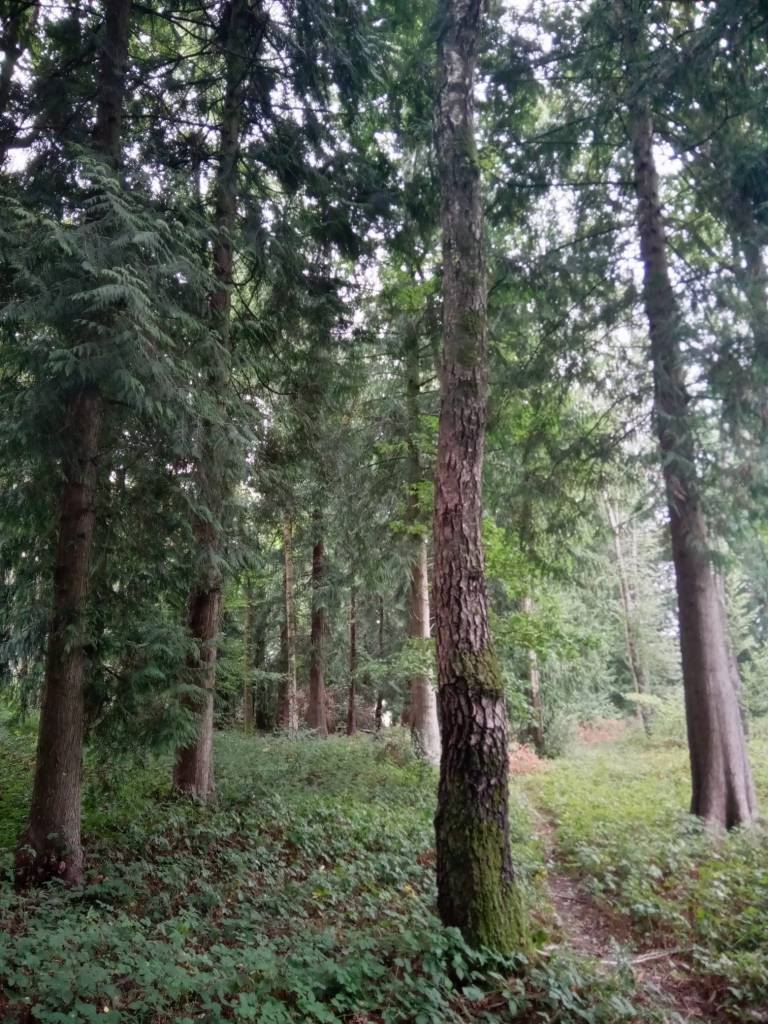
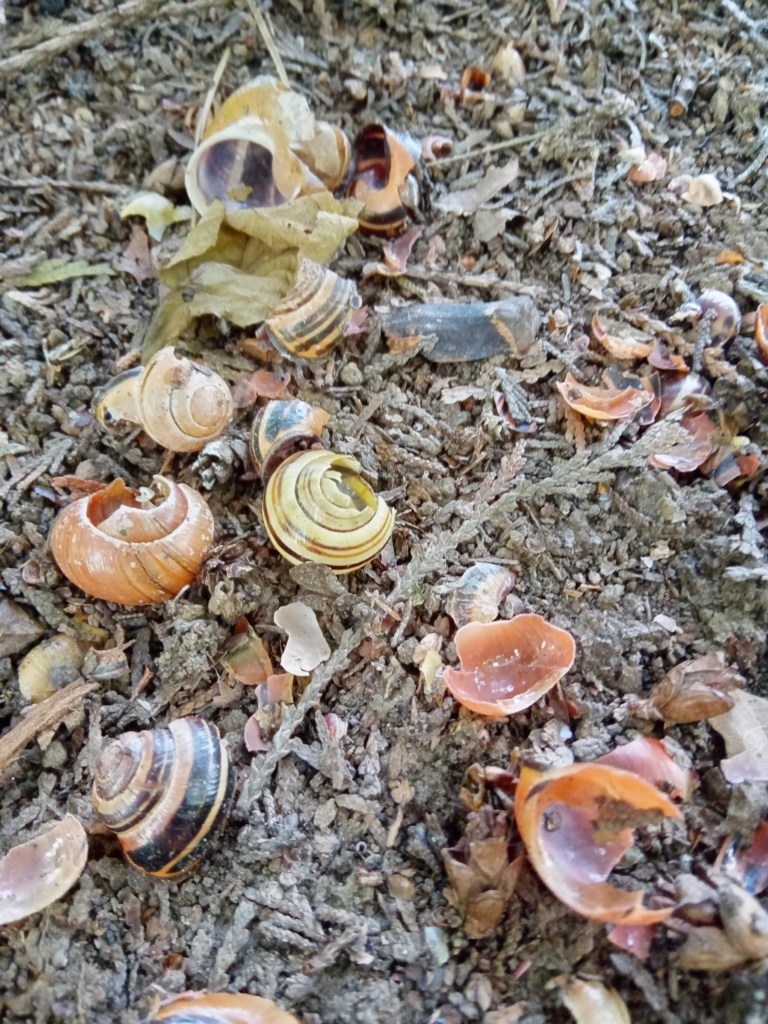
Being here also gave us a chance to use our senses. We crushed western red cedar leaves to see if they really do smell of pineapple, listened out for woodpeckers, watched for deer on the woodland edges, and felt the crunch of snail shells when we accidentally walked over a song thrush anvil! On a path into the woods we found a long-tailed tit nest, and touched the soft lining of feathers. Further along the path in this photo, we found the fungus called King Alfred’s Cakes.

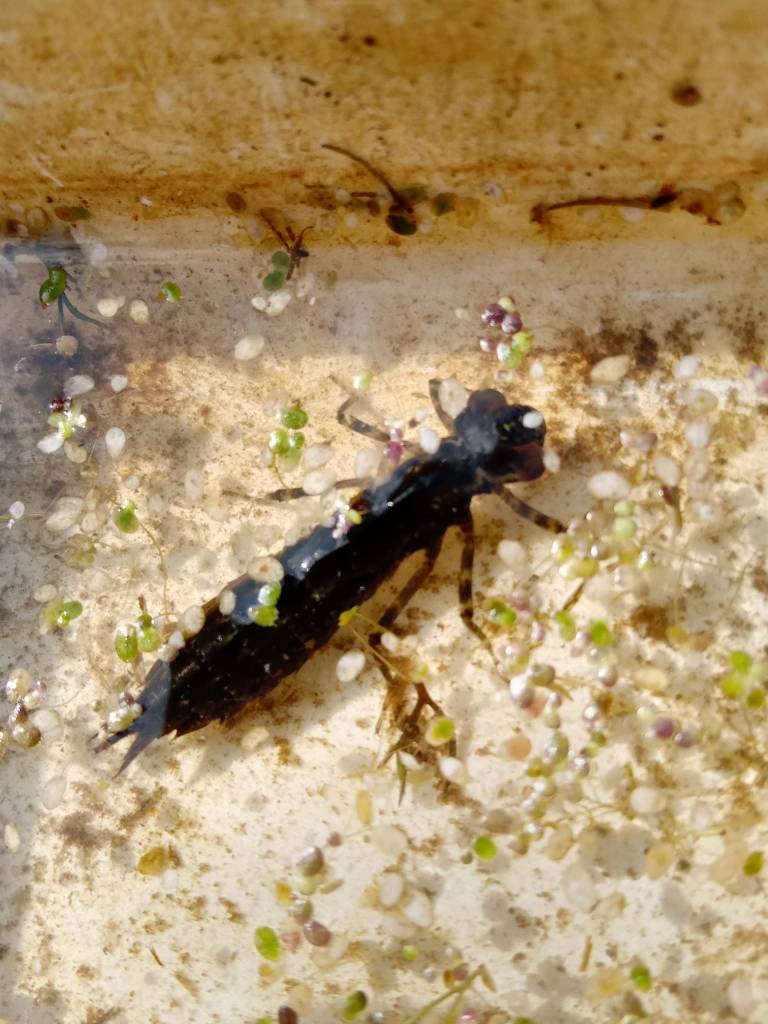
The first time I realised that this person was interested in wildlife was when we were in our area back in January, and they spotted a fox walking through, roughly in the centre of this picture. What a magical moment! This was the first time I’d seen a fox so close. After that we kept a an eye and ear out for other creatures, one time spotting a woodlouse shedding its skin and another time watching a jay. We also did a bit of pond dipping, finding several newts and dragonfly nymphs.

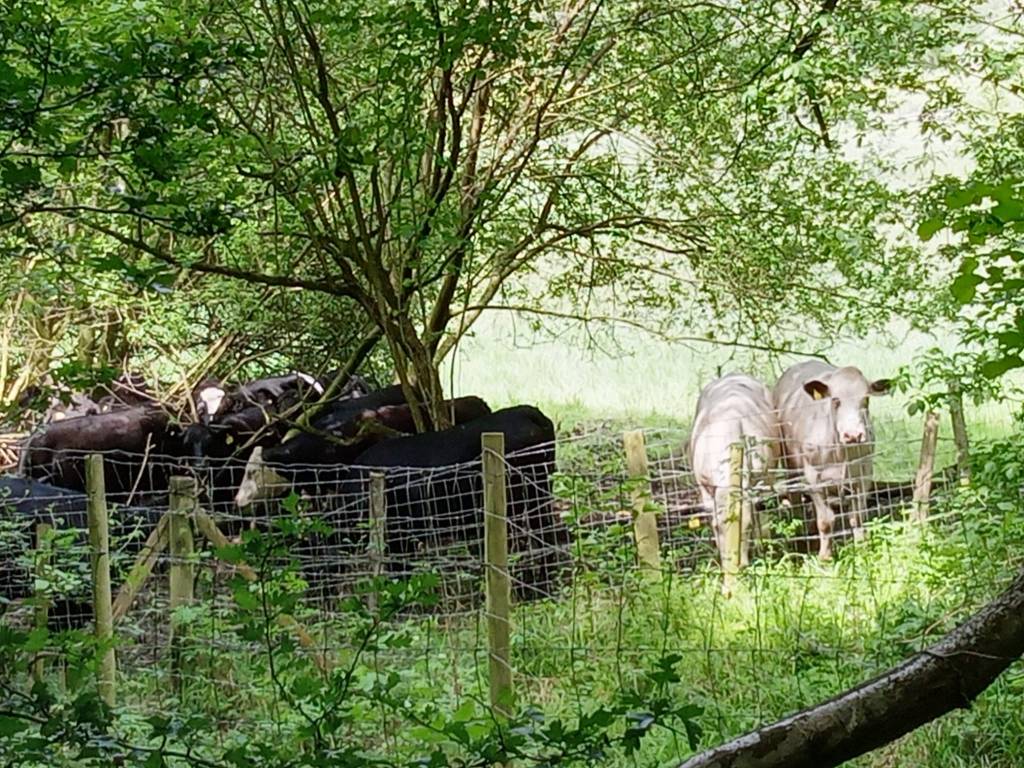
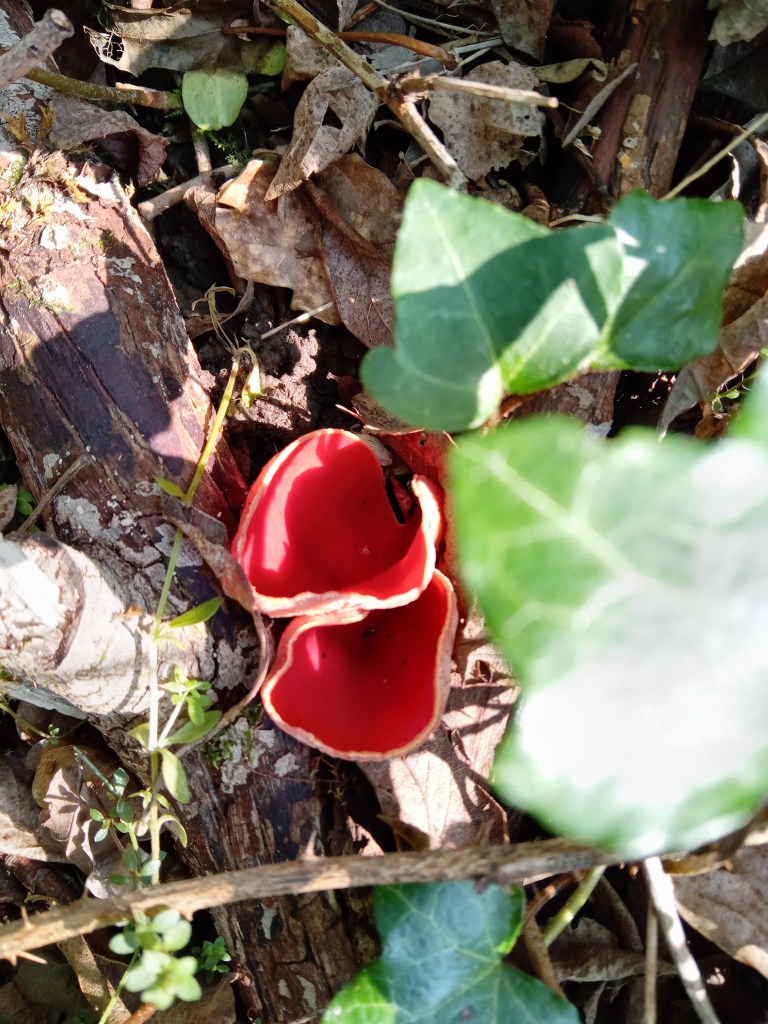
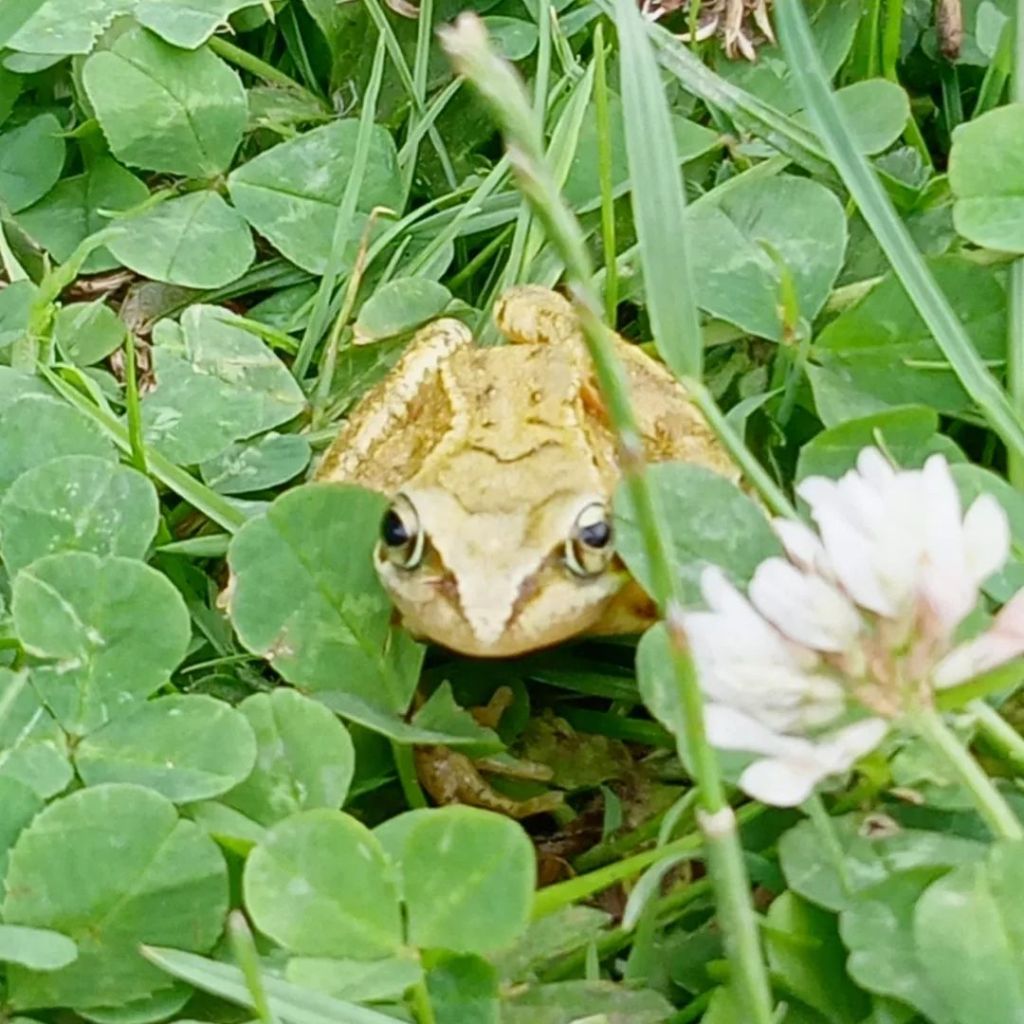
As well as the individual I’ve written about above, there was one group that particularly enjoyed going on nature walks, and we also had some special encounters. One afternoon on our way to the nature reserve, we startled a deer in a hedge, and it sprang out past us at speed, giving us quite an adrenalin rush! When we got to the reserve, it was warm and sunny. I was at the back of the group chatting to one individual when I spotted a grass snake – the first time I’d ever seen one – and excitedly shouted ‘snake!’ The others in the group had missed it, and I think a couple of them were quite annoyed! Needless to say, I didn’t get a photo of either, but we did spot these grazing cows on the same day, another highlight. At other times we found Scarlet Elf Cup mushrooms in the woods, and froglets sprang out of some long grass on our walk there.

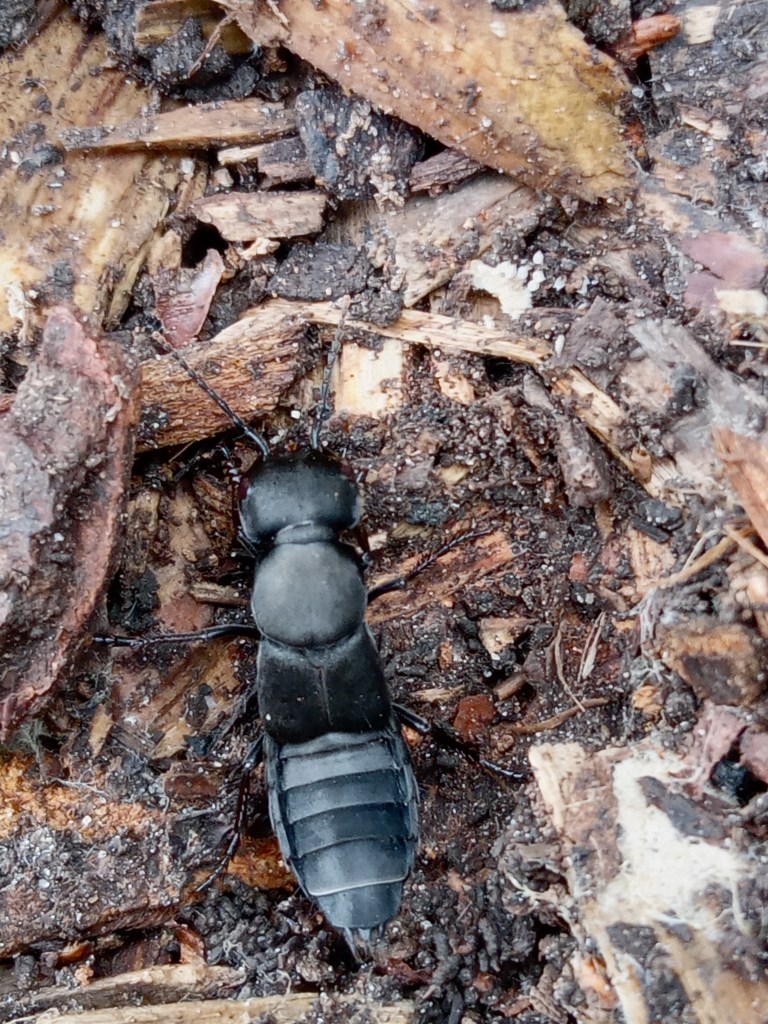
This is the Devil’s Coach Horse beetle, introduced to me by my nature-loving colleague Tom. It was generally fairly easy to find under our log stumps around the fire circle, and quite a hit even with people that weren’t very interested in nature. This is because it raises its tail like a scorpion when it feels threatened – such as when a human reveals its hiding place!

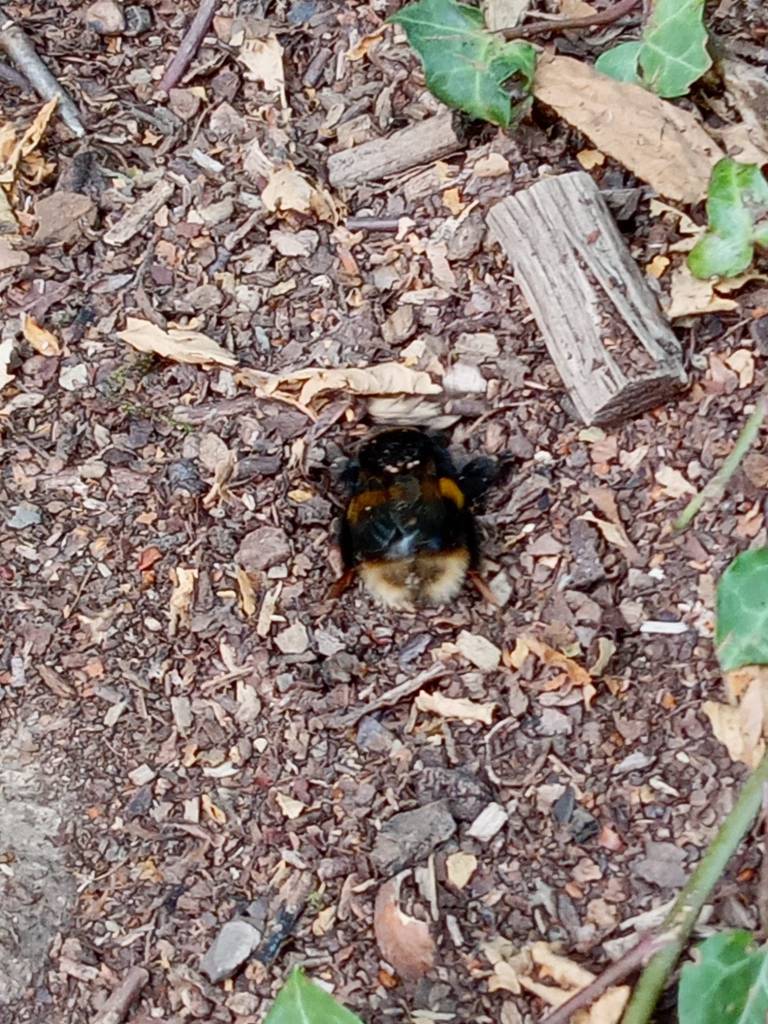
I think my enthusiasm for everyday nature rubbed off on some of the young people I worked with, as one excitedly showed me when they found a jay feather (and I gritted my teeth, wishing I’d spotted it first!!) Another time, at holiday club, we sat eating our lunch watching this queen bee burrowing into the ground, and discussed why she was doing it.

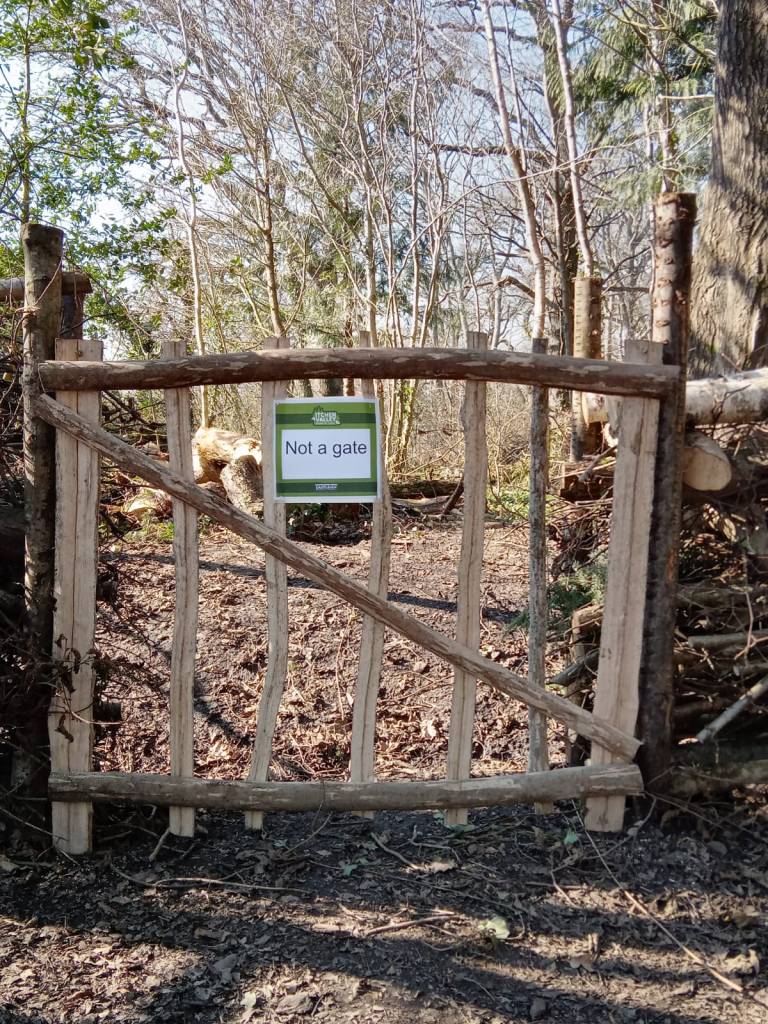
Ok, this isn’t a ‘nature’ photo, but when this sign appeared on a fence – which, let’s be honest, does look like a gate! – it amused me so much I kept showing it to everyone. I’ve included it here because it still makes me smile, and reminds me how much fun I had working with Youth Options at Itchen Valley Country Park. It’s a wonderful setting, with countless opportunities for discovering nature and having fun.

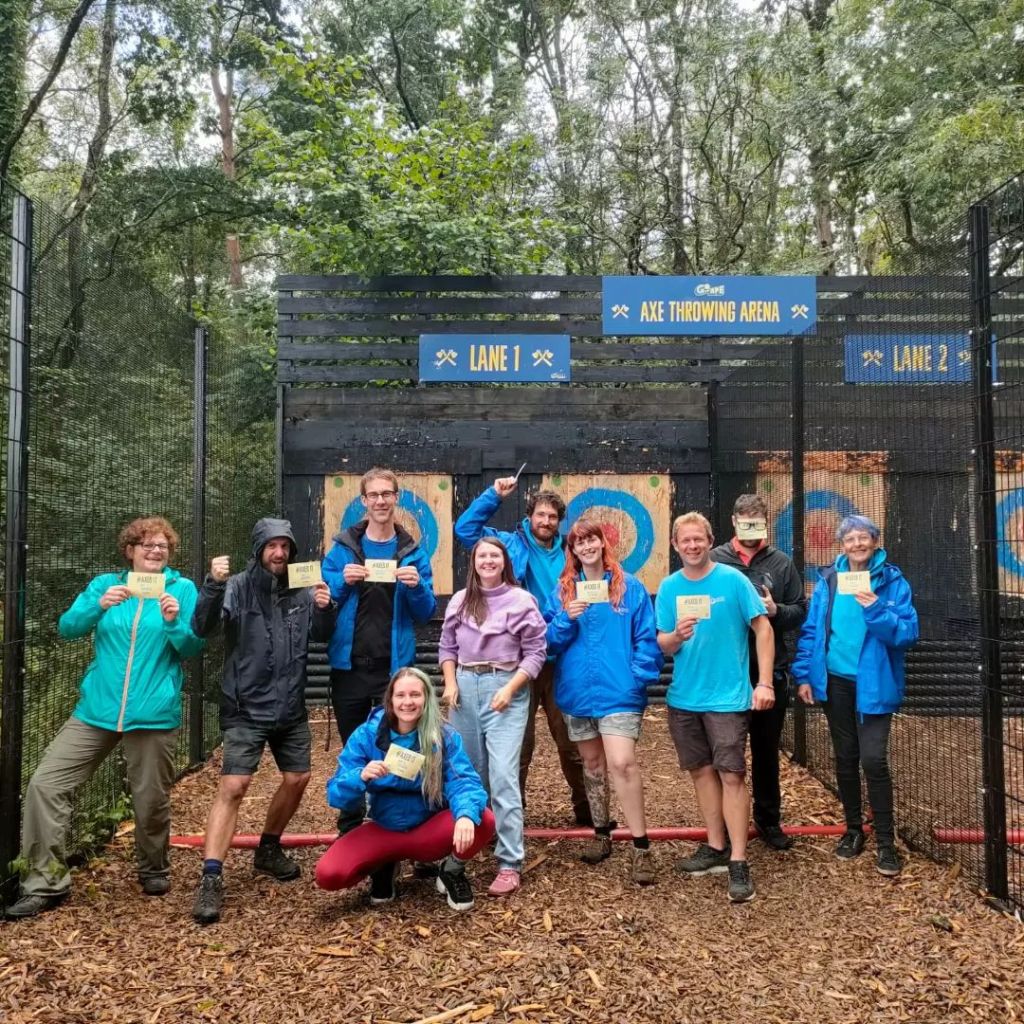
I can’t share pictures of the young people I worked with, so instead I’m ending on this one with my colleagues. Our post-holiday club social was to take part in axe throwing at Go Ape! in the park, and I was invited even though I’d left my job the previous week. I wasn’t very good at it, but we had fun and all got a certificate. The best thing about that day though was that as I arrived to lock up my bike, I bumped into the young person I’ve written about at the start of this blog, out on a visit to the park with his school. That really made my day! So I just want to say a huge thank you to everyone I worked with, especially the young people. Many happy memories were made and I learned a lot, but most of all I had fun.